
Medicare Supplement Insurance (Medigap): Plans, Costs, and What It Covers for Seniors
Legally Reviewed by James Whitaker, Elder Law Attorney
Updated on October 9, 2026
Key Takeaways
Understand Medicare Supplement Insurance (Medigap). Compare Plan G vs Plan N, 2026 out-of-pocket costs, skilled nursing coverage, and critical long-term care limits.

When older adults and their families transition into retirement, one of the biggest financial surprises is discovering that Original Medicare does not cover 100% of healthcare costs. In fact, Original Medicare has no annual out-of-pocket maximum, leaving beneficiaries responsible for significant deductibles, copayments, and a 20% coinsurance on outpatient care.
Medicare Supplement Insurance, widely known as Medigap, is private health insurance specifically designed to fill these financial "gaps." However, for families navigating aging and senior living transitions, understanding what Medigap covers—and crucially, what it does not cover—is essential to avoid catastrophic out-of-pocket expenses.
1. How Medigap Works with Original Medicare
Medigap policies are sold by private insurance companies, but they are strictly standardized and regulated by federal and state laws. To purchase a Medigap policy, you must already be enrolled in both Medicare Part A (Hospital Insurance) and Medicare Part B (Medical Insurance).[2]
Without supplemental coverage, an older adult faces substantial cost-sharing under CY 2026 Medicare rules:
- Part A Inpatient Hospital Deductible: $1,736 per benefit period before Medicare pays for hospital stays.
- Part A Skilled Nursing Facility (SNF) Coinsurance: $0 per day for days 1–20, but $217 per day for days 21–100 following a qualifying 3-day inpatient stay (potentially exceeding $17,000 in out-of-pocket copays for an extended rehab recovery).
- Part B Annual Deductible: $283 per year.
- Part B 20% Coinsurance: After meeting the deductible, patients owe 20% of the Medicare-approved amount for all doctor visits, outpatient surgeries, physical therapy, durable medical equipment (wheelchairs, hospital beds), and chemotherapy, with no ceiling.
A Medigap policy pays some or all of these out-of-pocket costs directly to the healthcare provider after Medicare pays its share.
2. Standardized Medigap Plans: Comparing Plan G and Plan N
In most states, Medigap policies are categorized by letters: A, B, C, D, F, G, K, L, M, and N. Every policy with the same letter offers identical basic benefits, regardless of which private insurer sells it (premiums and customer service, however, vary by company). Note that Massachusetts, Minnesota, and Wisconsin have their own state-specific standardization systems.
While legacy Plans C and F offered "first-dollar coverage" covering all deductibles, federal legislation phased them out for individuals who became eligible for Medicare on or after January 1, 2020. Today, the two most popular options are:
- Plan G: The comprehensive benchmark. Plan G covers 100% of the Part A hospital deductible ($1,736), 100% of the skilled nursing coinsurance ($217/day for days 21–100), 100% of Part B coinsurance (the 20%), and Part B excess charges. The only cost you pay out-of-pocket is the annual Part B deductible ($283 in 2026).
- Plan N: A budget-conscious alternative. Plan N offers lower monthly premiums than Plan G. In exchange, you pay the Part B deductible ($283) plus small copayments (up to $20 for some doctor visits and up to $50 for emergency room visits that do not result in an inpatient admission). Plan N does not cover Part B excess charges.
3. The Critical Warning: Medigap Does NOT Cover Custodial Senior Living
The single most dangerous misconception among families is assuming that a Medicare Supplement policy will pay for an assisted living community, memory care unit, or long-term nursing home stay.
Important Care Distinction: Skilled Care vs. Custodial Care
Medigap covers skilled care: If an older adult breaks a hip, spends 3 consecutive inpatient days in the hospital, and is discharged to a skilled nursing facility for physical rehabilitation, Medigap Plan G covers the $217/day coinsurance for days 21–100 while skilled recovery is ongoing.
Medigap does NOT cover custodial care: Once rehabilitation concludes and an older adult requires ongoing help with Activities of Daily Living (ADLs)—such as bathing, dressing, eating, medication management, or memory supervision—care is categorized as custodial. Medigap pays $0 for assisted living, memory care, or long-term nursing home room and board.
To fund long-term senior care, families must explore alternative strategies:
- Long-Term Care Insurance (LTCI): Private policies specifically written to reimburse daily home care, assisted living, and nursing home costs after benefit triggers (e.g., loss of 2+ ADLs) are verified.
- State Medicaid Programs: Joint federal-state assistance that covers nursing home care and, in many states, assisted living services via Home- and Community-Based Services (HCBS) waivers for individuals who meet clinical and financial eligibility criteria.
- Veterans Aid & Attendance: Supplemental pension benefits of up to $2,431/month (2026 rate) for eligible wartime veterans and surviving spouses requiring daily personal care support.
- Private Pay: Using personal retirement savings, pensions, home equity, or family contributions.
4. Enrollment Timing and Guaranteed Issue Rights
Timing your Medigap enrollment is critical. Your Medigap Open Enrollment Period is a one-time, 6-month window that begins the first month you are 65 or older and enrolled in Medicare Part B.
During this 6-month window, you have guaranteed issue rights: private insurance companies cannot deny you any Medigap plan they sell, cannot place waiting periods on pre-existing conditions, and cannot charge higher premiums based on your medical history.
If you miss this window and attempt to purchase or switch a Medigap plan later, insurers in most states can subject you to medical underwriting. If you have chronic conditions (e.g., Parkinson's, heart disease, diabetes, or early-stage dementia), insurers can deny your application or charge significantly higher rates.
5. Where to Get Free, Unbiased Guidance
Choosing between Medigap plans, evaluating private insurer rates, or comparing Medigap against Medicare Advantage can be overwhelming. Fortunately, free assistance is available:
- State Health Insurance Assistance Program (SHIP): A federally funded network of certified, unbiased counselors in every state who provide free, confidential Medicare and Medigap counseling with no sales pitch (shiphelp.org).
- Medicare.gov: Use the official Medicare Plan Finder tool or call 1-800-MEDICARE (1-800-633-4227) to view standardized plan availability and rate estimates in your zip code.
- Local Area Agencies on Aging (AAA): Community organizations that connect seniors to local benefit enrollment specialists and caregiver support programs.
Disclaimer: This article is general educational information, not medical, legal, tax, or financial advice. Medigap plan availability, premium costs, and underwriting rules vary by state, insurer, and age. Medicare cost-sharing figures reflect CMS CY 2026 standards. Before selecting or changing coverage, consult your State Health Insurance Assistance Program (SHIP), Medicare.gov, or a licensed insurance professional.
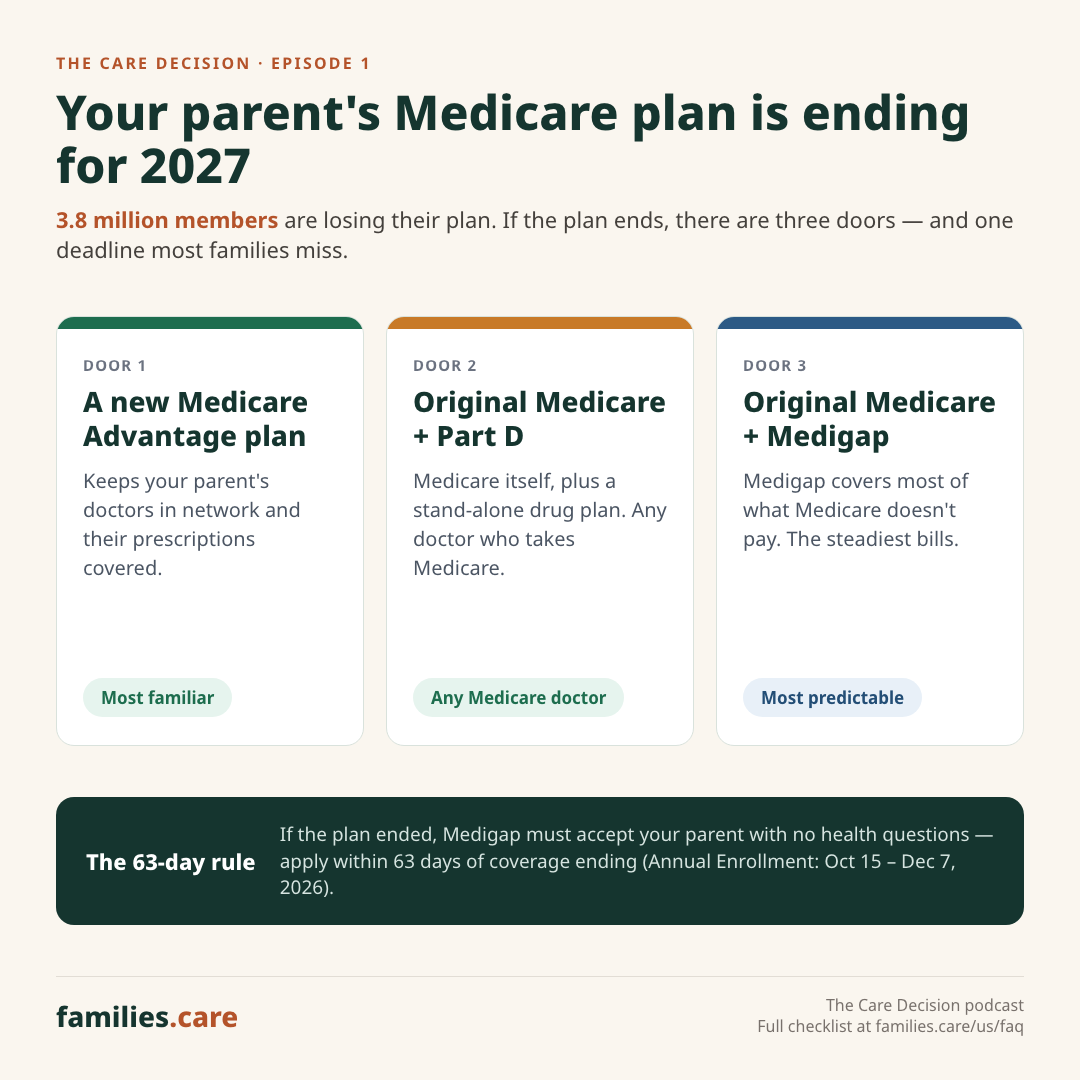
When a Medicare Advantage Plan Ends for 2027: Your 63-Day Medigap Guaranteed-Issue Window
Normally, switching from a Medicare Advantage plan back to Original Medicare after your initial trial right can trigger medical underwriting for a Medigap (Medicare Supplement) policy in most states. However, when a carrier discontinues a Medicare Advantage plan or exits your parent’s service area for 2027, federal law grants a 63-day guaranteed-issue window ending 63 days after coverage terminates on December 31, 2026 (or after the claim-notification date). During this window, insurers must offer eligible Medigap policies without medical underwriting or pre-existing condition exclusions.
For the step-by-step comparison order (Doctors → Prescriptions under the finalized $700 Part D deductible and $2,400 annual drug cap → Maximum out-of-pocket → Extra benefits → Premium last), read Medicare Open Enrollment 2026: Key Dates & Plan-Ending Checklist, The Care Decision Ep 1: Your Parent’s Medicare Plan Is Ending. Now What?, and The Care Decision Ep 2: Medicare Doesn’t Pay for Assisted Living — What Actually Does.
Related Articles
Frequently Asked Questions
- What is the difference between Medigap and Medicare Advantage?
- Medigap works alongside Original Medicare (Part A and Part B) to pay cost-sharing gaps like deductibles and 20% coinsurance with no network restrictions nationwide. Medicare Advantage (Part C) replaces Original Medicare with a private managed-care plan (HMO/PPO), often with localized networks, prior authorization rules, and separate copayments.
- Does Medicare Supplement Insurance pay for assisted living or memory care?
- No. Medigap only covers Medicare-approved medical cost-sharing. Because assisted living, memory care, and custodial nursing home stays consist of non-medical room, board, and personal assistance with activities of daily living (ADLs), Medigap policies pay $0 toward these expenses. Families must rely on private savings, long-term care insurance, or state Medicaid programs.
- Does Medigap cover skilled nursing facility (SNF) care?
- Yes, for short-term rehabilitation. Under Original Medicare in 2026, skilled nursing facility stays are covered 100% for days 1–20, but require a $217/day coinsurance for days 21–100 following a qualifying 3-day inpatient hospital stay. Most Medigap plans (including Plan G and Plan N) cover 100% of this $217/day coinsurance.
- When is the best time to enroll in a Medigap policy?
- The ideal window is your 6-month Medigap Open Enrollment Period, which begins the first month you are 65 or older and enrolled in Medicare Part B. During this window, you have guaranteed issue rights: insurance companies cannot deny you coverage or charge higher premiums due to pre-existing health conditions.
Verified references & primary sources
5 verified sourcesQuantitative and regulatory claims in this guide are grounded against official registries and benchmark datasets.
-
Statutory RegistryCareScout · Verified 2026-08-15 · General senior-care planning information.
“" However, for families navigating aging and senior living transitions, understanding what Medigap covers—and crucially, what it does not cover—is essential to …”
-
Statutory RegistryMedicare.gov · Verified 2026-08-15 · General senior-care planning information.
“Medicare Supplement Insurance , widely known as Medigap , is private health insurance specifically designed to fill these financial "gaps.”
-
Statutory RegistryMedicaid.gov · Verified 2026-07-10 · General senior-care planning information.
-
Statutory RegistryNational Institute on Aging · Verified 2026-07-10 · General senior-care planning information.
-
Statutory RegistryU.S. Department of Veterans Affairs · Verified 2026-08-15 · General senior-care planning information.
How we research and verify this information
Our team compiles this listing from public records and provider data, and reviews it against authoritative sources. Read our editorial standards and research methodology.
- Cost of Care Survey (2025)Publisher: CareScout. Supports: General senior-care planning information for this guide. Last checked: 2026-08-15.
- Skilled nursing facility coveragePublisher: Medicare.gov. Supports: General senior-care planning information for this guide. Last checked: 2026-08-15.
- Medicaid coverage and eligibilityPublisher: Medicaid.gov. Supports: General senior-care planning information for this guide. Last checked: 2026-07-10.
- Long-term-care guidance for familiesPublisher: National Institute on Aging. Supports: General senior-care planning information for this guide. Last checked: 2026-07-10.
- VA pension rates (Aid & Attendance)Publisher: U.S. Department of Veterans Affairs. Supports: General senior-care planning information for this guide. Last checked: 2026-08-15.