
What Medicare Covers in Senior Care Planning
Expertly Reviewed by Luis Diaz Sendel, Founder, families.care
Updated on October 15, 2026
Editorial Dispatch
Grounded against 5 primary statutory & directory sources.Markdown / Cite ↗

Key Takeaways
Medicare covers short-term skilled nursing and limited home health, not long-term custodial care. Compare what each funding route pays before you choose.
Enrollment season is when many families review both their health insurance coverage and their broader care budgets. With the enrollment window opening October 15, understanding the distinction between medical care and residential assistance is essential. One fundamental rule defines both decisions: Medicare covers short-term skilled nursing care and limited home health services following a qualifying hospital stay. It does not cover long-term custodial care, such as assisted living or extended nursing-home stays.
Custodial care refers to non-medical assistance with activities of daily living (ADLs), such as bathing, dressing, eating, and mobility. Because Medicare is designed for acute medical needs and short-term rehabilitation, families seeking long-term residential or memory support must explore alternative funding mechanisms.[2]
Medicaid and Veterans Affairs (VA) benefits represent the primary public routes for subsidizing long-term custodial care. Program structures and eligibility thresholds vary by state. In Alabama, for instance, the state Medicaid agency administers Home and Community-Based Services (HCBS) waivers that can assist qualified low-income residents with in-home personal care and, under specific conditions, certain community-based services. Comparing localized provider rates alongside available benefit programs allows families to evaluate their options before making enrollment choices.
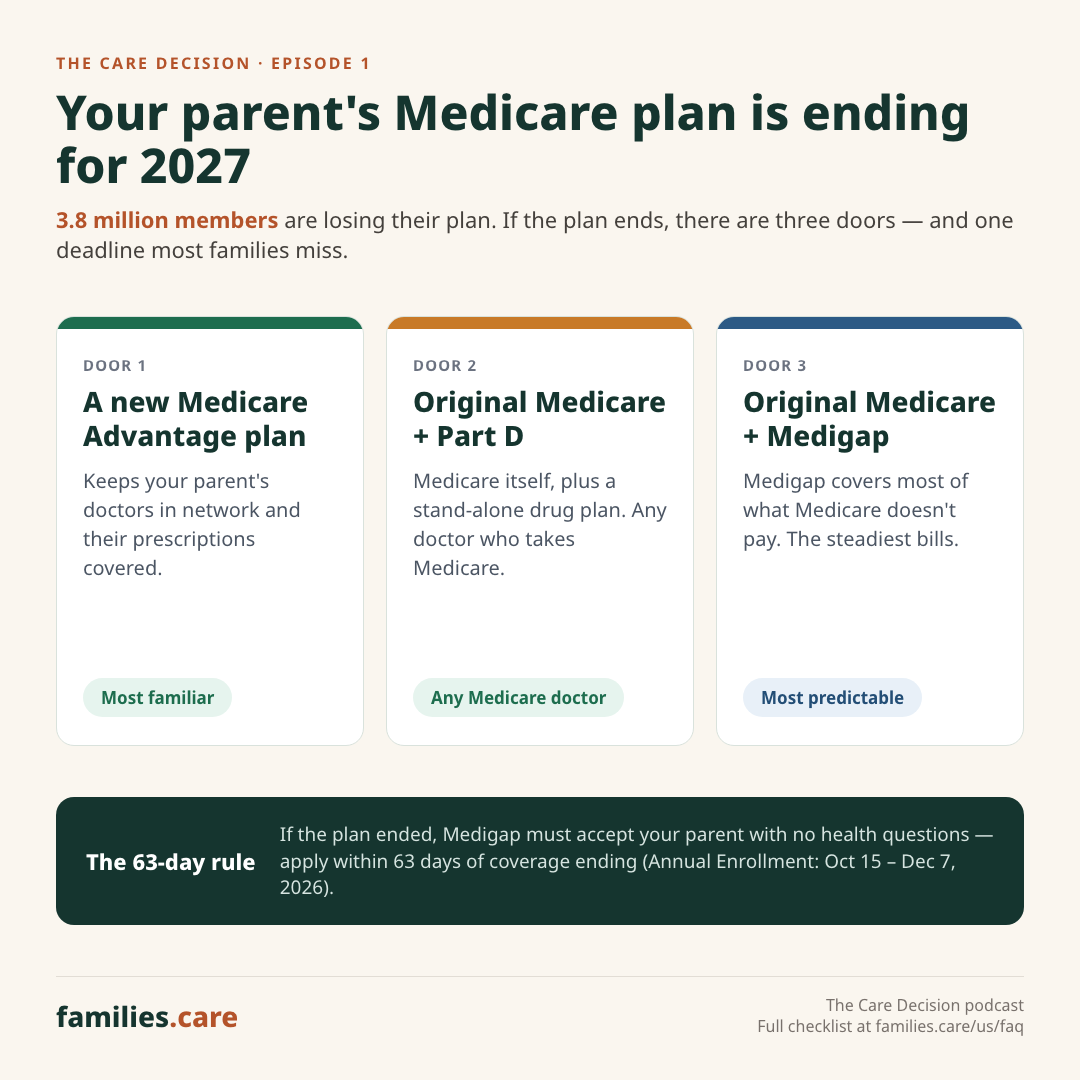
If a Parent’s Medicare Advantage Plan Is Ending for 2027: Three Coverage Doors
During Open Enrollment (October 15 – December 7, 2026), families whose carrier is discontinuing a Medicare Advantage plan compare three paths: Door 1 (choose a new Medicare Advantage plan to keep network doctors and bundled benefits), Door 2 (return to Original Medicare Parts A & B with a stand-alone Part D drug plan and an optional Medigap policy under the federal 63-day guaranteed-issue window with no health underwriting), or Door 3 (take no action, which defaults to Original Medicare on January 1, 2027 without a Part D drug plan unless enrolled separately). Review the full timeline and 5-step checklist in Medicare Open Enrollment 2026: Key Dates, compare finalized 2027 Part D parameters in 2027 Medicare Costs: Final and Pending, and see the 4 long-term care funding bridges in The Care Decision Ep 2: Medicare Doesn’t Pay for Assisted Living — What Actually Does.
Your Medicare Plan’s Star Rating May Be a Mirage This Year — 3 Things to Check Before Open Enrollment
The window: Medicare Open Enrollment runs October 15 – December 7, 2026, and changes take effect January 1, 2027. This is the one annual window most people have to switch Medicare Advantage or Part D prescription drug plans for 2027.[2]
What actually changed in the ratings formula: CMS’s Contract Year 2027 final rule removed 11 Star Ratings measures — mostly administrative metrics such as call-center performance (including interpreter and TTY availability) and appeals handling — and reinstated the general reward factor in place of the Health Equity Index (HEI). Because fewer operational metrics can pull a composite score down, a plan can show a higher star rating this year without its care having improved at all. CMS’s own regulatory analysis projects roughly $18.5B ($18.56 billion) flowing to plan sponsors over 10 years from these formula and bonus-payment changes. Only one genuinely new clinical measure was added for the 2027 measurement year: depression screening and follow-up.
What families should do — read under the headline star: Check the underlying categories (drug coverage, care coordination, and member experience with the care itself), then verify the three things that actually determine whether a plan works for your parent in 2027:
- Their medications are on the plan’s 2027 formulary at a tolerable tier — confirm every routine prescription, tier placement, and any prior-authorization or step-therapy rules (alongside the finalized 2027 Part D $700 maximum deductible and $2,400 annual out-of-pocket cap).
- Their doctors and hospital are in network for 2027 — provider networks change yearly, so check each primary care physician, specialist, and hospital by name in the plan’s 2027 directory.
- Their pharmacy is preferred in-network — copays at a standard in-network pharmacy can be substantially higher than at a preferred in-network pharmacy under the same plan.
Check stars last, not first. A high-starred plan that drops your parent’s specialist or moves a daily medication to a non-preferred tier will cost your family far more than a lower-starred plan that covers their actual doctors and prescriptions.
Watch for the marketing surge: Federal broker and agent marketing restrictions were loosened effective October 1, 2026, so families should expect a higher volume of calls, mailers, and ads this season — and should know that a sales call is not advice. For free, unbiased guidance with no sales commission, contact your local State Health Insurance Assistance Program (SHIP) counselor, and review our live Medicare Open Enrollment 2026 key dates explainer, 2027 plan-ending checklist, 2027 Medicare costs guide, and FAQ entry (“When is Medicare Open Enrollment for 2026?”) for the dates and plan-ending rules.
Sources & 2027 rule-change explainers: CMS Contract Year 2027 Medicare Advantage and Part D Final Rule Fact Sheet; Medicare Star Ratings 2027 Rule-Change Explainer (Avidon Health, updated 2026-10-03); and 2027 Star Ratings Measure-Set & Reward-Factor Analysis (RISE Health, updated 2026-10-03).
Related resources on families.care
Related Articles
Frequently Asked Questions
- Does Medicare pay for assisted living or memory care?
- No. Medicare does not cover custodial care, room and board in assisted living, or memory care communities. It only covers medically necessary skilled nursing or therapy services on a short-term basis.
- How do families cover the cost of long-term custodial care?
- Long-term custodial care is typically paid through private family funds, long-term care insurance policies, state Medicaid waiver programs (for individuals meeting financial and care-need criteria), or VA Aid and Attendance benefits for qualifying veterans and surviving spouses.
Verified references & primary sources
5 verified sourcesQuantitative and regulatory claims in this guide are grounded against official registries and benchmark datasets.
-
Statutory RegistryCareScout · Verified 2026-08-15 · General senior-care planning information.
“Their medications are on the plan’s 2027 formulary at a tolerable tier — confirm every routine prescription, tier placement, and any prior-authorization or step…”
-
Statutory RegistryMedicare.gov · Verified 2026-08-15 · General senior-care planning information.
“Because Medicare is designed for acute medical needs and short-term rehabilitation, families seeking long-term residential or memory support must explore altern…”
-
Statutory RegistryMedicaid.gov · Verified 2026-07-10 · General senior-care planning information.
-
Statutory RegistryNational Institute on Aging · Verified 2026-07-10 · General senior-care planning information.
-
Statutory RegistryU.S. Department of Veterans Affairs · Verified 2026-08-15 · General senior-care planning information.
How we research and verify this information
Our team compiles this listing from public records and provider data, and reviews it against authoritative sources. Read our editorial standards and research methodology.
- Cost of Care Survey (2025)Publisher: CareScout. Supports: General senior-care planning information for this guide. Last checked: 2026-08-15.
- Skilled nursing facility coveragePublisher: Medicare.gov. Supports: General senior-care planning information for this guide. Last checked: 2026-08-15.
- Medicaid coverage and eligibilityPublisher: Medicaid.gov. Supports: General senior-care planning information for this guide. Last checked: 2026-07-10.
- Long-term-care guidance for familiesPublisher: National Institute on Aging. Supports: General senior-care planning information for this guide. Last checked: 2026-07-10.
- VA pension rates (Aid & Attendance)Publisher: U.S. Department of Veterans Affairs. Supports: General senior-care planning information for this guide. Last checked: 2026-08-15.