
2027 Medicare Costs: Final and Pending
Expertly Reviewed by Luis Diaz Sendel, Founder, families.care
Updated on October 15, 2026
Editorial Dispatch
Grounded against 5 primary statutory & directory sources.Markdown / Cite ↗

Key Takeaways
Part D's 2027 costs are final: a $700 deductible and a $2,400 out-of-pocket cap. Part B figures are pending. See what's official and what confirms your costs.
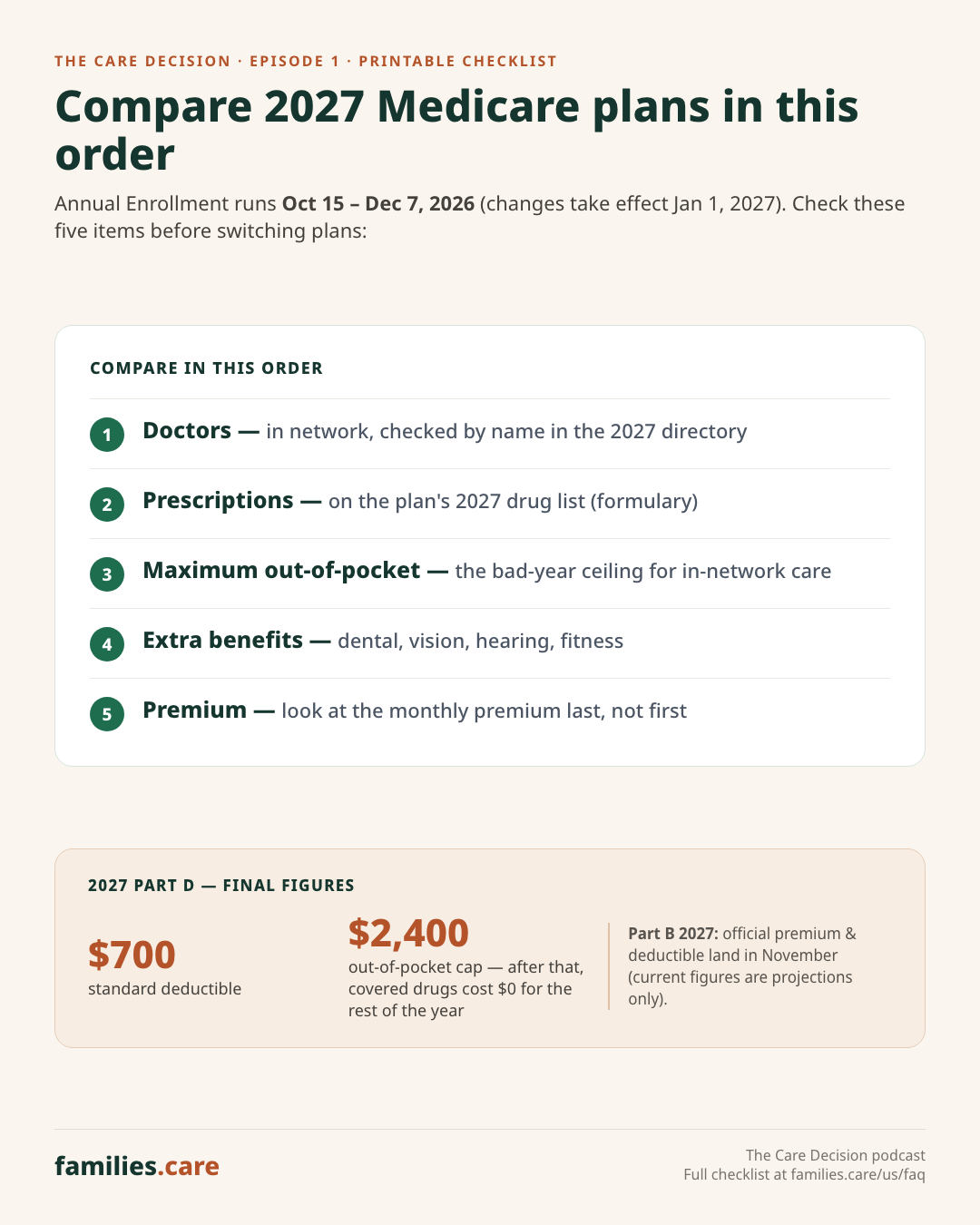
Half of the 2027 Medicare cost picture is now official. In its Rate Announcement, the Centers for Medicare & Medicaid Services (CMS) finalized the 2027 Part D prescription drug standard benefit parameters: a $700 deductible (up from $615 in 2026) and an annual out-of-pocket cap of $2,400 (up from $2,100). Once spending on covered medications reaches that cap, the plan pays the remaining cost for covered drugs for the rest of the calendar year. CMS also set the Part D base beneficiary premium at $41.33 a month. Individual private plans may charge less than the statutory standard deductible, so each plan's own documentation determines out-of-pocket totals.
| Benefit Figure | Status | 2027 Value | Prior Value (2026) |
|---|---|---|---|
| Part D Standard Deductible | Final | $700 | $615 |
| Part D Annual Out-of-Pocket Cap | Final | $2,400 | $2,100 |
| Part D Base Beneficiary Premium | Final | $41.33/mo | $38.99/mo |
| Part B Standard Premium | Pending Official (Projected) | ~$209.50/mo | $202.90/mo |
| Part B Annual Deductible | Pending Official (Projected) | ~$292 | $283 |
The other half of the cost picture remains pending. CMS has not yet announced the official 2027 Part B premium or deductible; official releases typically land in November. The 2026 Medicare Trustees Report projects a standard Part B premium of approximately $209.50 a month (up from $202.90) and an annual deductible of approximately $292 (up from $283). These figures are actuarial estimates, and final numbers published by CMS may differ.
The document that confirms exact out-of-pocket costs for each household is the Annual Notice of Change (ANOC), mailed by insurance carriers by the end of September. It details the plan's exact premium changes, copayment tiers, and formulary coverage for 2027.[1]
How to Compare 2027 Plans in Order (5-Step Checklist)
When evaluating 2027 plan options — especially if an existing Medicare Advantage plan is changing benefits or exiting a county — looking at the monthly premium first can hide network or formulary gaps. Compare plans in this 5-step sequence: (1) Doctors in network by name, (2) Prescriptions on the 2027 formulary (paired with the finalized $700 max standard deductible and $2,400 annual out-of-pocket cap), (3) Maximum out-of-pocket (MOOP) ceiling, (4) Extra benefits (dental, vision, hearing), and (5) Monthly premium last. For the full walkthrough of discontinued-plan options and deadlines, see Medicare Open Enrollment 2026: Key Dates & Plan-Ending Checklist.
Your Medicare Plan’s Star Rating May Be a Mirage This Year — 3 Things to Check Before Open Enrollment
The window: Medicare Open Enrollment runs October 15 – December 7, 2026, and changes take effect January 1, 2027. This is the one annual window most people have to switch Medicare Advantage or Part D prescription drug plans for 2027.[2]
What actually changed in the ratings formula: CMS’s Contract Year 2027 final rule removed 11 Star Ratings measures — mostly administrative metrics such as call-center performance (including interpreter and TTY availability) and appeals handling — and reinstated the general reward factor in place of the Health Equity Index (HEI). Because fewer operational metrics can pull a composite score down, a plan can show a higher star rating this year without its care having improved at all. CMS’s own regulatory analysis projects roughly $18.5B ($18.56 billion) flowing to plan sponsors over 10 years from these formula and bonus-payment changes. Only one genuinely new clinical measure was added for the 2027 measurement year: depression screening and follow-up.
What families should do — read under the headline star: Check the underlying categories (drug coverage, care coordination, and member experience with the care itself), then verify the three things that actually determine whether a plan works for your parent in 2027:
- Their medications are on the plan’s 2027 formulary at a tolerable tier — confirm every routine prescription, tier placement, and any prior-authorization or step-therapy rules (alongside the finalized 2027 Part D $700 maximum deductible and $2,400 annual out-of-pocket cap).
- Their doctors and hospital are in network for 2027 — provider networks change yearly, so check each primary care physician, specialist, and hospital by name in the plan’s 2027 directory.
- Their pharmacy is preferred in-network — copays at a standard in-network pharmacy can be substantially higher than at a preferred in-network pharmacy under the same plan.
Check stars last, not first. A high-starred plan that drops your parent’s specialist or moves a daily medication to a non-preferred tier will cost your family far more than a lower-starred plan that covers their actual doctors and prescriptions.
Watch for the marketing surge: Federal broker and agent marketing restrictions were loosened effective October 1, 2026, so families should expect a higher volume of calls, mailers, and ads this season — and should know that a sales call is not advice. For free, unbiased guidance with no sales commission, contact your local State Health Insurance Assistance Program (SHIP) counselor, and review our live Medicare Open Enrollment 2026 key dates explainer, 2027 plan-ending checklist, 2027 Medicare costs guide, and FAQ entry (“When is Medicare Open Enrollment for 2026?”) for the dates and plan-ending rules.
Sources & 2027 rule-change explainers: CMS Contract Year 2027 Medicare Advantage and Part D Final Rule Fact Sheet; Medicare Star Ratings 2027 Rule-Change Explainer (Avidon Health, updated 2026-10-03); and 2027 Star Ratings Measure-Set & Reward-Factor Analysis (RISE Health, updated 2026-10-03).
Related Articles
Frequently Asked Questions
- What is the 2027 Part D out-of-pocket prescription drug cap?
- For 2027, the Part D annual out-of-pocket cap is finalized at $2,400 (up from $2,100 in 2026). Once a beneficiary spends $2,400 out-of-pocket on covered prescription medications, the plan covers 100% of remaining covered drug costs for the year.
- Are the 2027 Part B premium and deductible numbers final?
- No. CMS typically announces the official Part B premium and deductible in November. Current figures (~$209.50/month premium and ~$292 deductible) are projections from the 2026 Medicare Trustees Report.
Verified references & primary sources
5 verified sourcesQuantitative and regulatory claims in this guide are grounded against official registries and benchmark datasets.
-
Statutory RegistryCareScout · Verified 2026-08-15 · General senior-care planning information.
“It details the plan's exact premium changes, copayment tiers, and formulary coverage for 2027.”
-
Statutory RegistryMedicare.gov · Verified 2026-08-15 · General senior-care planning information.
“The window: Medicare Open Enrollment runs October 15 – December 7, 2026 , and changes take effect January 1, 2027 .”
-
Statutory RegistryMedicaid.gov · Verified 2026-07-10 · General senior-care planning information.
-
Statutory RegistryNational Institute on Aging · Verified 2026-07-10 · General senior-care planning information.
-
Statutory RegistryU.S. Department of Veterans Affairs · Verified 2026-08-15 · General senior-care planning information.
How we research and verify this information
Our team compiles this listing from public records and provider data, and reviews it against authoritative sources. Read our editorial standards and research methodology.
- Cost of Care Survey (2025)Publisher: CareScout. Supports: General senior-care planning information for this guide. Last checked: 2026-08-15.
- Skilled nursing facility coveragePublisher: Medicare.gov. Supports: General senior-care planning information for this guide. Last checked: 2026-08-15.
- Medicaid coverage and eligibilityPublisher: Medicaid.gov. Supports: General senior-care planning information for this guide. Last checked: 2026-07-10.
- Long-term-care guidance for familiesPublisher: National Institute on Aging. Supports: General senior-care planning information for this guide. Last checked: 2026-07-10.
- VA pension rates (Aid & Attendance)Publisher: U.S. Department of Veterans Affairs. Supports: General senior-care planning information for this guide. Last checked: 2026-08-15.