
How Families Actually Pay for Assisted Living & Memory Care: The Six Doors
One real decision families face with an aging parent, answered all the way through.

How Families Actually Pay for Assisted Living & Memory Care: The Six Doors
Stream below or download MP3 for a family meeting or car ride.
Jump to Chapter (Click timestamp to seek audio):
The voices in this episode are AI-generated. The script was researched, written, and fact-checked by the families.care team.
Key takeaways
- 01Split every facility quote into 3 buckets: Bucket 1 (Room & Board), Bucket 2 (Personal Care & Supervision Tier), and Bucket 3 (Medical & Prescription Care).
- 02Federal statute bars Medicaid HCBS waivers from paying Bucket 1 (Room & Board); resident Social Security covers capped Room & Board while the state waiver covers Bucket 2.
- 03Door 1 (Fixed Income): 2026 average retired worker Social Security is $2,071/mo, rising 3.6% (~$75/mo) in 2027.
- 04Door 2 (Long-Term Care Insurance): Requires 2 of 6 ADLs or severe cognitive impairment; start the claim on Day 1 to run the 60–90 day elimination clock.
- 05Door 3 (VA Aid & Attendance): 2026 MAPR up to $2,424/mo (single veteran), $2,874/mo (married veteran), or $1,558/mo (surviving spouse) paid tax-free in cash; file VA Intent to File immediately.
- 06Door 4–6 (Medicaid Waivers, Home Equity & Tax Deductions): Most income-cap states apply a $2,982/mo (300% SSI) 2026 limit with Qualified Income Trust options; confirm 12–24 month private-pay waiver rules in writing and check IRC Sec. 213(d) medical deductions.
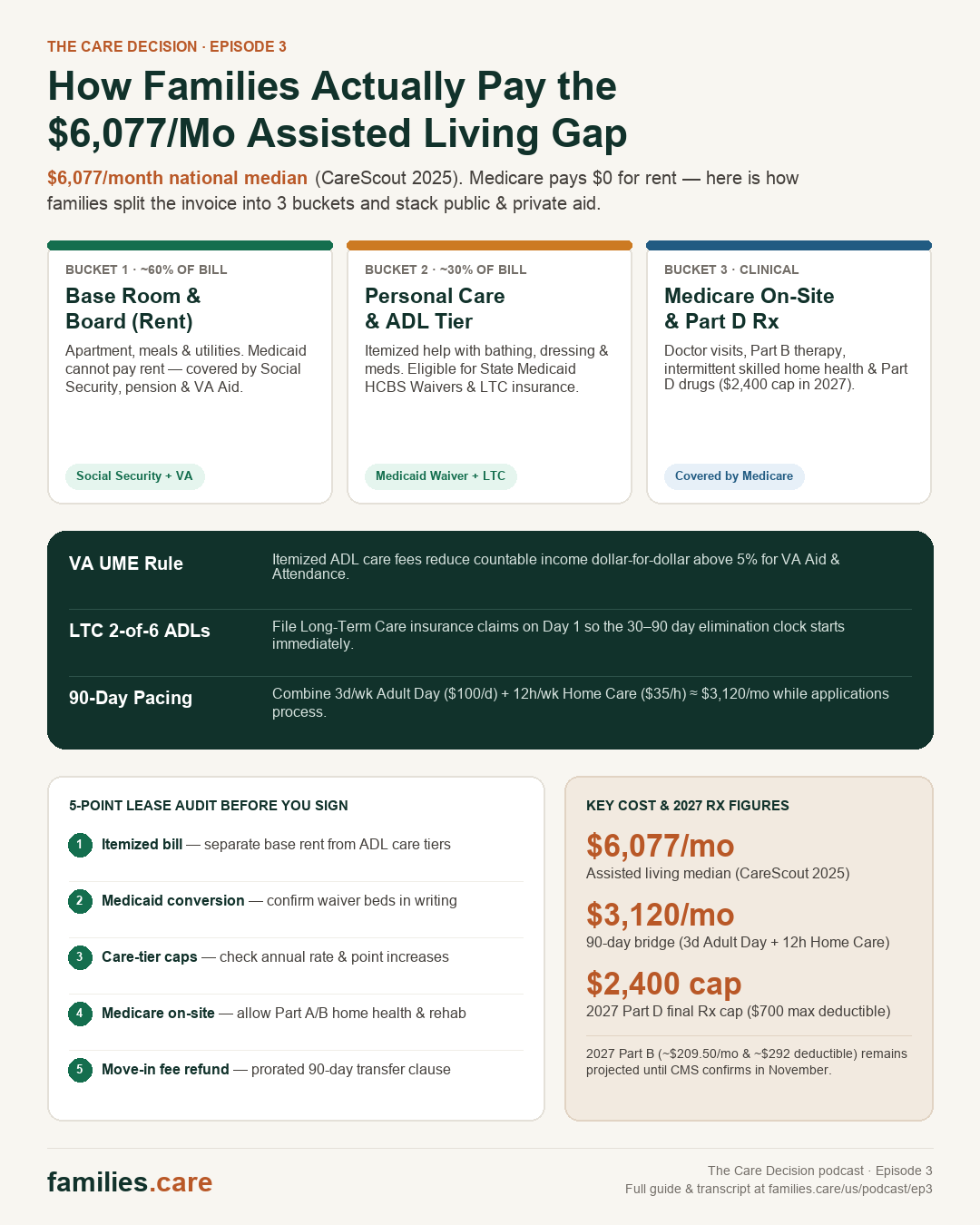
Printable Reference Cards for Episode 3
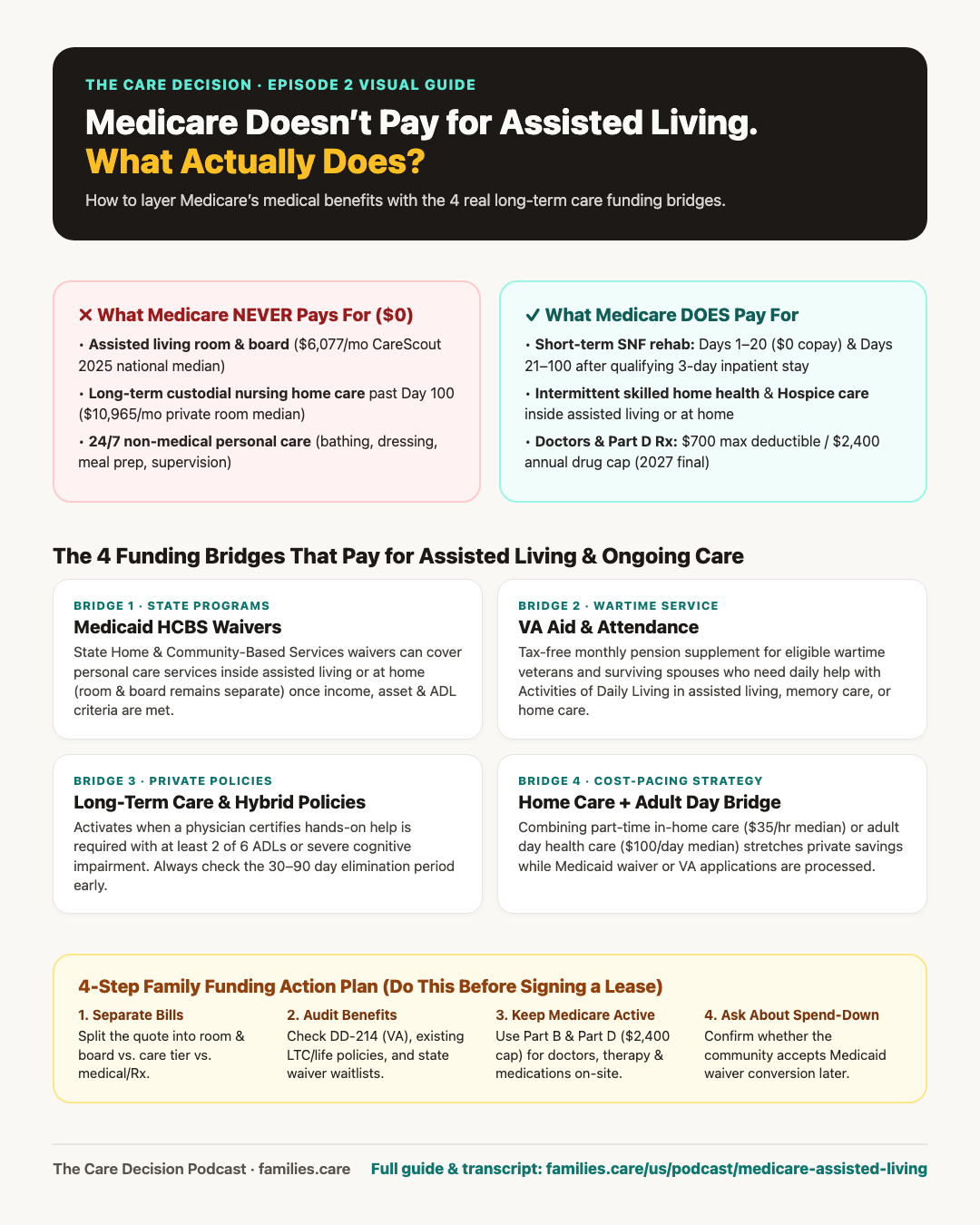
Designed for families to use during insurer calls, facility tours, and kitchen-table planning. Tap any reference card to open it full screen.

Show notes
If the national median for assisted living is $6,200 a month and the average retired worker's Social Security check in 2026 is $2,071 a month, there is a $4,000+ monthly gap appearing on the kitchen table every 30 days. In Episode 3, Maya and Daniel explain why no single program pays the whole invoice — and how splitting your community's quote into 3 separate legal buckets (Bucket 1: Room & Board, Bucket 2: Personal Care Tier, Bucket 3: Medical & Clinical Care) unlocks the Six Funding Doors: (1) Social Security & pensions (including the 3.6% 2027 COLA), (2) Long-Term Care Insurance (2-of-6 ADL triggers & 90-day elimination clocks), (3) VA Aid & Attendance tax-free cash ($1,558–$2,874/mo), (4) State Medicaid HCBS Assisted Living Waivers (why Medicaid never pays Room & Board and why 12–24 month private-pay rules matter), (5) Home equity & bridge financing, and (6) Life settlements & the IRS Sec. 213(d) medical expense deduction.
Links from this episode
3-Bucket Monthly Gap & Six-Doors Benefit Stacker
Split the community quote into Room & Board (Bucket 1) and Personal Care/ADLs (Bucket 2) to see how Social Security, VA Aid & Attendance, LTC insurance, and state Medicaid HCBS waivers reduce your net monthly gap.
Net Monthly Family Gap (After Benefits)
$4,129/mo
Total Invoice: $6,200/mo · Covered: $2,071/mo
90-Day Elimination / Approval Bridge
$12,387
Home Care + Adult Day pacing ($3,120/mo) saves $9,240 over 90d
24-Month Net Family Out-of-Pocket
$99,096
Bucket 3 Clinical & Part D ($2,400 Rx cap) stays on Medicare
5-Question Tour Worksheet & 24-Month Survival Calculator
Fill in the numbers quoted during your tour to calculate the 2-year total at the next care tier up, then print a 1-page scorecard.
Day-1 Monthly (Base + Meds)
$7,140/mo
Year-2 Monthly (Next Tier Up)
$8,390/mo
24-Month Total at Next Tier Up
$199,774
Community B — Side-by-Side Comparison (e.g. Low Base À La Carte vs. All-Inclusive)
Community B Day-1 Monthly
$6,600/mo
Community B Year-2 Monthly
$8,321/mo
Community B 24-Month Total
$198,052
⚖️ 24-Month Comparison: Community B is $1,722 lower over 2 years despite higher tier add-ons.
Was this episode helpful for your family’s decision?
Anonymous 1–5 star rating · Helps families find the clearest guides first.
Turn This Episode Into Your Local Plan
National averages only tell half the story. Check the exact figures, Medicaid waiver rules, and verified communities in your parent’s state and city.
Cost Calculator
Compare Local Care Costs by State & City
See CareScout 2025 assisted living medians and estimated memory care rates in your area.
Provider Directory
Search Verified Local Communities
Filter assisted living, memory care, and skilled nursing near your parent’s ZIP or city.
State & Federal Guides
Medicare, Medicaid & Care Checklists
Step-by-step written guides grounded in CMS rules and state Medicaid statutes.
Full transcript (the recording script)
This is the production script reproduced verbatim, exactly as recorded.
Maya: A quick note before we begin. This episode uses A I generated voices. The script was researched, written, and fact checked by the families dot care team, and the figures in it come from official sources.
Daniel: Welcome back to The Care Decision, the families dot care podcast, where we take one real decision that families face with an aging parent, and we answer it all the way through. I am Daniel.
Maya: And I am Maya. In Episode Two, we priced the memory care and assisted living bill honestly: a local base rate, a twenty to thirty percent premium for a secured memory care floor, and a stack of assessed care tiers on top. Today, we answer the question every family asks five minutes after seeing that quote.
Daniel: Which is: how do families actually pay the gap? Because if the national median for assisted living is around six thousand dollars a month, and the average retired worker's Social Security check in twenty twenty-six is two thousand seventy-one dollars a month, there is a four-thousand-dollar hole appearing on the kitchen table every thirty days.
Maya: And the single biggest mistake families make when they stare at that hole is looking for one magic program that pays the whole invoice. That program does not exist. The secret to paying for assisted living or memory care without burning through savings in fourteen months is refusing to treat the invoice as one single bill.
Daniel: Explain what you mean by that. The community sends one monthly statement.
Maya: They send one statement, yes, but legally and financially, an assisted living or memory care invoice is three separate bills stapled together. Bucket One is Room and Board: the apartment walls, utilities, and three meals a day. Bucket Two is Personal Care and Supervision: hands-on help with bathing, dressing, mobility, medication administration, and twenty-four-hour dementia supervision. And Bucket Three is Medical and Clinical Care: doctors, physical therapy, skilled nursing visits, and prescription drugs.
Daniel: And why does splitting the bill into three buckets change what a family can get paid for?
Maya: Because every benefit program in the United States is wired to a specific bucket. When a someone tells you, Medicare does not pay for assisted living, they mean Medicare does not pay Bucket One or Bucket Two. Medicare still pays Bucket Three, even when your parent lives in an assisted living apartment. And when a state says it has an Assisted Living Medicaid Waiver, federal law still prohibits Medicaid from paying Bucket One, the room and board. Medicaid only pays Bucket Two, the personal care services.
Daniel: Stop on that sentence for a second, because that catches thousands of families off guard every year. Even if your parent qualifies for a state Medicaid waiver in assisted living, Medicaid does not pay the rent?
Maya: By federal statute, Medicaid home and community-based waivers cannot pay room and board. Your parent's own monthly income, usually their Social Security check minus a small personal needs allowance, pays the Room and Board bucket, which the state typically caps for waiver residents. Then the state Medicaid waiver pays the facility for Bucket Two, the personal care tier. If you do not separate the buckets, none of the rules make sense. Once you separate them, the six funding doors fall right into place.
Daniel: Let us walk through the six doors in the order a family should check them. Door One: Fixed monthly income.
Maya: Door One is the foundation: Social Security, pensions, and required minimum distributions from retirement accounts. In twenty twenty-six, the average retired worker's Social Security benefit is two thousand seventy-one dollars a month, and with the three point six percent cost-of-living adjustment announced for twenty twenty-seven, that rises by roughly seventy-five dollars a month. Door One almost always goes straight to Bucket One, the Room and Board line. It rarely covers the whole bill, so its job is to shrink the monthly gap that the other five doors have to bridge.
Daniel: Door Two: Long-Term Care Insurance, for the families whose parents bought a policy years ago.
Maya: If your parent has a long-term care insurance policy, or a hybrid life insurance policy with a long-term care rider, pull the actual contract out of the drawer today, because two traps sit inside almost every policy. Trap one is the benefit trigger: most tax-qualified policies only start paying when a doctor or nurse certifies that your parent needs substantial assistance with at least two of the six activities of daily living, bathing, dressing, toileting, transferring, continence, or eating, OR has severe cognitive impairment requiring supervision for safety.
Daniel: And trap two is the clock.
Maya: The elimination period. Think of it as a deductible measured in days instead of dollars, usually sixty or ninety days. During those first ninety days, the family pays out of pocket while the clock runs. And check whether the policy counts calendar days or service days. In an assisted living or memory care facility, every day is a service day, so a ninety-day elimination period takes three months. Start the claim the day your parent moves in, or even during the assessment before move-in, so you do not lose an extra month waiting for paperwork.
Daniel: Door Three: Veterans benefits, specifically VA Aid and Attendance.
Maya: This is the most underused cash benefit in senior care. If your parent, or your parent's late spouse, served on active duty for at least ninety days with at least one day during a Congress-defined wartime period, and received an honorable or general discharge, they may qualify for the VA Aid and Attendance pension adder. For twenty twenty-six, the maximum Aid and Attendance benefit is up to two thousand three hundred fifty-eight dollars a month for a single veteran, up to two thousand seven hundred ninety-five dollars a month for a married veteran, and up to one thousand five hundred fifteen dollars a month for a surviving spouse.
Daniel: And which bucket does VA Aid and Attendance pay?
Maya: Any bucket you need. Unlike Medicare or Medicaid, VA Aid and Attendance is paid in cash directly to the veteran or surviving spouse's bank account every month, tax-free, specifically because they need help with daily activities or live in a protective environment. The catch is processing time: a VA claim can take four to nine months to adjudicate, though benefits are paid retroactively to the month after the application or intent-to-file was submitted. File the VA Intent to File form on day one to lock in your parent's effective date.
Daniel: Door Four: State Medicaid Home and Community-Based Services waivers, often called HCBS or 1915(c) waivers.
Maya: Most states now operate an assisted living or residential care Medicaid waiver, though the name and the rules change at every state line: Assisted Living Waiver in California, STAR+PLUS in Texas, Statewide Medicaid Managed Care Long-Term Care in Florida, Supportive Living Program in Illinois. Three realities govern Door Four. First, the financial test: in most states in twenty twenty-six, a single applicant faces a countable asset limit of two thousand dollars and an income cap around two thousand nine hundred one dollars a month, though states with an income cap usually allow a Qualified Income Trust, or Miller Trust, for income above that line.
Daniel: What is the second reality on Medicaid waivers?
Maya: Unlike nursing home Medicaid, which is an entitlement, assisted living waivers have capped enrollment slots. That means waiting lists exist in many states, AND not every assisted living community accepts Medicaid waiver rates. Some communities accept private pay only; others require your parent to pay privately for twelve or twenty-four months before converting to a Medicaid waiver bed. You must ask that question on the tour before signing.
Daniel: Door Five: Home equity and bridge financing.
Maya: For middle-class families who have too many assets for Medicaid today, or who are waiting six months for a house to sell or a VA claim to clear, the home is usually the largest asset on the balance sheet. Families use three tools here: selling the home and placing the proceeds in a dedicated care account; renting the home out to generate monthly cash flow toward Bucket One; or using a short-term senior living bridge loan or home equity line of credit solely to cover the ninety-day long-term care insurance elimination period or the months until the home closes.
Daniel: And Door Six: Life insurance settlements and tax deductions.
Maya: Two overlooked levers sit in Door Six. First, if a parent has an older life insurance policy they no longer need or are about to let lapse, a life settlement or accelerated death benefit can convert that policy into immediate care funds, though families should always check how a lump-sum payout affects Medicaid asset eligibility. Second, the IRS medical expense deduction: when a resident is in memory care or assisted living primarily for medical or cognitive care and has a care plan certified by a licensed health practitioner, a significant portion, sometimes the entire monthly fee for a chronically ill resident, can qualify as an itemized medical expense deduction above seven point five percent of adjusted gross income. Have a CPA check Internal Revenue Code Section 213(d) at tax time.
Daniel: Let us put this together into the five-step action checklist for Episode Three.
Maya: Step one: Take your community quote from Episode Two and split it into the three buckets on paper: Room and Board, Personal Care Tier, and Medical Care. Step two: Subtract your parent's net Social Security and pension income from the total to see the exact monthly gap. Step three: If there is a wartime veteran or surviving spouse in the picture, file a VA Intent to File today to lock in retroactive Aid and Attendance benefits. Step four: If your parent has long-term care insurance, open the claim immediately to start the sixty- or ninety-day elimination clock. And step five: Ask the community in writing whether they accept your state's Medicaid Assisted Living Waiver, and whether they require a one- or two-year private-pay period first.
Daniel: Our interactive 3-Bucket Invoice Split Reference Card, our fifty-state Medicaid waiver guides, and our printable Tour Worksheet are all free at families dot care.
Maya: That is Episode Three of The Care Decision. One real decision, answered all the way through. I am Maya.
Daniel: And I am Daniel. Thanks for listening, and split the invoice before you sign.