
How Families Actually Pay the $6,077/Month Assisted Living Gap (The Care Decision · Ep 3)
Expertly Reviewed by Luis Diaz Sendel, Founder, families.care
Updated on October 15, 2026
Key Takeaways
How families stack Medicaid HCBS waivers, VA Aid & Attendance, LTC policies, and home-care bridge pacing to cover the $6,077/mo assisted living cost gap.
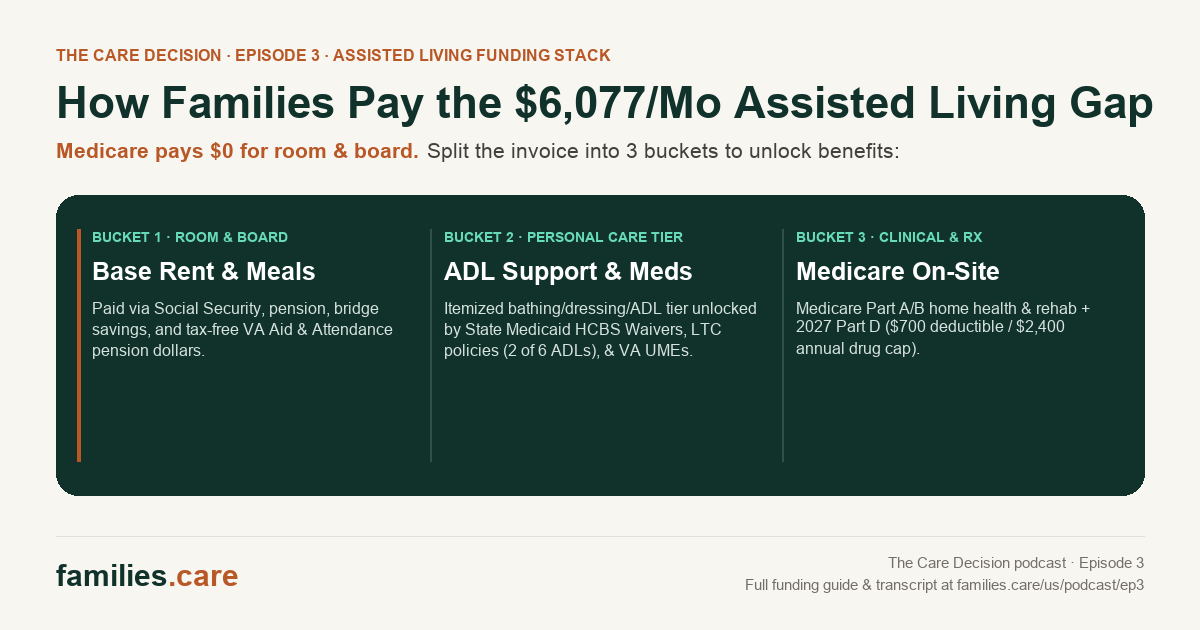
Knowing that Medicare pays $0 for assisted living room and board is only half the battle. The practical question every family faces at the kitchen table is: how do we actually assemble $6,077 a month (the CareScout 2025 national median) without draining a parent's savings in the first year or accidentally disqualifying them from public benefits? Episode 3 of The Care Decision walks through the exact mechanics of splitting an assisted living invoice into three funding buckets, sequencing Medicaid HCBS waivers alongside VA Aid & Attendance and Long-Term Care insurance, and pacing cash flow during the 60-to-120-day benefit approval window.
The Care Decision · Episode 3 Companion Guide & Transcript
This companion page publishes the Episode 3 funding-stack blueprint, 5-point lease audit checklist, and full 5-segment transcript.[1] Host-recorded audio will be added once final casting is complete.[1]
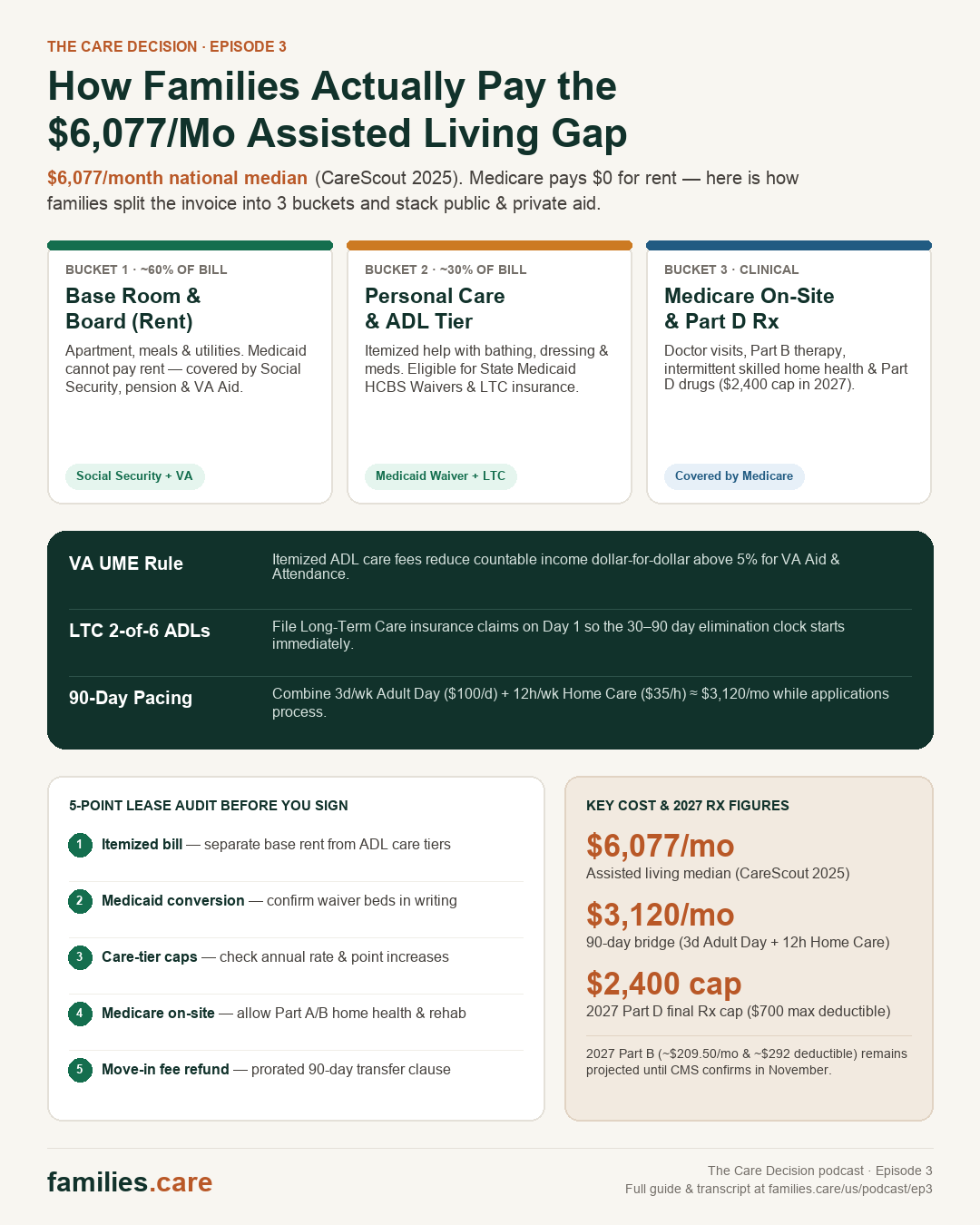
Episode 3 Visual Blueprint: The 3-Bucket Assisted Living Funding Stack
Save or print the Episode 3 reference card below before reviewing an assisted living residency contract or submitting a state Medicaid waiver or VA Aid & Attendance claim.[3]
1. Anatomy of the $6,077/Month Assisted Living Invoice: Why Itemization Unlocks Aid
When an assisted living community quotes a single bundled monthly rate (around the $6,077/month CareScout 2025 national median), benefit agencies cannot tell which dollars pay for rent versus hands-on personal care. Asking the community business office for an itemized three-bucket invoice is the first step in every benefit application:
- Bucket 1 — Base Room, Board & Utilities (~55%–65% of the monthly bill): Covers the private apartment, three daily meals, housekeeping, and building maintenance. Federal Medicaid law prohibits state waivers from paying pure room and board, so families cover Bucket 1 using the resident's monthly Social Security check, pension income, home-sale proceeds, or tax-free VA Aid & Attendance pension dollars.
- Bucket 2 — Personal Care & ADL Support Tier (~25%–35% of the monthly bill): Covers hands-on help with bathing, dressing, toileting, mobility transfers, continence care, and daily medication administration. Because these are documented Activities of Daily Living (ADLs), Bucket 2 is the exact portion eligible for state Medicaid HCBS waiver subsidies, private Long-Term Care (LTC) insurance daily benefits, and VA Unreimbursed Medical Expense (UME) deductions.
- Bucket 3 — Clinical & Prescription Layer (Billed directly to Medicare): Physician house calls, outpatient physical/occupational therapy under Medicare Part B (where 2026 Medicare Trustees Report projections estimate a ~$209.50/month standard premium and ~$292 deductible for 2027, projections only until CMS confirms in November), intermittent skilled home health ordered by a doctor, and maintenance prescriptions under Medicare Part D (protected in 2027 by the finalized $700 maximum deductible, $2,400 annual out-of-pocket cap, and $41.33/month base beneficiary premium).
2. How to Stack Medicaid Waivers, VA Aid & Attendance, and LTC Policies in Sequence
Many families assume they must choose only one benefit program. In practice, families regularly sequence two or three sources over a multi-year care journey — provided they follow federal coordination rules:
- Trigger Long-Term Care (LTC) or Hybrid Policies on Day 1: Most private LTC policies require a licensed physician or nurse to certify need for hands-on help with at least 2 of 6 ADLs ( expected to last at least 90 days) or severe cognitive impairment. File the claim on move-in day so the 30-to-90-day elimination period runs while initial family bridge funds are used.
- Deduct Assisted Living Care Tiers on the VA Aid & Attendance Application: When wartime veterans or surviving spouses apply for VA Aid & Attendance, gross household income is reduced dollar-for-dollar by recurring Unreimbursed Medical Expenses (UMEs) exceeding 5% of the basic pension rate. When an assisted living physician orders personal care or memory supervision for at least 2 ADLs, the care-tier invoice (and often the full facility fee in memory care or protected environments) counts as a recurring medical deduction — qualifying middle-income families whose gross retirement income would otherwise look too high.
- Plan the State Medicaid HCBS Waiver Transition Before Private Funds Hit Zero: State 1915(c) and 1115 assisted living waivers have both clinical level-of-care criteria and strict asset/income tests (plus a 60-month look-back period on uncompensated asset transfers in most states). Because waiver slot waitlists can take 3 to 9 months, families should contact their local Area Agency on Aging or elder-law counselor at least 6 to 12 months before private funds are projected to run low.
3. Bridging the 60-to-120-Day Approval Gap Without Burning Through Savings
Even when a parent clearly qualifies for VA Aid & Attendance, an LTC insurance policy, or a state Medicaid waiver, benefits rarely pay out in Month 1. LTC policies enforce a 30-to-90-day elimination period, VA claims take several months to adjudicate (though retroactive to the first of the month after filing), and state Medicaid waivers require clinical assessments. To keep monthly out-of-pocket spending sustainable during that 60-to-120-day window:
- Use the Home Care + Adult Day Pacing Formula: Instead of paying $6,077/month private-pay while waiting for paperwork, families who can safely support a parent at home for 90 days often combine 3 days a week of adult day health care ($100/day CareScout 2025 median, ~$1,300/month) with 12 hours a week of in-home personal care aides ($35/hour median, ~$1,820/month) — cutting the monthly cash burn roughly in half (~$3,120/month) while the LTC elimination clock or VA claim processes.
- Maximize Medicare Clinical Services During the Transition: Ask the primary care physician whether your parent qualifies for intermittent Medicare home health (skilled nursing, physical therapy, occupational therapy) at $0 clinical copay, and verify during Medicare Open Enrollment (October 15 – December 7, 2026) that all 2027 maintenance prescriptions are on-formulary under the finalized $2,400 Part D out-of-pocket cap.
4. 5-Point Assisted Living Lease Audit Before You Sign
- Itemized Base Rent vs. ADL Care Tier: Confirm the monthly statement separates room & board from personal care and medication management for VA UME and LTC insurance claims.
- Medicaid Waiver Conversion Policy in Writing: Verify whether the community holds a state Medicaid HCBS waiver contract, how many years of private pay it requires first (typically 12–24 months), and whether a waiver bed is guaranteed at conversion.
- Annual Rate-Lock & Care-Tier Escalation Caps: Ask how often care-level points are reassessed and what the historical annual base-rent increase has been over the past three years.
- Third-Party Medicare Home Health & Hospice Access: Confirm residents can bring in Medicare-certified skilled home health, outpatient Part B therapy, and hospice agencies on-site without extra community surcharges.
- Refundability of Community Move-In Fees: Clarify whether the one-time community fee is prorated if a resident transfers to a skilled nursing facility ($10,965/month private room median) within the first 90 days.
5. Episode 3 Full Transcript
Segment 1 — From Sticker Shock to a Monthly Funding Math Plan
In Episode 2, we covered the rule that catches millions of families off guard: Medicare pays $0 toward assisted living room and board. Once that shock settles, the next question is pure kitchen-table math. With the national median cost of assisted living sitting at $6,077 a month in the CareScout 2025 Cost of Care Survey, and memory care often running $1,200 to $1,800 higher, very few retirees have $6,000 a month in spare pension income. Families who bridge that gap successfully don't rely on a single check — they split the assisted living bill into three distinct buckets and match each bucket to the program built to pay it.
Segment 2 — Splitting the Invoice: Room & Board vs. Care Tier vs. Clinical
Before you sign an assisted living lease or submit a benefit form, ask the community business office for an itemized breakdown. Bucket 1 is base room and board — the apartment, utilities, and meals. Because Medicaid waivers cannot pay pure rent, Bucket 1 is covered by your parent's Social Security check, pension, and tax-free VA Aid and Attendance dollars. Bucket 2 is the personal care tier — daily hands-on help with bathing, dressing, toileting, mobility, or medication management. When those care charges are itemized separately on the invoice, state Medicaid Home and Community-Based Services waivers and private long-term care insurance policies can pay Bucket 2 directly. And Bucket 3 is the clinical layer — doctor visits, physical therapy, intermittent skilled home health, and Part D prescriptions, where for 2027 CMS has finalized a $700 maximum standard deductible and a $2,400 annual out-of-pocket cap on covered drugs. Bucket 3 stays on your parent's Medicare card.
Segment 3 — The VA Aid & Attendance Medical-Expense Deduction Secret
One of the most overlooked rules in senior care finance is how the Department of Veterans Affairs calculates income for the Aid and Attendance pension supplement. Families often look at a wartime veteran's or surviving spouse's monthly Social Security and small pension and assume they make too much to qualify. But the VA looks at countable income after subtracting recurring Unreimbursed Medical Expenses — called UMEs. Once a physician certifies that your parent needs daily assistance with at least two Activities of Daily Living or supervision for cognitive impairment in assisted living or memory care, those monthly care invoices reduce countable income dollar for dollar above the 5 percent deductible threshold. That single calculation regularly turns an apparent denial into a tax-free monthly benefit check.
Segment 4 — Surviving the 60-to-120-Day Approval & Elimination Window
Even when your parent qualifies for a long-term care insurance policy, VA Aid and Attendance, or a state Medicaid waiver, none of those programs send a check on Day 1. Long-term care policies usually have a 30- to 90-day elimination period, VA applications take months to process, and state Medicaid waivers have clinical screening queues. If your parent can remain safely at home during that 90-day window, pacing care by combining three days a week of adult day health care at the $100-a-day national median with 12 hours a week of in-home aide support at the $35-an-hour median keeps monthly spending near $3,100 — preserving nearly $9,000 in family savings over three months while the elimination clock runs out.
Segment 5 — The Five Lease Clauses to Check Before Move-In Day
Finally, never sign an assisted living agreement without checking five clauses in writing: first, that monthly invoices itemize base rent separately from ADL care tiers; second, whether the community accepts state Medicaid waiver conversion after a private-pay period and how many waiver beds they maintain; third, how care-level price increases are calculated; fourth, that your parent can use Medicare-certified home health and Part B therapy on-site without community surcharges; and fifth, whether the move-in fee is prorated if their medical needs change within the first 90 days.
Related resources on families.care
- The Care Decision Ep 2: Medicare Doesn't Pay for Assisted Living — What Actually Does
- The Care Decision Ep 1: Your Parent's Medicare Plan Is Ending for 2027. Now What?
- Medicare Open Enrollment 2026: Key Dates & Plan-Ending Checklist
- Medicare vs. Medicaid for Senior Care: Complete Family Guide
- VA Aid & Attendance Benefits for Senior Care
- Assisted Living Costs & Financial Assistance Guide
- Senior Care Costs by U.S. State (CareScout 2025 Benchmarks)
Related Articles
Frequently Asked Questions
- How do families split an assisted living invoice to qualify for financial assistance?
- Ask the assisted living community for an itemized monthly invoice separated into three buckets: (1) Base room, board, and utilities (paid via Social Security, pension, savings, or VA Aid & Attendance), (2) Personal care and Activities of Daily Living (ADL) support tiers (eligible for state Medicaid HCBS waiver coverage, Long-Term Care insurance daily benefits, and VA Unreimbursed Medical Expense deductions), and (3) Clinical and prescription care (covered on-site by Medicare Parts A, B, and Part D under the finalized 2027 $700 deductible and $2,400 annual out-of-pocket cap).
- Can a middle-income veteran or surviving spouse qualify for VA Aid & Attendance in assisted living?
- Often yes. The VA calculates Aid & Attendance eligibility by subtracting recurring Unreimbursed Medical Expenses (UMEs) above 5% of the basic pension rate from gross household income. When a clinician certifies that a resident needs daily help with at least 2 of 6 ADLs or supervision for cognitive impairment, assisted living care fees can be deducted from gross income, qualifying many families whose retirement income initially appears too high.
- How can families reduce out-of-pocket costs during the 60-to-120-day wait for VA, LTC insurance, or Medicaid waiver approval?
- While waiting for a 30-to-90-day Long-Term Care insurance elimination period or a VA/Medicaid waiver application to process, families who can safely care for a parent at home often combine 3 days/week of adult day health care ($100/day CareScout 2025 national median) with 12 hours/week of in-home personal care ($35/hour median). This pacing bridge averages roughly $3,120/month — about half the $6,077/month assisted living median — while already counting toward many policy elimination clocks.
Verified references & primary sources
5 verified sourcesQuantitative and regulatory claims in this guide are grounded against official registries and benchmark datasets.
-
Statutory RegistryCareScout · Verified 2026-08-15 · General senior-care planning information.
“This companion page publishes the Episode 3 funding-stack blueprint, 5-point lease audit checklist, and full 5-segment transcript.”
-
Statutory RegistryMedicare.gov · Verified 2026-08-15 · General senior-care planning information.
-
Statutory RegistryMedicaid.gov · Verified 2026-07-10 · General senior-care planning information.
“Save or print the Episode 3 reference card below before reviewing an assisted living residency contract or submitting a state Medicaid waiver or VA Aid & Attend…”
-
Statutory RegistryNational Institute on Aging · Verified 2026-07-10 · General senior-care planning information.
-
Statutory RegistryU.S. Department of Veterans Affairs · Verified 2026-08-15 · General senior-care planning information.
How we research and verify this information
Our team compiles this listing from public records and provider data, and reviews it against authoritative sources. Read our editorial standards and research methodology.
- Cost of Care Survey (2025)Publisher: CareScout. Supports: General senior-care planning information for this guide. Last checked: 2026-08-15.
- Skilled nursing facility coveragePublisher: Medicare.gov. Supports: General senior-care planning information for this guide. Last checked: 2026-08-15.
- Medicaid coverage and eligibilityPublisher: Medicaid.gov. Supports: General senior-care planning information for this guide. Last checked: 2026-07-10.
- Long-term-care guidance for familiesPublisher: National Institute on Aging. Supports: General senior-care planning information for this guide. Last checked: 2026-07-10.
- VA pension rates (Aid & Attendance)Publisher: U.S. Department of Veterans Affairs. Supports: General senior-care planning information for this guide. Last checked: 2026-08-15.