
What Does Memory Care Actually Cost?
One real decision families face with an aging parent, answered all the way through.
What Does Memory Care Actually Cost?
Stream below or download MP3 for a family meeting or car ride.
Jump to Chapter (Click timestamp to seek audio):
The voices in this episode are AI-generated. The script was researched, written, and fact-checked by the families.care team.
Key takeaways
- 01CareScout Cost of Care Survey 2025: assisted living national median $6,200/mo ($74,400/yr), up 5% year over year; no separate memory care median is published.
- 02Memory care premium: typically 20–30% over the same community's assisted living rate; it buys staffing ratios, a secured unit, and dementia-specific training.
- 03Comparison anchors (CareScout 2025): nursing home semi-private room $9,581/mo, private room $10,798/mo; adult day health care about $95/day; non-medical home caregiver about $35/hour.
- 04The cheaper brochure rate is often the more expensive real bill: a low base rate billed à la carte can pass an honest all-inclusive price once care tiers start moving.
- 05Get tier triggers, medication management pricing, and incontinence pricing in writing before signing.
- 06Next episode: how families actually pay for care — the six doors.
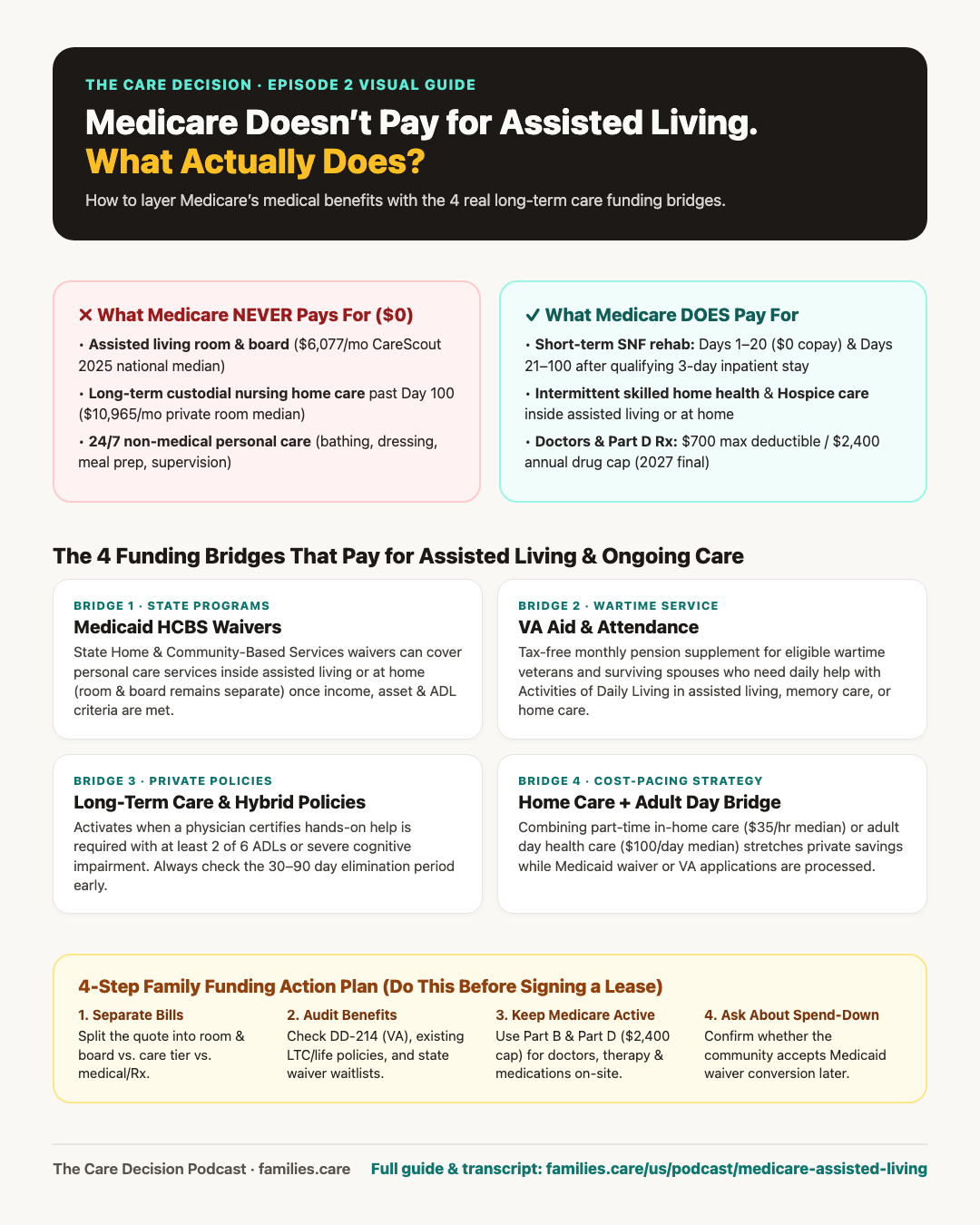
Printable Reference Cards for Episode 2
Designed for families to use during insurer calls, facility tours, and kitchen-table planning. Tap any reference card to open it full screen.

Show notes
There is no official national price for memory care. The benchmark survey everyone cites — the CareScout Cost of Care Survey — publishes a national median for assisted living ($6,200 a month in the 2025 survey) and does not survey memory care separately. What families actually pay is a local base rate, plus a premium for the secured memory care floor, plus a stack of assessed charges on top. In this episode, Maya and Daniel walk through the whole stack: the base rate and the premium (assisted living's $6,200 national median; memory care typically 20–30% above the same community's assisted living rate — A Place for Mom's 2026 medians imply about 23%, private data, labeled as such); why geography swamps every national number (medians from roughly $4,400/month in Mississippi to about $9,600 in Massachusetts and around $12,000 in Hawaii); the ten price movers (care tier and reassessment, medication management, incontinence care, mobility and transfers, help with daily activities; the secured unit itself, apartment choice, and pricing model — all-inclusive vs à la carte; move-in fee, annual increases, and length of stay multiplying all of it); a worked example on published figures only ($6,690/month becomes $80,280 for one year and $160,560 for twenty-four months, before assessed tier and medication lines); what doesn't pay (Medicare does not cover long-term custodial care, and GUIDE's respite help does not reach memory care residents — memory care unit residents are not GUIDE-eligible as of July 2026); and a five-question checklist to ask any memory care community before signing, ending with the two-year total at the next tier up.
Links from this episode
5-Question Tour Worksheet & 24-Month Survival Calculator
Fill in the numbers quoted during your tour to calculate the 2-year total at the next care tier up, then print a 1-page scorecard.
Day-1 Monthly (Base + Meds)
$7,140/mo
Year-2 Monthly (Next Tier Up)
$8,390/mo
24-Month Total at Next Tier Up
$199,774
Community B — Side-by-Side Comparison (e.g. Low Base À La Carte vs. All-Inclusive)
Community B Day-1 Monthly
$6,600/mo
Community B Year-2 Monthly
$8,321/mo
Community B 24-Month Total
$198,052
⚖️ 24-Month Comparison: Community B is $1,722 lower over 2 years despite higher tier add-ons.
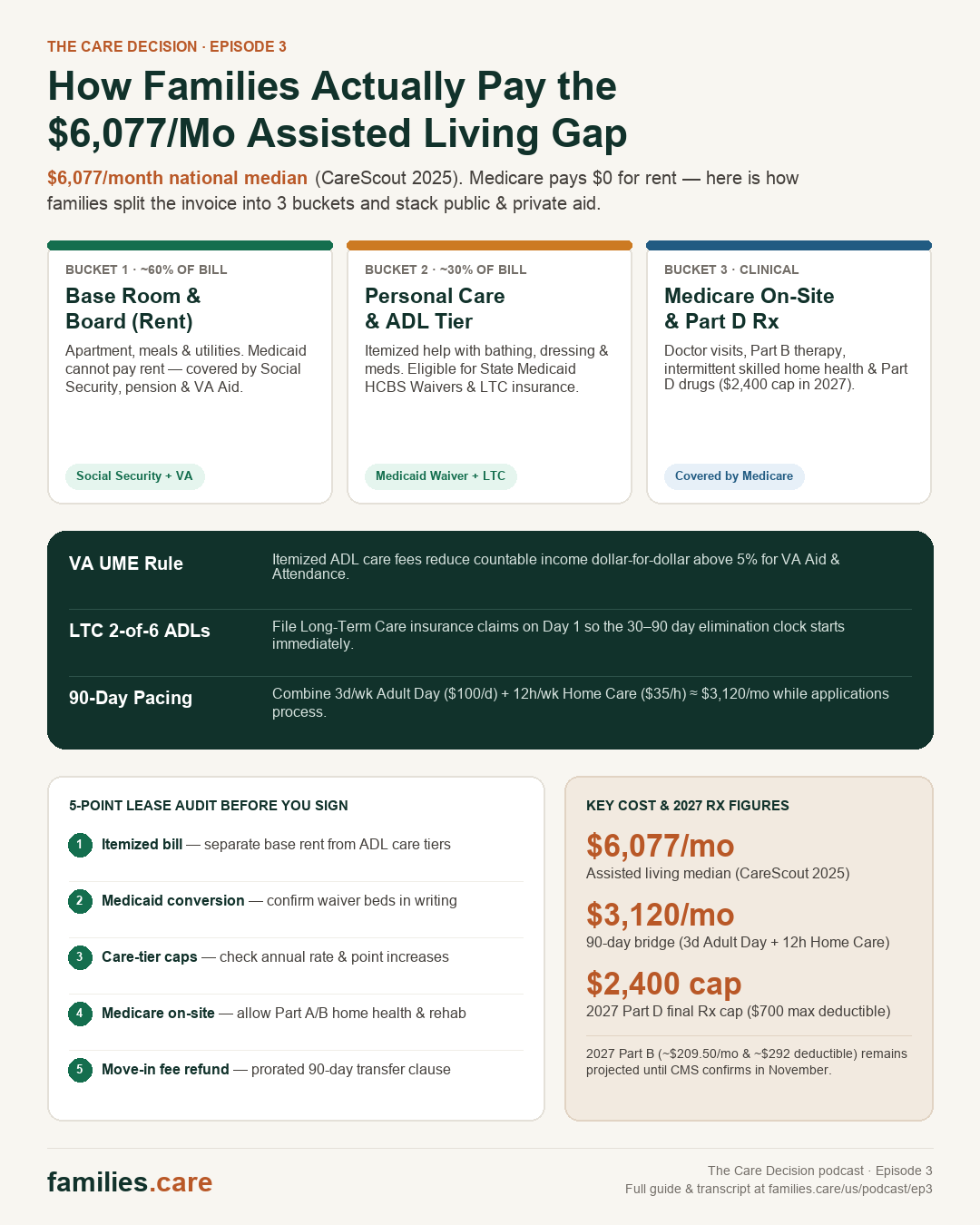
How Families Actually Pay the $6,200/Month Assisted Living Gap
Once you know what assisted living or memory care costs in your parent’s city, the next question is how to pay the gap between Social Security ($2,071/mo average) and the monthly community invoice ($6,200/mo national median). Episode 3 breaks the invoice into Room & Board, Personal Care, and Clinical Care so you can stack Medicaid HCBS waivers, VA Aid & Attendance (up to $2,874/mo), and Medicare Part B without leaving benefits on the table.
🎙️ Read Episode 3 Opening Excerpt (Maya & Daniel: The Six Doors & 3-Bucket Split) Read excerpt ↓
Daniel: In Episode Two we priced the memory care and assisted living bill honestly. Now comes the kitchen-table question: when the monthly bill is six thousand dollars and Social Security is two thousand, how do families actually pay the four-thousand-dollar gap?
Maya: By refusing to treat the invoice as one single bill. Every assisted living or memory care invoice is actually three bills stapled together: Bucket One is Room and Board, Bucket Two is Personal Care and Supervision, and Bucket Three is Medical and Clinical Care. No single program pays all three — and knowing which door pays which bucket is how families survive the math.
Daniel: Including the rule that surprises almost everyone applying for a state Medicaid waiver: even when your parent qualifies for an Assisted Living Medicaid Waiver, federal law generally prohibits Medicaid from paying the Room and Board bucket.
🧮 Open Interactive 3-Bucket Monthly Gap & Six-Doors Benefit Calculator (Ep 3 · Printable) Expand ↓
3-Bucket Monthly Gap & Six-Doors Benefit Stacker
Split the community quote into Room & Board (Bucket 1) and Personal Care/ADLs (Bucket 2) to see how Social Security, VA Aid & Attendance, LTC insurance, and state Medicaid HCBS waivers reduce your net monthly gap.
Net Monthly Family Gap (After Benefits)
$4,129/mo
Total Invoice: $6,200/mo · Covered: $2,071/mo
90-Day Elimination / Approval Bridge
$12,387
Home Care + Adult Day pacing ($3,120/mo) saves $9,240 over 90d
24-Month Net Family Out-of-Pocket
$99,096
Bucket 3 Clinical & Part D ($2,400 Rx cap) stays on Medicare
Was this episode helpful for your family’s decision?
Anonymous 1–5 star rating · Helps families find the clearest guides first.
Turn This Episode Into Your Local Plan
National averages only tell half the story. Check the exact figures, Medicaid waiver rules, and verified communities in your parent’s state and city.
Cost Calculator
Compare Local Care Costs by State & City
See CareScout 2025 assisted living medians and estimated memory care rates in your area.
Provider Directory
Search Verified Local Communities
Filter assisted living, memory care, and skilled nursing near your parent’s ZIP or city.
State & Federal Guides
Medicare, Medicaid & Care Checklists
Step-by-step written guides grounded in CMS rules and state Medicaid statutes.
Full transcript (the recording script)
This is the production script reproduced verbatim, exactly as recorded.
Maya: A quick note before we begin. This episode uses A I generated voices. The script was researched, written, and fact checked by the families dot care team, and the figures in it come from official sources.
Daniel: Maya, I want to start with a search. It is the search thousands of families run at a kitchen table, usually late at night, usually right after a diagnosis or a fall. They type: how much does memory care cost?
Maya: And they get an answer. Every website gives them a number. A single, confident number.
Daniel: So what is wrong with the number?
Maya: It does not officially exist. The benchmark survey everyone cites, the CareScout Cost of Care Survey, publishes a national median for assisted living. It does not survey memory care separately. There is no official national price for memory care. What exists is a base rate, and then a stack of adjustments on top of it. Today, we name the whole stack.
Daniel: And the wrong number is not harmless. A family budgets around the first figure they find. Then they tour a community, and the quote comes back higher, sometimes much higher, and they assume they are being taken advantage of.
Maya: When usually, nobody has lied to them. The first number was never a price. It was somebody's estimate of a base rate, with the stack quietly left off. The quote is the base rate with the stack put back on. Both numbers can be honest, and the gap between them can still be thousands of dollars a month. That gap is what today is for.
Daniel: Which is the promise we made at the end of our first episode, so let us keep it properly. Welcome to The Care Decision, the families dot care podcast, where we take one real decision that families face with an aging parent, and we answer it all the way through. I am Daniel.
Maya: And I am Maya. Today's decision is this one: given a quote from a memory care community, how does a family know what the real monthly number will be, and which parts of it they can still influence before signing?
Daniel: And a note on how we will handle numbers today. Every figure we use comes from the sources we name as we go, and when a figure is an estimate, or one private company's data, we will say so in the same breath. If we do not give a number, it is because a number we can stand behind does not exist.
Daniel: Start with the base rate, then. What do we actually know from the survey itself?
Maya: The CareScout Cost of Care Survey for twenty twenty-five, CareScout is the name on it now, though many families know it as the old Genworth survey, was fielded between July and November of twenty twenty-five and published in March of twenty twenty-six, from about sixteen thousand completed surveys. Its national median for assisted living is six thousand two hundred dollars a month. That is seventy-four thousand four hundred dollars a year, and that median rose five percent from the year before.
Daniel: And memory care sits on top of that base how?
Maya: As a premium. Memory care typically runs twenty to thirty percent above the same community's assisted living rate. Same building, same dining room. The difference is care. A memory care floor needs more staff per resident, it is a secured unit so residents cannot wander into danger, and the staff have dementia-specific training. That is what the premium buys.
Daniel: And that premium model is not just our description of the market. It is how the estimates families actually see are built, including ours.
Maya: It is. Our own state cost reports at families dot care take the CareScout assisted living figures and apply exactly this premium to estimate memory care, because there is no separate memory care survey to quote instead. When you see an estimated memory care figure on our site, that is the machinery underneath it: a measured base, plus an estimated premium. Measured, plus estimated. Knowing which half of any number is which is most of today's lesson.
Daniel: Is there anything that pins the premium down tighter than a range?
Maya: Only private data, and we label it as such. A Place for Mom, the large referral service, puts its twenty twenty-six medians at five thousand four hundred nineteen dollars for assisted living and six thousand six hundred ninety dollars for memory care. Do the division, and the premium inside their data is about twenty-three percent, inside that twenty to thirty range. But be clear about what that is: one company's figures, not an official statistic. The official statistic for memory care does not exist, which is the whole point of this episode.
Daniel: Meanwhile, the same survey does give us the neighbouring numbers, and those matter for comparison.
Maya: They do. A semi-private room in a nursing home: nine thousand five hundred eighty-one dollars a month. A private room: ten thousand seven hundred ninety-eight dollars. Adult day health care runs about ninety-five dollars a day. And a non-medical home caregiver is about thirty-five dollars an hour, which sounds gentle until a family prices what round-the-clock help at home would actually take, and does that multiplication themselves.
Daniel: Those anchors matter because families rarely choose memory care in a vacuum. They are choosing between the secured floor, a nursing home they hope to avoid, and staying home with help coming in. The survey prices all three honestly, and the honest comparison is unflattering to every option, which is sort of the point. Care is expensive in every setting. The settings just bill it differently.
Daniel: Now the part that makes every national number wobble: geography.
Maya: Enormously. Assisted living medians run from roughly four thousand four hundred dollars a month in Mississippi to about nine thousand six hundred in Massachusetts, and around twelve thousand in Hawaii. And here is a local example from our own state cost reports at families dot care, which are built on the CareScout data. In New Hampshire, assisted living runs eight thousand twenty-five dollars a month, and the estimated memory care figure, using that same premium model, is ten thousand thirty-one dollars a month.
Daniel: So two families, same diagnosis, same level of care, can face figures thousands of dollars apart purely because of a state line.
Maya: Purely because of a state line, yes. Which is why every national figure in this episode should be read as a starting point for a local question, never as the answer to it.
Daniel: So the base rate is local, the premium is a range, and the real bill is a stack. Which brings us to the stack itself.
Maya: Ten things move the price. We will take them in three groups: what the community assesses, what the family chooses, and what time does.
Daniel: Group one, the assessed. Number one?
Maya: The level-of-care tier. Communities do not price your parent; they price an assessment. Staff score how much help your parent needs, and that score lands them in a care tier. Points or levels, every community has its own ladder. The brochure quotes the front door. The assessment sets the bill. And moving up one tier in the middle of a stay is the most common price jump families do not expect. The assessment is not a one-time event, either. Communities reassess: after a hospital stay, after a fall, after a change the staff can see. Every reassessment is a chance for the tier, and the bill, to move.
Daniel: Two.
Maya: Medication management. In many communities it is a separate monthly line, not folded into the tier. More medications, and more times a day someone has to administer them, means a higher fee. A parent who arrives managing their own pills, and later cannot, is a parent whose bill just changed. It is also one of the easiest lines to price before you sign, because a medication list is a piece of paper. Bring the list. Ask what managing exactly that list costs, per month, at this community.
Daniel: Three.
Maya: Incontinence care. Supplies plus staff time, and it is frequently tiered on its own. It is rarely the first number in the brochure, and often one of the first additions to the invoice. Families are sometimes embarrassed to ask about it in a sales office. Ask anyway. It is a standard line, the staff price it every day, and a surprise on the invoice helps no one.
Daniel: Four.
Maya: Mobility and transfers. Can your parent move from bed to chair with one person steadying them, or does it take two staff members? Do they need wheelchair support? And notice the trigger hiding inside this one: a fall can move a resident up a tier overnight, and the bill follows the tier. This is also why two residents in identical apartments, on the same corridor, can pay noticeably different monthly bills. The rooms match. The help does not.
Daniel: Five.
Maya: The everyday activities: bathing, dressing, grooming. How often, and with how much help. Those counts feed straight into the tier we started with. Group one, in one sentence: the community is not really charging for the room your parent sleeps in. It is charging for the hours of human help your parent needs, and it re-measures those hours as needs change.
Daniel: So group one is the part of the bill a family cannot negotiate down, because it is measured off the person.
Maya: Measured, yes, but not beyond influence, and never beyond inspection. What a family can do is see it clearly: ask how the assessment works, when it is repeated, and what it showed. An unexplained tier is a bill you cannot plan around. An explained one, you can.
Daniel: Group two, what the family chooses. Six.
Maya: The secured unit itself. Choosing memory care means choosing that floor, and the floor carries the twenty to thirty percent premium from earlier in this episode. Families sometimes set a memory care quote beside a cheaper assisted living quote and treat the difference as markup. It is not markup. It is staffing ratios, wander management, and specialized programming. Whether a parent needs that floor is a care question. But the premium is the price of the setting, and it belongs in the comparison honestly. And notice what the premium is mostly buying: people. More staff per resident, awake and trained for the specific ways dementia goes wrong at three in the morning. That is expensive because people are expensive, and it does not get cheaper by being quoted in smaller type.
Daniel: Seven.
Maya: The apartment. Studio or one-bedroom. Private or shared. A shared room is the biggest single lever a family controls at move-in. Everything in group one is assessed; this one is picked off a floor plan, and it can be worth more than any negotiation over the care lines. It also runs in both directions. A family can choose the smaller apartment on purpose, bank the difference, and hold it against the increases that group three is about to describe. That is a real strategy, and it is available on day one, before any assessment.
Daniel: Eight.
Maya: The pricing model. Some communities are all-inclusive: one number, most care inside it. Others quote a low base rate and bill a la carte, line by line. Here is the sentence to remember: the cheaper brochure rate is often the more expensive real bill. A low base with a stack of add-ons can pass an honest all-inclusive price, especially once group one starts moving. Neither model is dishonest. All-inclusive prices certainty; a la carte prices flexibility. The failure mode is signing an a la carte contract while budgeting as if it were all-inclusive. Read the contract you actually have.
Daniel: Group three, what time does. Nine.
Maya: Fees and increases. There is usually a one-time community fee at move-in, often around one month's rent. And rates rise. Remember the survey: the national assisted living median itself rose five percent in a single year. We are not promising your community raises five percent; nobody can promise a rate in either direction. We are saying: expect the number to move, and plan on movement, because standing still is the one outcome the history does not support. Ask the question directly: what did existing residents' rates do last year? Not the advertised rate for new residents. The increase applied to the people already living there. That answer goes into the checklist at the end of this episode, because it belongs in writing too.
Daniel: And ten.
Maya: How long. A monthly number feels survivable. The same number multiplied by a multi-year stay is the real planning figure. Nobody knows the length of a stay in advance, and anyone who quotes you one is guessing. But the multiplication itself is not optional. Do it. We will do it once, on published figures, in just a moment. One more thing about length of stay. Families often plan around the stay they hope for, which is the short one. Planning is not hoping. Run the monthly figure at two years as well as at six months, and look at both numbers before you sign.
Daniel: Time to do the arithmetic on one family, carefully. With a warning label.
Maya: A clear one. The family you are about to hear is illustrative: invented people, real figures. Every number in this example comes from the data we have already cited in this episode. And the parts no survey can price, we will say so, instead of inventing them.
Daniel: Set the scene.
Maya: A daughter is touring a community for her mother, who has mid-stage dementia and can no longer live alone safely. The community's assisted living apartments sit right at the level of A Place for Mom's twenty twenty-six median: five thousand four hundred nineteen dollars a month. Her mother, though, needs the secured memory care floor in the same building. That floor, at the median in the same data, is six thousand six hundred ninety dollars a month. Same building. That gap, about twenty-three percent, is the secured unit premium, and it arrives before a single personal detail about her mother is discussed.
Daniel: Then the assessment happens.
Maya: Then the assessment happens. Her mother needs hands-on help with bathing and dressing, and the community will manage her medications. Two consequences. First, she is placed in a care tier above the entry tier: group one, doing exactly what group one does. Second, medication management appears as its own line. Now, honesty about the next sentence: no survey publishes what those two lines cost, because every community prices its own tiers. So we will not invent them. What we can say is that her real monthly total starts at six thousand six hundred ninety dollars, and the tier and the medication line push it up from there, by amounts the community can, and should, give her in writing.
Daniel: And then the length of stay turns a monthly number into the planning number.
Maya: Even on the floor figure alone, six thousand six hundred ninety dollars, no increases, no tier changes, nothing going wrong, twenty-four months comes to one hundred sixty thousand five hundred sixty dollars. That is the arithmetic that belongs on the kitchen table next to the brochure. Not to frighten anyone. Because a family that has seen the two-year figure makes different choices in group two, the apartment and the pricing model, than a family still looking at the monthly one.
Daniel: Say the annual version too, because some families think in years.
Maya: One year at that floor figure is eighty thousand two hundred eighty dollars. And remember, that is the floor: before the tier she was actually assessed into, before the medication line, before any annual increase from group three. The brochure number was five thousand four hundred nineteen a month. The planning number is north of eighty thousand a year. Same building, same mother. The distance between those two numbers is exactly the stack we just spent ten items naming.
Daniel: Every family in this conversation eventually asks the same hopeful question. Does Medicare cover any of this?
Maya: It does not, and it is better to hear it plainly here than at a billing desk. Medicare does not pay for long-term custodial care. Memory care's core cost is room, board, and supervision, and that is exactly the part Medicare excludes. Medicare pays for medical care: doctors, hospitals, short skilled stays. It does not pay for the years of daily supervision that dementia requires.
Daniel: And this season there is a newer program families keep hearing about, GUIDE, and a specific trap in it for exactly our listeners.
Maya: There is. We verified this against C M S's own pages, and we are not going to soften it. As of July twenty twenty-six, people living in a memory care unit are not eligible for the GUIDE program. And assisted living residents who do qualify for GUIDE are not eligible for its respite funding. So GUIDE's respite help, up to two thousand five hundred dollars a year, generally does not reach memory care residents. If a salesperson, or a well-meaning neighbour, tells a memory care family that GUIDE will offset the bill, that is not what the program's own rules say.
Daniel: So a memory care family that has quietly budgeted that respite money into the plan is budgeting money they will not see.
Maya: That is exactly right, and it is why we are spending a full beat of this episode on a program most of our listeners will never use. The gap between what families have heard about GUIDE and what its rules actually say is widest precisely for memory care families, the people least able to absorb a budgeting mistake.
Daniel: Which raises the obvious question: what does pay? That is a whole episode of doors, and it is literally our next episode. For now, the written Funding Care guide at families dot care walks through the doors that do exist.
Maya: And one cross-reference, because it is still Medicare open enrollment season until December seventh. If you are also mid-plan-switch for a parent, Episode One is the checklist for that decision. Different bill, different episode.
Maya: So here is the checklist we would hand our own families: five questions to ask a memory care community before signing anything. Question one: what tier is my parent in today, and exactly what triggers the next tier up? Get the triggers, not just the tiers. The tier is where the most common unexpected jump lives, so the triggers are the part that matters.
Daniel: Question two: what is included in this rate, and what is a la carte? If the answer lives in a brochure, ask for it as a list. Remember mover eight: the cheaper brochure rate is often the more expensive real bill, and this question is how you find out which kind of contract you are actually being offered.
Maya: Question three: medication management and incontinence care, how are they priced, and can I see that pricing in writing? The two lines from our worked example. In writing is the operative phrase. These are the two add-on lines from the worked example, the ones no survey can price for you. Only the community can, so the community is who you ask.
Daniel: Question four: what was last year's rate increase, in percent? A community that answers plainly is telling you something about every future answer. The national median itself rose five percent in a year. Your community's own number is the one that will apply to your parent, so it is the one to get.
Maya: And question five, the one that turns a quote into a plan: what is the total cost of a two-year stay, at the next tier up from today's? Not today's tier. The next one. That is the number your family's savings actually have to survive.
Daniel: That is the real shape of the price: a local base, a premium for the secured floor, a stack of assessed care on top, and time multiplying all of it.
Maya: And none of it required an official average that does not exist. A base you can look up, a premium you can put a range on, and a stack you can itemise before you sign.
Maya: And the question underneath this one is the one we have promised for next time. Next time, we take on how families actually pay for care: the six doors. Private pay, long-term care insurance, Medicaid, veterans' benefits, home equity, and public programs, and which door fits which family.
Daniel: The written version of today's checklist is at families dot care, together with our memory care cost guide and the Funding Care guide.
Maya: That is our second episode. The Care Decision is about one decision, answered properly, every time. I am Maya.
Daniel: And I am Daniel. Thanks for listening, and get the tier pricing in writing.