
Medicare Doesn’t Pay for Assisted Living. Here’s What Actually Does (The Care Decision · Ep 2)
Expertly Reviewed by Luis Diaz Sendel, Founder, families.care
Updated on October 15, 2026
Key Takeaways
Medicare pays $0 for assisted living room and board ($6,077/mo median). Compare the 4 real funding bridges: Medicaid waivers, VA Aid & Attendance, LTC policies, and clinical layering.
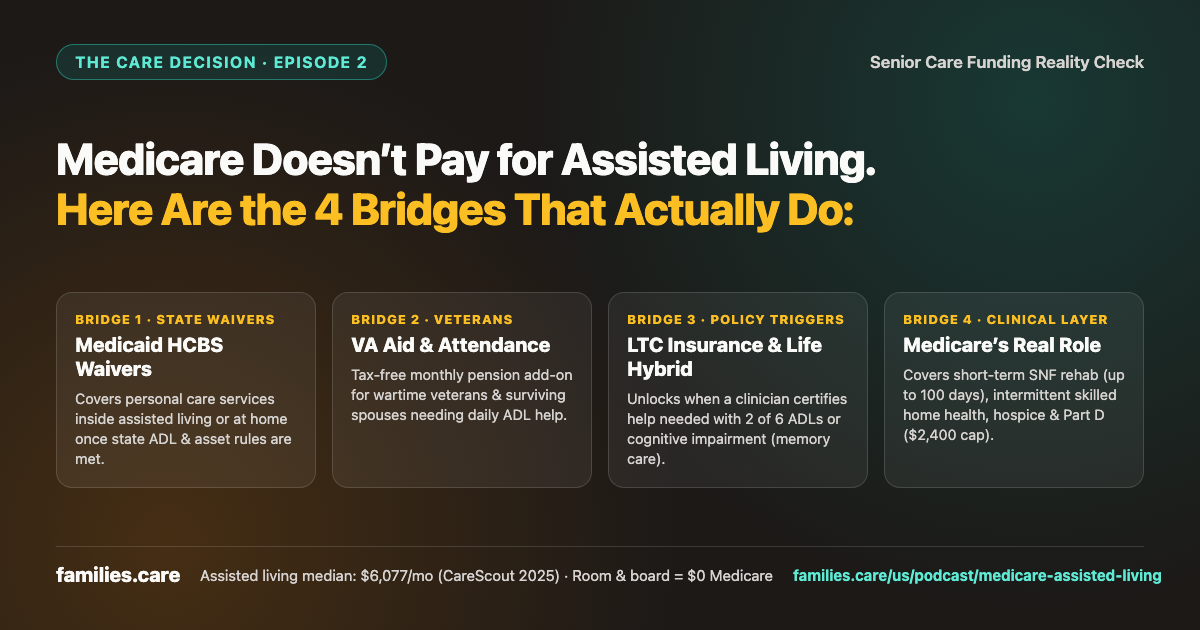
One of the most expensive surprises in family caregiving happens when a parent needs assisted living or memory care and the family discovers that Medicare pays $0 toward monthly room and board (which carries a $6,077/month national median in the CareScout 2025 Cost of Care Survey). Episode 2 of The Care Decision separates what Medicare actually covers from what it never covers — and walks through the four real funding bridges families combine to pay for assisted living, memory care, and ongoing home care.
The Care Decision · Episode 2 Companion Guide & Transcript
This companion page publishes the Episode 2 visual funding guide and full 5-segment transcript. Host-recorded audio will be added once final casting is complete.[1]
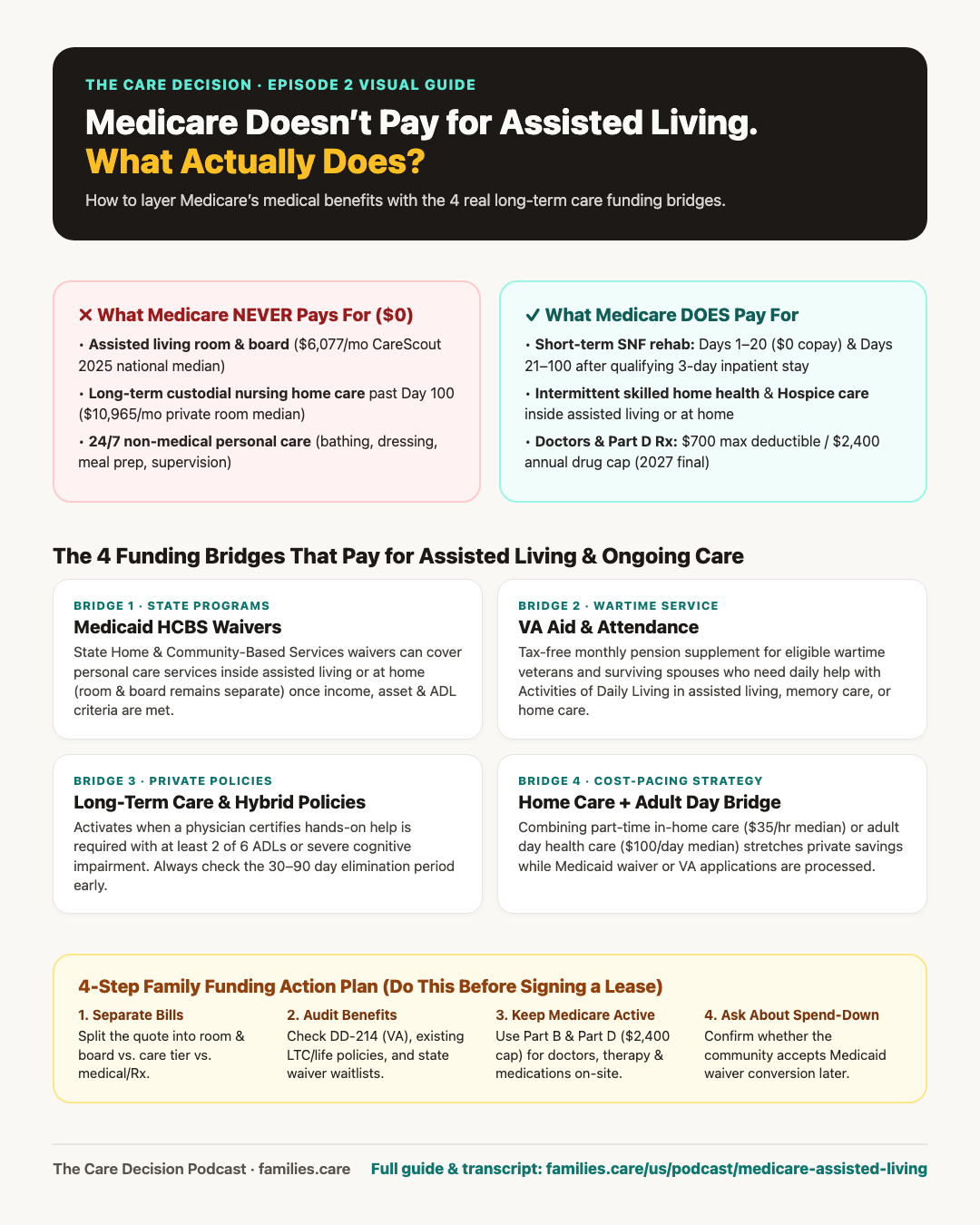
Episode 2 Visual Guide: What Medicare Covers vs. The 4 Funding Bridges
Save or print the Episode 2 visual breakdown below before touring an assisted living community or reviewing a monthly care contract.
1. The Boundary Line: Medical Recovery vs. Daily Custodial Living
Federal Medicare law draws a strict line between short-term clinical care (which Medicare covers) and ongoing custodial care and housing (which Medicare excludes):
- What Medicare NEVER Pays For ($0): Monthly assisted living rent and board ($6,077/month national median), memory care housing, long-term custodial nursing home stays after Day 100 ($10,965/month private room national median), and ongoing non-medical personal care (help with bathing, dressing, meal preparation, or medication reminders).
- What Medicare DOES Pay For: Short-term Skilled Nursing Facility (SNF) rehabilitation for up to 100 days per benefit period after a qualifying 3-day inpatient hospital stay (Days 1–20 at $0 coinsurance; Days 21–100 subject to daily Part A coinsurance), intermittent skilled home health nursing and therapy ordered by a physician, the Medicare Hospice Benefit, and ongoing Part B doctor visits and Part D prescription medications (subject to the finalized 2027 Part D parameters of a $700 max deductible and $2,400 annual out-of-pocket cap) even while your parent lives in an assisted living community.
2. The 4 Funding Bridges That Actually Pay for Assisted Living & Ongoing Care
Because Medicare only covers the clinical layer, families typically combine four funding bridges to cover monthly care costs:
- Bridge 1 — State Medicaid HCBS Waivers (1915(c) / 1115): While federal Medicaid does not pay the pure room-and-board portion of an assisted living bill, most states operate Home and Community-Based Services (HCBS) waivers that pay for the personal care and supportive services tier inside participating assisted living communities or at home once a resident meets state clinical (ADL) and financial eligibility rules.
- Bridge 2 — VA Aid & Attendance Pension Supplement: Wartime veterans (and surviving spouses) who require daily assistance with Activities of Daily Living or are housebound may qualify for the tax-free VA Aid & Attendance monthly pension supplement, which can be applied directly toward assisted living, memory care, or in-home care invoices.
- Bridge 3 — Long-Term Care Insurance & Hybrid Life Policies: Traditional long-term care policies and life-insurance policies with chronic-illness or LTC riders activate when a licensed clinician certifies that the insured needs hands-on assistance with at least 2 of 6 Activities of Daily Living (ADLs) — bathing, dressing, toileting, transferring, continence, or eating — or has severe cognitive impairment. Families should file the claim as soon as care starts so the 30-to-90-day elimination clock begins ticking immediately.
- Bridge 4 — Home Care + Adult Day Pacing Bridge: Because VA Aid & Attendance and state Medicaid waiver applications can take several months to process, families often pair part-time in-home care ($35/hour national median) with adult day health services ($100/day national median) to preserve private savings during the application window.
3. 4-Step Family Funding Action Plan Before Signing a Community Lease
- Separate the Quote into Three Buckets: Ask the community to itemize base room & board, personal care tier fees, and medication management so you know which dollars Medicaid waivers, VA benefits, or LTC insurance can reimburse.
- Audit Existing Benefits on Day 1: Locate discharge papers (DD-214) for VA eligibility, pull any older life or long-term care insurance contracts, and check state Medicaid waiver waitlists before private funds run low.
- Keep Medicare Working Inside the Community: When a resident in assisted living experiences a fall, illness, or decline, ask the primary care physician to order Medicare Part B outpatient therapy or intermittent Part A/B skilled home health on-site — and verify all prescriptions against the 2027 Part D $2,400 annual cap during Open Enrollment (October 15 – December 7, 2026).
- Ask the Medicaid Conversion Question Up Front: Before moving in, ask in writing whether the community accepts state Medicaid waiver conversion after a private-pay period (and how many waiver beds are allocated).
4. Episode 2 Full Transcript
Segment 1 — The $6,077-a-Month Surprise
It is the single most common sentence we hear from adult children touring an assisted living community for the first time: "Mom has Medicare and a great supplement — doesn't that cover this?" The answer is no. Across the United States, the median cost of an assisted living community is $6,077 a month according to the CareScout 2025 Cost of Care Survey, and Original Medicare and Medicare Advantage pay $0 toward assisted living rent and room and board. Understanding why — and knowing which four programs actually do pay — can save a family tens of thousands of dollars.
Segment 2 — What Medicare Actually Pays For Inside Assisted Living
Saying Medicare doesn't pay for assisted living doesn't mean your parent's Medicare card stops working when they move in. Medicare still pays for doctor visits, specialist care, hospital stays, medical equipment, and prescription drugs under Part D — where for 2027, CMS has finalized a $700 maximum standard deductible and a $2,400 annual out-of-pocket cap on covered medications. Even more importantly, if your parent has a qualifying three-day inpatient hospital stay, Medicare Part A covers up to 100 days of skilled nursing rehab. And if your parent lives in assisted living and needs intermittent skilled nursing, physical therapy, or speech therapy ordered by a doctor, Medicare home health can come right into their assisted living apartment at $0 copay for the clinical visits.
Segment 3 — Bridge 1 & Bridge 2: Medicaid HCBS Waivers and VA Aid & Attendance
So how do families pay for the personal care and housing side of the bill? Bridge 1 is a state Medicaid Home and Community-Based Services waiver. While Medicaid won't pay the pure room-and-board rent in assisted living, most states have waiver programs that pay the daily personal-care service fee for residents who meet clinical and financial rules. Bridge 2 is VA Aid and Attendance — a tax-free monthly pension add-on for wartime veterans and surviving spouses who need daily help with dressing, bathing, or medication management. Many families don't realize a surviving spouse of a wartime veteran can qualify even if the veteran never used VA health care.
Segment 4 — Bridge 3 & Bridge 4: Long-Term Care Policies and Cost Pacing
Bridge 3 is private long-term care insurance or a hybrid life-insurance policy with a chronic-illness rider. Those policies unlock when a doctor certifies that your parent needs hands-on help with at least two of the six Activities of Daily Living — or has cognitive impairment requiring supervision, such as Alzheimer's disease. Because most policies have a 30- to 90-day elimination period before checks start arriving, open the claim on day one. Bridge 4 is cost pacing: while a VA or Medicaid waiver application is pending, combining part-time in-home care at a national median of $35 an hour with adult day health care at $100 a day can cut monthly out-of-pocket burn in half until benefits activate.
Segment 5 — The Four Questions to Ask Before You Sign
Before signing any assisted living residency agreement, ask for the bill broken into room and board versus care levels, start VA and LTC claims immediately, review your parent's 2027 Medicare drug and doctor coverage before December 7, and confirm in writing whether the community accepts Medicaid waiver conversion if private savings are spent down later.
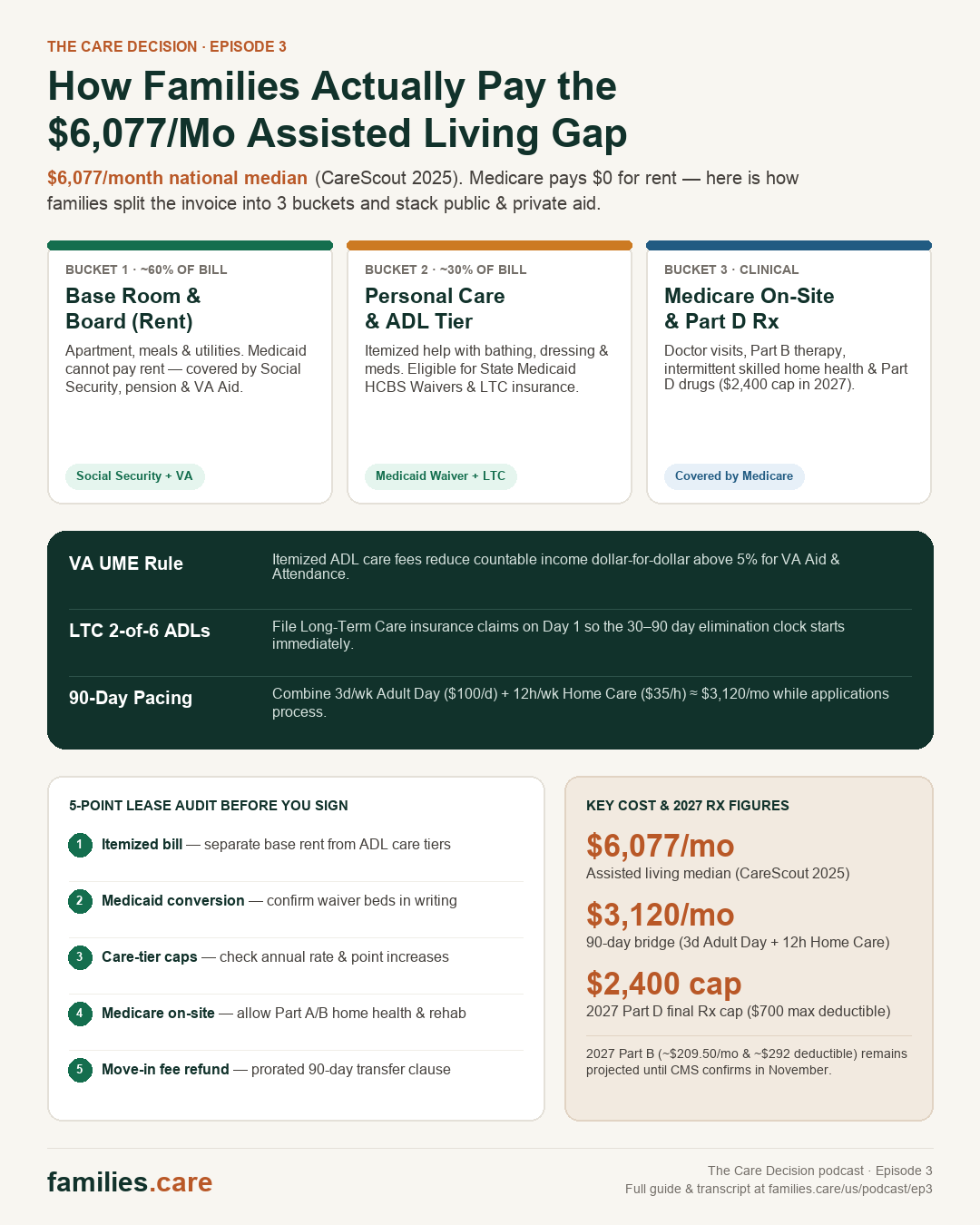
How to Split the $6,077/Month Assisted Living Invoice Into 3 Funding Buckets
When an assisted living community quotes a single bundled rate (around the $6,077/month CareScout 2025 national median), ask the business office to itemize the bill into three distinct buckets: Bucket 1 — Base Room & Board (covered by Social Security, pension, bridge savings, and tax-free VA Aid & Attendance), Bucket 2 — Personal Care & ADL Support Tier (eligible for state Medicaid HCBS waivers, Long-Term Care insurance 2-of-6 ADL triggers, and VA Unreimbursed Medical Expense deductions), and Bucket 3 — Clinical & Prescription Layer (covered on-site by Medicare Part A/B home health and therapy plus Part D drugs under the finalized 2027 $700 max deductible and $2,400 annual out-of-pocket cap). For the full 3-bucket blueprint, 90-day bridge math (~$3,120/mo using 3d/wk Adult Day + 12h/wk Home Care), and 5-point lease audit, read The Care Decision Ep 3: How Families Actually Pay the $6,077/Month Assisted Living Gap.
Related resources on families.care
- The Care Decision Ep 3: How Families Actually Pay the $6,077/Month Assisted Living Gap
- The Care Decision Ep 1: Your Parent's Medicare Plan Is Ending for 2027. Now What?
- Medicare Open Enrollment 2026: Key Dates & Plan-Ending Checklist
- What Medicare Covers in Senior Care Planning
- Medicare vs. Medicaid for Senior Care: Complete Family Guide
- VA Aid & Attendance Benefits for Senior Care
- Senior Care Costs by U.S. State (CareScout 2025 Benchmarks)
Related Articles
Frequently Asked Questions
- Does Medicare pay for assisted living or memory care?
- No. Original Medicare and Medicare Advantage pay $0 toward assisted living or memory care room and board ($6,077/month national median in the CareScout 2025 survey). However, Medicare continues to cover doctor visits, medical equipment, Part D prescription drugs ($700 max deductible and $2,400 out-of-pocket cap for 2027), qualifying short-term skilled nursing rehab (up to 100 days), intermittent skilled home health, and hospice care delivered inside an assisted living community.
- What are the 4 main ways families pay for assisted living when Medicare does not?
- Families typically combine four funding bridges: (1) state Medicaid Home and Community-Based Services (HCBS) waivers that help pay personal care service fees for eligible residents, (2) VA Aid & Attendance tax-free pension supplements for wartime veterans and surviving spouses needing daily ADL help, (3) private Long-Term Care Insurance or hybrid life-insurance policies triggered when a clinician certifies need for help with 2 of 6 ADLs or cognitive impairment, and (4) private-pay cost pacing using part-time in-home care ($35/hr median) and adult day health care ($100/day median) while benefit applications are processed.
Verified references & primary sources
5 verified sourcesQuantitative and regulatory claims in this guide are grounded against official registries and benchmark datasets.
-
Statutory RegistryCareScout · Verified 2026-08-15 · General senior-care planning information.
“Host-recorded audio will be added once final casting is complete.”
-
Statutory RegistryMedicare.gov · Verified 2026-08-15 · General senior-care planning information.
“Federal Medicare law draws a strict line between short-term clinical care (which Medicare covers) and ongoing custodial care and housing (which Medicare exclude…”
-
Statutory RegistryMedicaid.gov · Verified 2026-07-10 · General senior-care planning information.
“Audit Existing Benefits on Day 1: Locate discharge papers (DD-214) for VA eligibility, pull any older life or long-term care insurance contracts, and check stat…”
-
Statutory RegistryNational Institute on Aging · Verified 2026-07-10 · General senior-care planning information.
-
Statutory RegistryU.S. Department of Veterans Affairs · Verified 2026-08-15 · General senior-care planning information.
How we research and verify this information
Our team compiles this listing from public records and provider data, and reviews it against authoritative sources. Read our editorial standards and research methodology.
- Cost of Care Survey (2025)Publisher: CareScout. Supports: General senior-care planning information for this guide. Last checked: 2026-08-15.
- Skilled nursing facility coveragePublisher: Medicare.gov. Supports: General senior-care planning information for this guide. Last checked: 2026-08-15.
- Medicaid coverage and eligibilityPublisher: Medicaid.gov. Supports: General senior-care planning information for this guide. Last checked: 2026-07-10.
- Long-term-care guidance for familiesPublisher: National Institute on Aging. Supports: General senior-care planning information for this guide. Last checked: 2026-07-10.
- VA pension rates (Aid & Attendance)Publisher: U.S. Department of Veterans Affairs. Supports: General senior-care planning information for this guide. Last checked: 2026-08-15.