Saltar al contenido principal
Esta página aún no está disponible en español. Ver en inglés →
families.care
A kind female nurse in scrubs smiling warmly while assisting an older senior couple with an engaging art and games table activity
North Carolina

How to Apply for North Carolina Medicaid: Complete Guide and Forms

North Carolina Medicaid · DHB-5201-ia

Content verified 2026-07-17T00:00:00.000Z

Medicaid Asset Protection & Spend-Down MilestonesGoverned Protocol
160-Month Lookback Guard

All asset transfers and gifts within 5 years are audited under state lookback statutes.

2Exempt vs. Countable Assets

Primary home equity, one vehicle, and personal effects remain protected under community spouse allowances.

3Miller Trust / QIT Path

Excess income in income-cap states is redirected into a Qualified Income Trust to preserve qualification.

Program overview

North Carolina Medicaid provides essential healthcare coverage for low-income individuals and families, including children, pregnant women, parents, seniors, and people with disabilities. NC Medicaid expanded to more people in December 2023, with more information about who is newly eligible and what's covered. The program offers comprehensive medical services through managed care plans and direct fee-for-service coverage.

Eligibility varies by category, but generally includes adults ages 19-64 with family income of $2,351/month or less, and adults ages 65+ with family income of $1,704/month or less for full Medicaid. Income limits are reported as a percentage of the federal poverty level, with 2026 FPL for a family of three at $27,320 and individual FPL at $15,960. Special categories include pregnant women, children, and individuals requiring long-term care services.

North Carolina Medicaid covers a wide range of medical services including doctor visits, hospital care, prescription medications, mental health services, dental care for children, and long-term care services. New NC Medicaid beneficiaries can learn about their health care options and primary care providers, and enroll in a health care option. The program also includes specialized services like non-emergency medical transportation and community-based care alternatives.

When applying, ensure all information is accurate and complete to avoid delays. It can take up to 45 days for the Department of Social Services (DSS) to decide if you qualify for NC Medicaid. Applicants should maintain current contact information and respond promptly to requests for additional documentation. Consider seeking assistance from local Medicaid Ambassadors or NC Navigators who can help guide you through the application process.

Main application form

Application for Health Coverage & Help Paying Costs (Short Form)

Form DHB-5201-ia

Download form

Additional forms

  • Adult Medicaid Application · DMA-5000

    For aged, blind, disabled, or family planning services

  • Medicaid for Families and Children · DMA-5063

    For families and children's Medicaid coverage

  • Application for Health Coverage & Help Paying Costs · DMA-5200

    General health coverage application form
Where to submit

Applications must be submitted to your local county Department of Social Services (DSS) office by mail, in person, fax, or email. Contact your county DSS office or call 1-888-245-0179 to find your local office.

Read guide

Applying for North Carolina Medicaid is easier than you think. You have multiple options: apply online through ePASS with your NCID, visit your local Department of Social Services office, or download and mail the paper application. Single adults without dependents can use the short form DHB-5201-ia, while others may need form DMA-5000 for aged, blind, or disabled categories. Income limits vary, but many working families qualify. Gather documents like Social Security cards, proof of income, and residency verification. The process takes up to 45 days, but coverage can be retroactive up to three months. Need help? Call 1-888-245-0179 or visit your local DSS office. North Carolina expanded Medicaid in 2023, so more people qualify than ever before. Don't wait - healthcare coverage could be more affordable than you expect.

Official resources

Related guides

Frequently Asked Questions

How do I apply for North Carolina Medicaid in North Carolina?

To apply for North Carolina Medicaid in North Carolina, complete Application for Health Coverage & Help Paying Costs (Short Form) (DHB-5201-ia), then submit it to Applications must be submitted to your local county Department of Social Services (DSS) office by mail, in person, fax, or email. Contact your county DSS office or call 1-888-245-0179 to find your local office..

What documents do I need to apply for North Carolina Medicaid in North Carolina?

You typically need to provide: Social Security card or documentation, Birth certificate or proof of age, Proof of North Carolina residency, Photo identification (driver's license or state ID), Proof of income (paystubs, W-2 forms, tax returns), Bank statements and asset verification, Health insurance policy information (if any), Immigration status documentation (if applicable), Medical bills and expenses, Disability determination letter (if applicable), Marriage certificate (if applicable), Proof of child support or alimony payments.

Where do I submit my North Carolina Medicaid application in North Carolina?

Submit your completed North Carolina Medicaid application to Applications must be submitted to your local county Department of Social Services (DSS) office by mail, in person, fax, or email. Contact your county DSS office or call 1-888-245-0179 to find your local office..

What is the main application form for North Carolina Medicaid in North Carolina?

The primary application form is Application for Health Coverage & Help Paying Costs (Short Form) (DHB-5201-ia). Download it from the official state website: https://policies.ncdhhs.gov/wp-content/uploads/DHB-5201-ia.pdf

Where can I find official information about North Carolina Medicaid in North Carolina?

Official information and application resources are available at NC Medicaid — How to Apply: https://medicaid.ncdhhs.gov/apply

How we research and verify this information

Our team compiles this listing from public records and provider data, and reviews it against authoritative sources. Read our editorial standards and research methodology.

Editorial review by John Richie, Senior Care Research Editor.

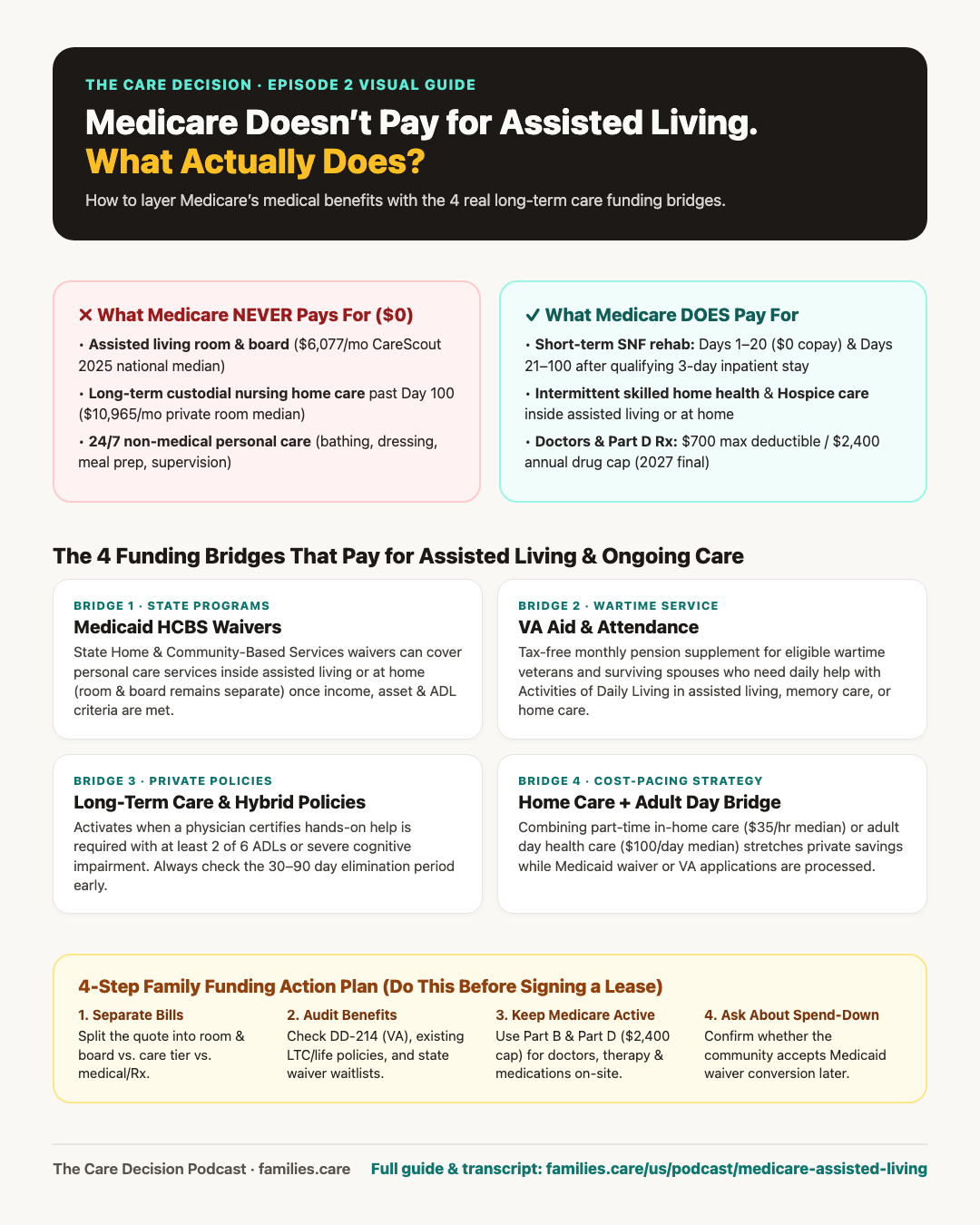
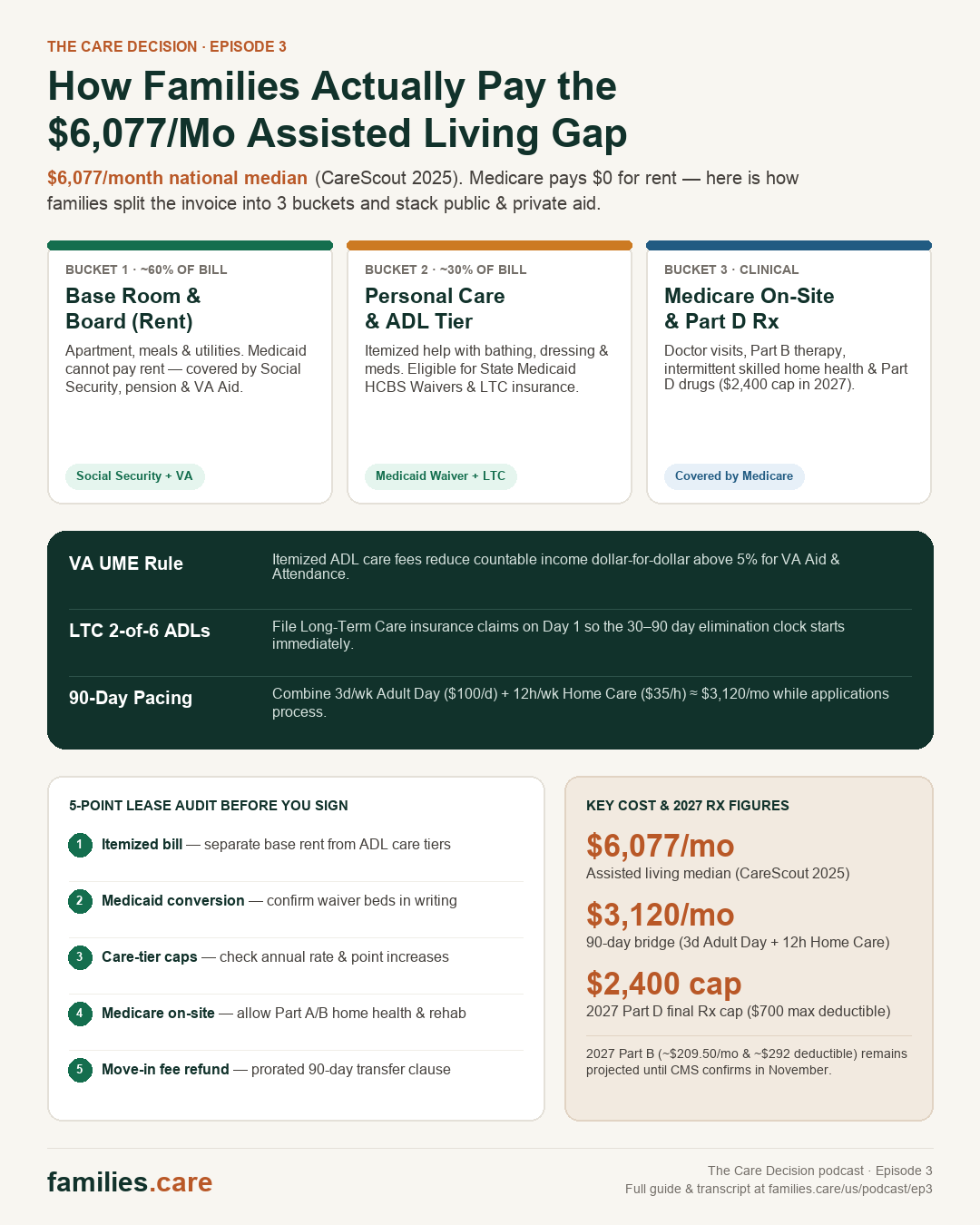
The Care Decision Podcast · Episode 2 & Printable Cost Checklists

Real Care Cost Breakdown: Audio Guide & Printable Tour Checklists

Base rent is rarely the final monthly invoice. Stream Episode 2 (19 min) or click either reference card below to zoom, save, or print our tour pricing checklist and 3-bucket invoice funding blueprint.

The Care Decision podcast cover art

Episode 02 · 19:21 · Hosted by Maya & Daniel

What Does Memory Care Actually Cost?

Assisted living base rent ($5,900–$6,250/mo) vs. memory care ($6,500–$8,500+/mo), level-of-care add-ons, and tour questions.

Tour Pricing Checklist · Ep 2 Assisted Living vs. Memory Care Cost Breakdown (Ep 2)
Save PNG
Funding Stack Blueprint · Ep 3 The 3-Bucket Invoice Split ($6,200/mo Gap · Ep 3)
Save PNG
📝 Open Interactive 5-Question Facility Tour Worksheet & 24-Month Calculator (Printable) Expand ↓
Interactive Facility Tour Scorecard

5-Question Tour Worksheet & 24-Month Survival Calculator

Fill in the numbers quoted during your tour to calculate the 2-year total at the next care tier up, then print a 1-page scorecard.

Day-1 Monthly (Base + Meds)

$7,140/mo

Year-2 Monthly (Next Tier Up)

$8,390/mo

24-Month Total at Next Tier Up

$199,774

🧮 Open Interactive 3-Bucket Monthly Gap & Six-Doors Benefit Calculator (Ep 3 · Printable) Expand ↓
Interactive 3-Bucket Funding Stack · Ep 3

3-Bucket Monthly Gap & Six-Doors Benefit Stacker

Split the community quote into Room & Board (Bucket 1) and Personal Care/ADLs (Bucket 2) to see how Social Security, VA Aid & Attendance, LTC insurance, and state Medicaid HCBS waivers reduce your net monthly gap.

Net Monthly Family Gap (After Benefits)

$4,129/mo

Total Invoice: $6,200/mo · Covered: $2,071/mo

90-Day Elimination / Approval Bridge

$12,387

Home Care + Adult Day pacing ($3,120/mo) saves $9,240 over 90d

24-Month Net Family Out-of-Pocket

$99,096

Bucket 3 Clinical & Part D ($2,400 Rx cap) stays on Medicare

Card 1 / 1

Printable Family Reference Card

⬇ Save PNG