
The Care Decision
One real decision families face with an aging parent, answered all the way through.
Built for families making local care decisions — combining 50-state Medicaid rules, county Medicare Advantage plan changes, 48-hour hospital discharge rights, and CareScout 2025 local cost medians with printable kitchen-table checklists.

4-Part Decision Curriculum
Start Where Your Family Is Today
Medicare Plan Exits & 63-Day Medigap
What Memory Care Actually Costs
Paying the $6,200/mo Assisted Living Gap
48-Hour Hospital Discharge & SNF Vetting
Episodes & Decision Playbooks
4 audio episodes with companion playbooks · Ordered newest first
-
3-Midnight Inpatient RuleBFCC-QIO Discharge AppealCMS 5-Star Inspection & Staffing
Episode 4: The 48-Hour Hospital Discharge & CMS Five-Star Nursing Home Playbook
When a hospital discharge planner hands your family a list of five skilled nursing facilities on a Thursday afternoon with 48 hours to choose, panic sets in. In Episode 4, Maya and Daniel walk through the exact hospital discharge survival playbook: (1) The 3-Midnight Inpatient Trap: why hospital observation status voids Medicare Part A rehab coverage entirely ($0 paid by Medicare; leaving families with $9,581+/mo nursing home bills), (2) The MOON Notice & Medicare Advantage prior auth rules, (3) The BFCC-QIO Fast Appeal: how calling the phone number on the Important Message from Medicare by the notice deadline before leaving the hospital triggers an independent medical review (pausing non-covered inpatient hospital charges while standard Medicare deductibles and coinsurance may still apply), (4) CMS Five-Star Vetting in 20 Minutes: why to prioritize unannounced Health Inspection Stars (and G–L harm citations) and PBJ RN staffing hours/turnover over self-reported Quality Measures, (5) The 5 PM Shift-Change Walk-In Test and Friday pharmacy rule, and (6) The 5-Step Survival Checklist.
Jump to chapter:
Printable Reference Cards in This Episode (Click to Enlarge):
-
3-Bucket Invoice SplitVA Aid & AttendanceMedicaid HCBS Waivers
Episode 3: How Families Actually Pay for Assisted Living & Memory Care: The Six Doors
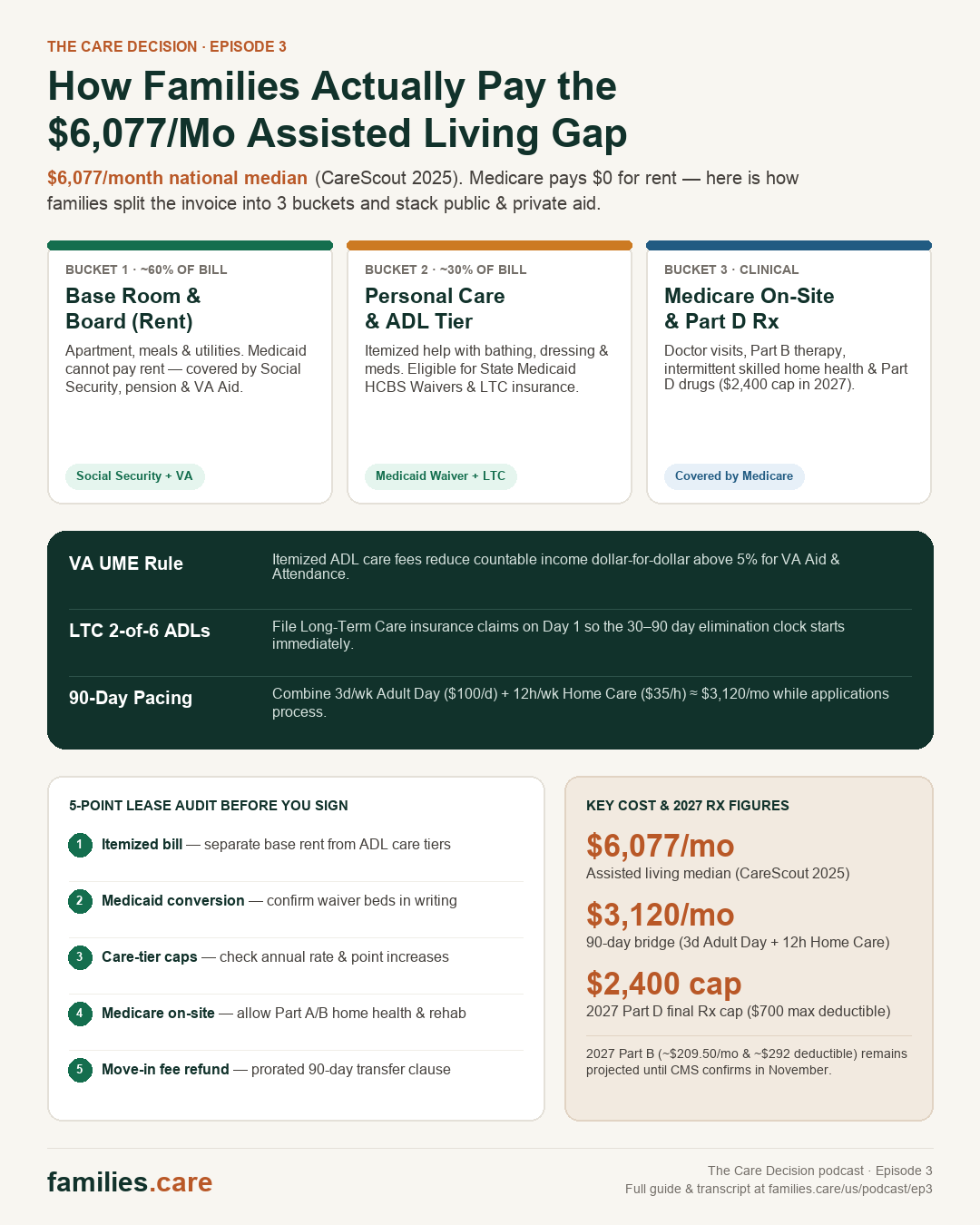
If the national median for assisted living is $6,200 a month and the average retired worker's Social Security check in 2026 is $2,071 a month, there is a $4,000+ monthly gap appearing on the kitchen table every 30 days. In Episode 3, Maya and Daniel explain why no single program pays the whole invoice — and how splitting your community's quote into 3 separate legal buckets (Bucket 1: Room & Board, Bucket 2: Personal Care Tier, Bucket 3: Medical & Clinical Care) unlocks the Six Funding Doors: (1) Social Security & pensions (including the 3.6% 2027 COLA), (2) Long-Term Care Insurance (2-of-6 ADL triggers & 90-day elimination clocks), (3) VA Aid & Attendance tax-free cash ($1,558–$2,874/mo), (4) State Medicaid HCBS Assisted Living Waivers (why Medicaid never pays Room & Board and why 12–24 month private-pay rules matter), (5) Home equity & bridge financing, and (6) Life settlements & the IRS Sec. 213(d) medical expense deduction.
Jump to chapter:
Printable Reference Cards in This Episode (Click to Enlarge):
-
50-State Cost Medians10 Memory Care Price Movers5-Question Tour Checklist
Episode 2: What Does Memory Care Actually Cost?
There is no official national price for memory care. The benchmark survey everyone cites — the CareScout Cost of Care Survey — publishes a national median for assisted living ($6,200 a month in the 2025 survey) and does not survey memory care separately. What families actually pay is a local base rate, plus a premium for the secured memory care floor, plus a stack of assessed charges on top. In this episode, Maya and Daniel walk through the whole stack: the base rate and the premium (assisted living's $6,200 national median; memory care typically 20–30% above the same community's assisted living rate — A Place for Mom's 2026 medians imply about 23%, private data, labeled as such); why geography swamps every national number (medians from roughly $4,400/month in Mississippi to about $9,600 in Massachusetts and around $12,000 in Hawaii); the ten price movers (care tier and reassessment, medication management, incontinence care, mobility and transfers, help with daily activities; the secured unit itself, apartment choice, and pricing model — all-inclusive vs à la carte; move-in fee, annual increases, and length of stay multiplying all of it); a worked example on published figures only ($6,690/month becomes $80,280 for one year and $160,560 for twenty-four months, before assessed tier and medication lines); what doesn't pay (Medicare does not cover long-term custodial care, and GUIDE's respite help does not reach memory care residents — memory care unit residents are not GUIDE-eligible as of July 2026); and a five-question checklist to ask any memory care community before signing, ending with the two-year total at the next tier up.
Jump to chapter:
Printable Reference Cards in This Episode (Click to Enlarge):
-
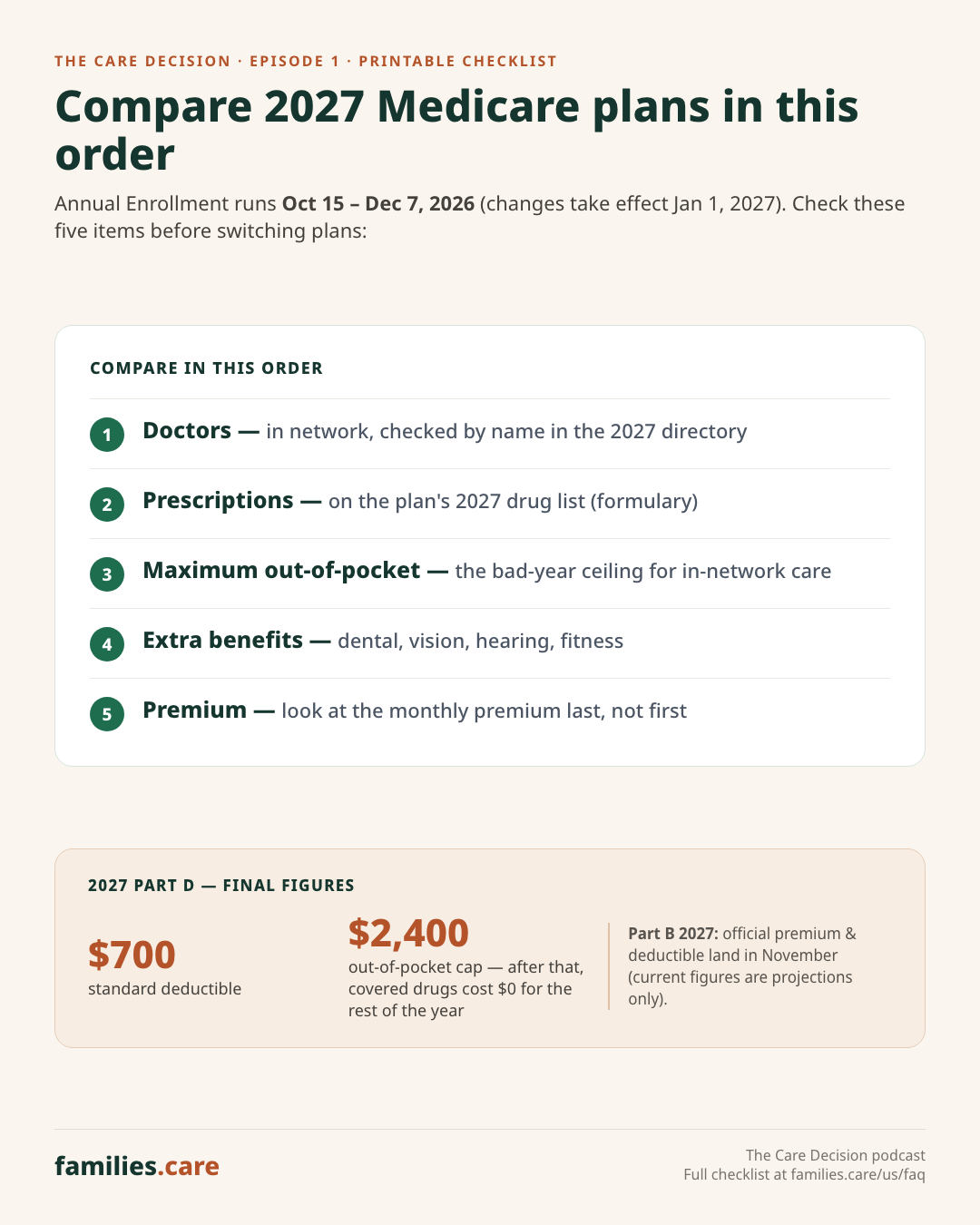
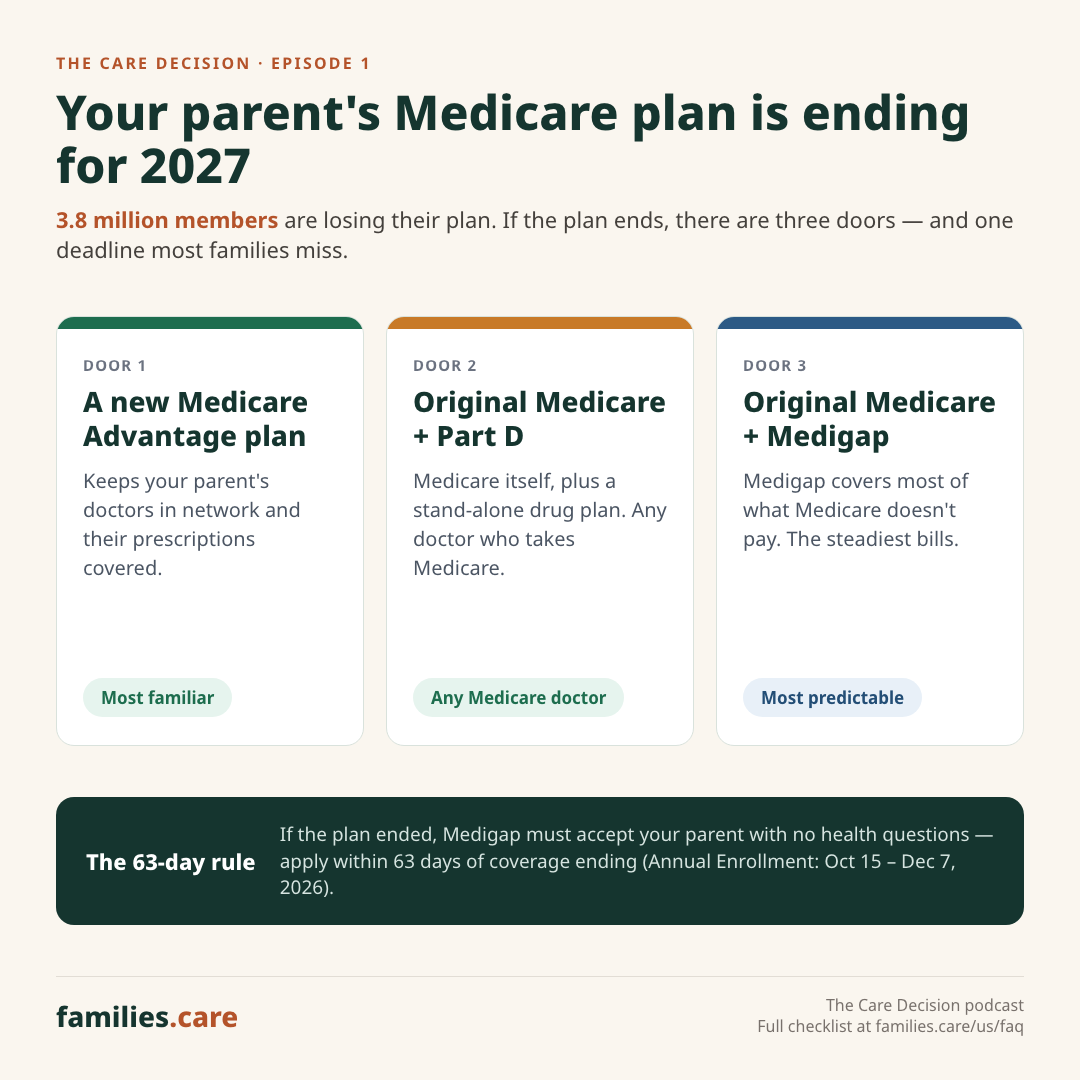
County Plan Exits63-Day Medigap Rule2027 Part D Cap ($2,400)
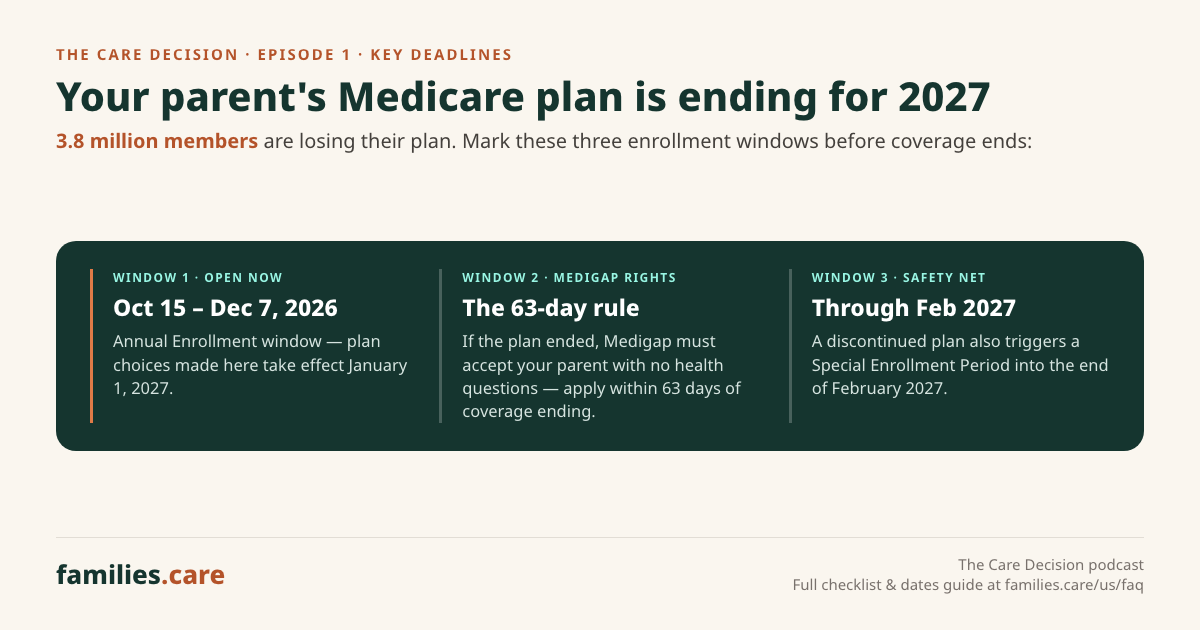
Episode 1: Your Parent's Medicare Plan Is Ending. Now What?
Roughly 3.8 million people on Medicare are losing their current health plan for 2027 — insurers are leaving counties, ending contracts, or not renewing plans. If your parent got a thick letter from their insurance company in September and set it aside, that letter may be telling them their coverage ends December 31.
Jump to chapter:
Printable Reference Cards in This Episode (Click to Enlarge):
How Families Actually Pay the $6,200/Month Assisted Living Gap
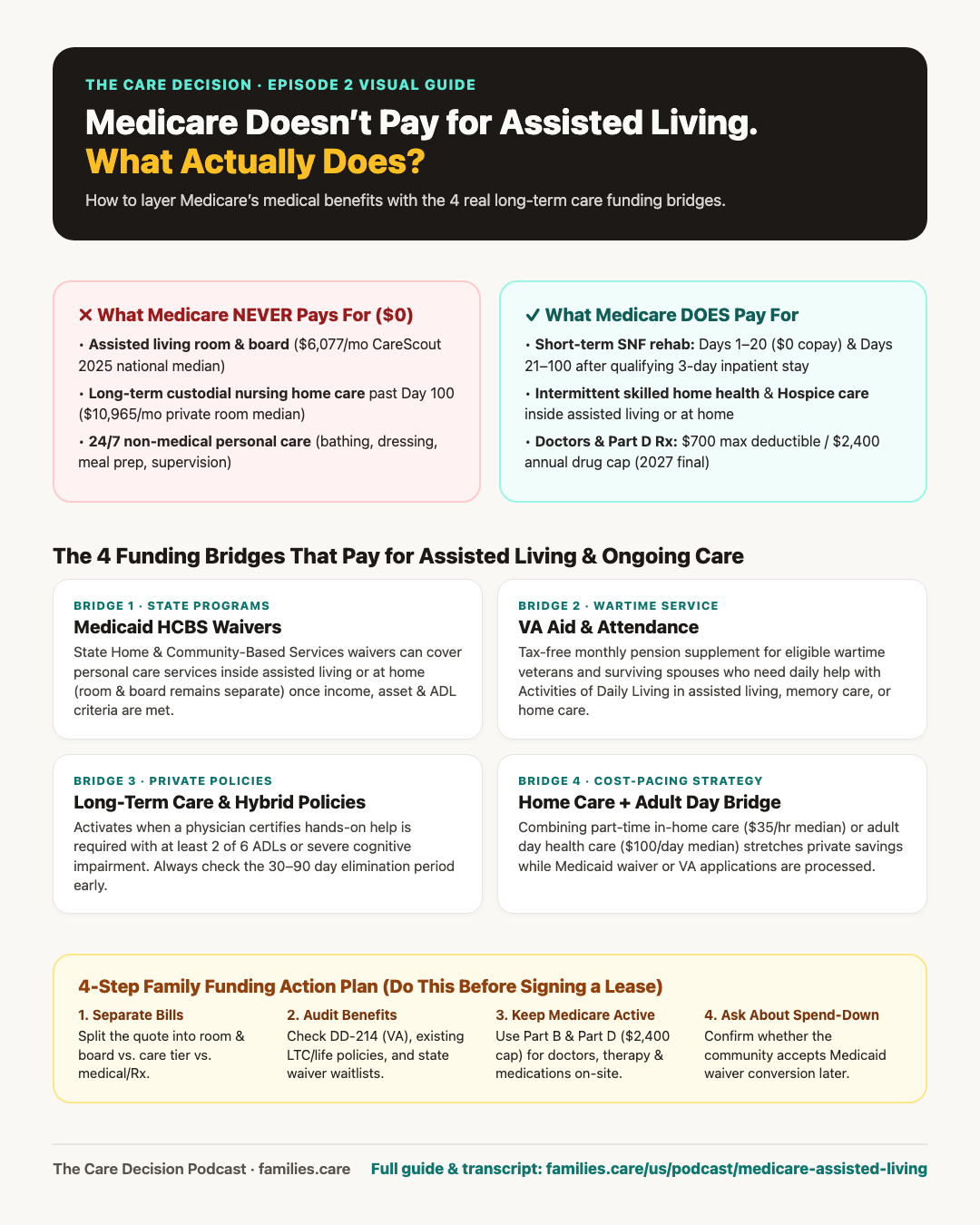
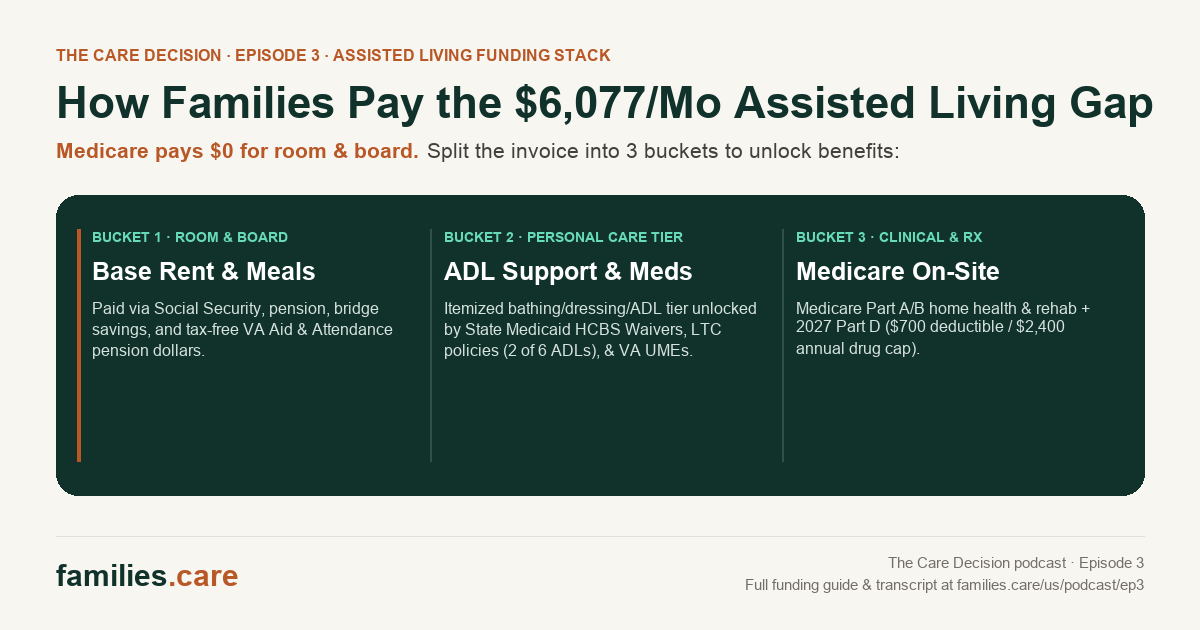
Once you know what assisted living or memory care costs in your parent’s city, the next question is how to pay the gap between Social Security ($2,071/mo average) and the monthly community invoice ($6,200/mo national median). Episode 3 breaks the invoice into Room & Board, Personal Care, and Clinical Care so you can stack Medicaid HCBS waivers, VA Aid & Attendance (up to $2,874/mo), and Medicare Part B without leaving benefits on the table.
🎙️ Read Episode 3 Opening Excerpt (Maya & Daniel: The Six Doors & 3-Bucket Split) Read excerpt ↓
Daniel: In Episode Two we priced the memory care and assisted living bill honestly. Now comes the kitchen-table question: when the monthly bill is six thousand dollars and Social Security is two thousand, how do families actually pay the four-thousand-dollar gap?
Maya: By refusing to treat the invoice as one single bill. Every assisted living or memory care invoice is actually three bills stapled together: Bucket One is Room and Board, Bucket Two is Personal Care and Supervision, and Bucket Three is Medical and Clinical Care. No single program pays all three — and knowing which door pays which bucket is how families survive the math.
Daniel: Including the rule that surprises almost everyone applying for a state Medicaid waiver: even when your parent qualifies for an Assisted Living Medicaid Waiver, federal law generally prohibits Medicaid from paying the Room and Board bucket.
🧮 Open Interactive 3-Bucket Monthly Gap & Six-Doors Benefit Calculator (Ep 3 · Printable) Expand ↓
3-Bucket Monthly Gap & Six-Doors Benefit Stacker
Split the community quote into Room & Board (Bucket 1) and Personal Care/ADLs (Bucket 2) to see how Social Security, VA Aid & Attendance, LTC insurance, and state Medicaid HCBS waivers reduce your net monthly gap.
Net Monthly Family Gap (After Benefits)
$4,129/mo
Total Invoice: $6,200/mo · Covered: $2,071/mo
90-Day Elimination / Approval Bridge
$12,387
Home Care + Adult Day pacing ($3,120/mo) saves $9,240 over 90d
24-Month Net Family Out-of-Pocket
$99,096
Bucket 3 Clinical & Part D ($2,400 Rx cap) stays on Medicare
Printable Family Reference Cards & Checklists
Designed for families to use during insurer calls, facility tours, and kitchen-table planning. Tap any reference card to open it full screen.
5-Step Plan Comparison Checklist
The Three Doors Reference Card
Key Deadlines Timeline (2026–2027)
Assisted Living vs. Memory Care Cost Breakdown
How Families Pay the Monthly Care Gap
48-Hour Hospital Discharge & SNF Survival Playbook

📝 Open Interactive 5-Question Facility Tour Worksheet & 24-Month Calculator (Printable) Expand ↓
5-Question Tour Worksheet & 24-Month Survival Calculator
Fill in the numbers quoted during your tour to calculate the 2-year total at the next care tier up, then print a 1-page scorecard.
Day-1 Monthly (Base + Meds)
$7,140/mo
Year-2 Monthly (Next Tier Up)
$8,390/mo
24-Month Total at Next Tier Up
$199,774
Community B — Side-by-Side Comparison (e.g. Low Base À La Carte vs. All-Inclusive)
Community B Day-1 Monthly
$6,600/mo
Community B Year-2 Monthly
$8,321/mo
Community B 24-Month Total
$198,052
⚖️ 24-Month Comparison: Community B is $1,722 lower over 2 years despite higher tier add-ons.
Turn This Episode Into Your Local Plan
National averages only tell half the story. Check the exact figures, Medicaid waiver rules, and verified communities in your parent’s state and city.
Cost Calculator
Compare Local Care Costs by State & City
See CareScout 2025 assisted living medians and estimated memory care rates in your area.
Provider Directory
Search Verified Local Communities
Filter assisted living, memory care, and skilled nursing near your parent’s ZIP or city.
State & Federal Guides
Medicare, Medicaid & Care Checklists
Step-by-step written guides grounded in CMS rules and state Medicaid statutes.
Related guides
More guides in Resources & Guides →-
 Companion Guide · Ep 1Read written guide & checklist →
Your Parent's Medicare Plan Is Ending. Now What?
-
 Companion Guide · Ep 2Read written guide & tables →
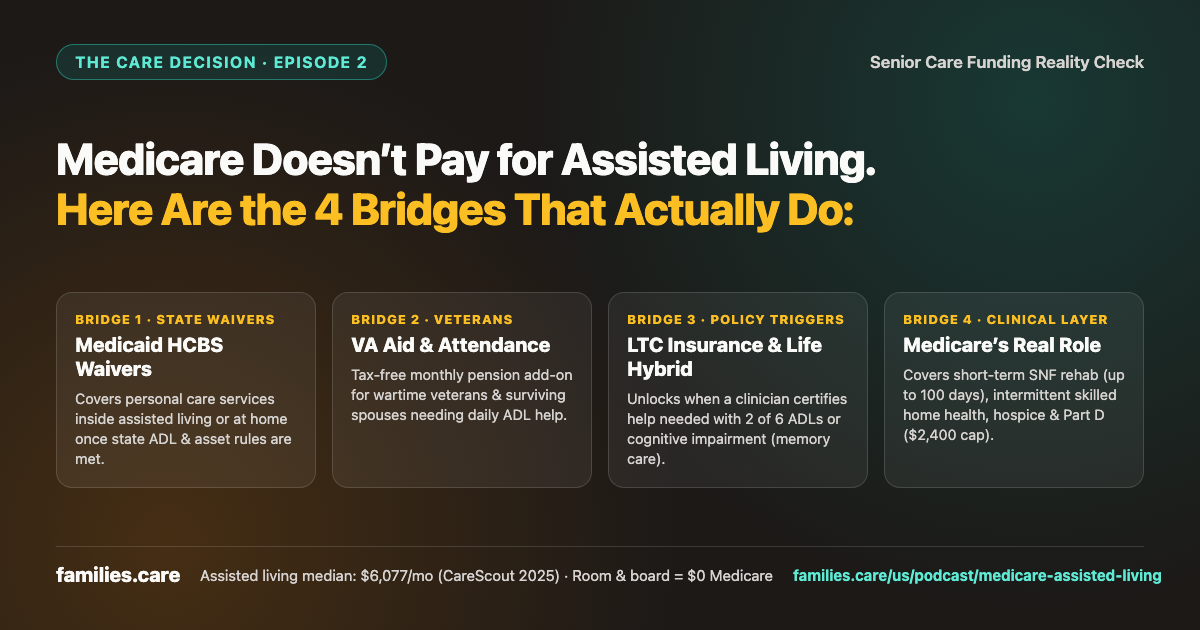
Medicare Doesn't Pay for Assisted Living. Here's What Actually Does
-
 Companion Guide · Ep 3Read funding stack breakdown →
How Families Actually Pay the $6,200/Month Assisted Living Gap
-
Companion Guide · Ep 4 EN + ES
The Hospital Just Said 48 Hours: How to Vet a Nursing Home
More guides in Resources & Guides.