families.care
A kind female nurse in scrubs smiling warmly while assisting an older senior couple with an engaging art and games table activity
South Dakota

How to Apply for South Dakota Medicaid Coverage

South Dakota Medicaid · DSS-EA-240

Content verified 2026-07-17T17:44:15.550Z

Medicaid Asset Protection & Spend-Down MilestonesGoverned Protocol
160-Month Lookback Guard

All asset transfers and gifts within 5 years are audited under state lookback statutes.

2Exempt vs. Countable Assets

Primary home equity, one vehicle, and personal effects remain protected under community spouse allowances.

3Miller Trust / QIT Path

Excess income in income-cap states is redirected into a Qualified Income Trust to preserve qualification.

Program overview

South Dakota Medicaid is a federal and state-funded program providing health coverage for people who meet certain eligibility standards. Medicaid acts as an insurance company for individuals and pays for medically necessary services. Medicaid provides health coverage to help pay for necessary medical expenses individuals need to stay healthy such as hospital stays, doctor visits, prescriptions, and other health care needs.

Adults under age 65 are eligible for Medicaid with income up to 138% of the poverty level. This took effect in July 2023, as a result of a ballot measure passed by voters in 2022. Pregnant women with household incomes up to 133% of FPL qualify; children with household incomes up to 204% of FPL qualify for CHIP; parents with dependent children are eligible with incomes up to 58% of FPL.

South Dakota Medicaid covers medically necessary health care services. The program includes comprehensive benefits such as doctor visits, hospital stays, prescription medications, preventive care, and long-term care services. The state offers Home and Community Based Services waiver programs to meet the needs of individuals who prefer to receive long-term services and supports in their home or community instead of an institutional setting.

The start date of medical coverage depends on the date the application is received by the Department of Social Services. Medical coverage may go back three months prior to the month the application is received if you have unpaid medical bills and meet eligibility requirements during this time period. An interview is not required to apply for South Dakota Medicaid, however you may request one.

Main application form

Application for Resource Assessment, Long-Term Care, or Other Related Medical Assistance

Form DSS-EA-240

Download form

Additional forms

  • Application for Health Coverage & Help Paying Costs · DSS-EA-FSSA

    For CHIP, pregnant women programs and low income families

    Download form →
  • Economic Assistance Application · DSS-EA-301

    General economic assistance application for multiple programs

    Download form →
Where to submit

Applications may be mailed, faxed, e-mailed, or dropped off in-person at any Department of Social Services office. Individuals may also apply online through http://dss.sd.gov/applyonline or in person at their local DSS office.

Read guide

South Dakota Medicaid provides essential healthcare coverage for eligible residents. You can apply using form DSS-EA-240 for long-term care services or DSS-EA-FSSA for families and pregnant women. Adults qualify with incomes up to 138% of poverty level since expansion began in 2023. The program covers doctor visits, hospital stays, prescriptions, and long-term care services. No interview is required to apply. Submit your application online at eaportal.sd.gov, mail it to your local DSS office, or apply in person. Coverage can start retroactively up to three months if you have unpaid medical bills. Gather required documents including Social Security cards, income proof, bank statements, and insurance information before applying.

Official resources

Related guides

Frequently Asked Questions

How do I apply for South Dakota Medicaid in South Dakota?

To apply for South Dakota Medicaid in South Dakota, complete Application for Resource Assessment, Long-Term Care, or Other Related Medical Assistance (DSS-EA-240), then submit it to Applications may be mailed, faxed, e-mailed, or dropped off in-person at any Department of Social Services office. Individuals may also apply online through http://dss.sd.gov/applyonline or in person at their local DSS office..

What documents do I need to apply for South Dakota Medicaid in South Dakota?

You typically need to provide: Social Security cards for all household members, Birth certificates for all applicants, Proof of identity (driver's license, state ID, or passport), Proof of income for previous three months (pay stubs, Social Security statements, unemployment benefits), Bank statements for all accounts from past three months, Insurance cards for any current health coverage, Property deeds or mortgage statements if applicable, Vehicle registration and title documents, Medical bills if seeking retroactive coverage, Immigration documents if applicable (Green Card, naturalization certificate), Proof of disability determination if applying under aged/blind/disabled categories, Marriage certificate or divorce decree if applicable.

Where do I submit my South Dakota Medicaid application in South Dakota?

Submit your completed South Dakota Medicaid application to Applications may be mailed, faxed, e-mailed, or dropped off in-person at any Department of Social Services office. Individuals may also apply online through http://dss.sd.gov/applyonline or in person at their local DSS office..

What is the main application form for South Dakota Medicaid in South Dakota?

The primary application form is Application for Resource Assessment, Long-Term Care, or Other Related Medical Assistance (DSS-EA-240). Download it from the official state website: https://dss.sd.gov/formsandpubs/docs/MEDELGBLTY/EA240.pdf

Where can I find official information about South Dakota Medicaid in South Dakota?

Official information and application resources are available at South Dakota Medicaid General Information: https://dss.sd.gov/medicaid/

How we research and verify this information

Our team compiles this listing from public records and provider data, and reviews it against authoritative sources. Read our editorial standards and research methodology.

Editorial review by John Richie, Senior Care Research Editor.

The Care Decision Podcast · Episode 2 & Printable Cost Checklists

Real Care Cost Breakdown: Audio Guide & Printable Tour Checklists

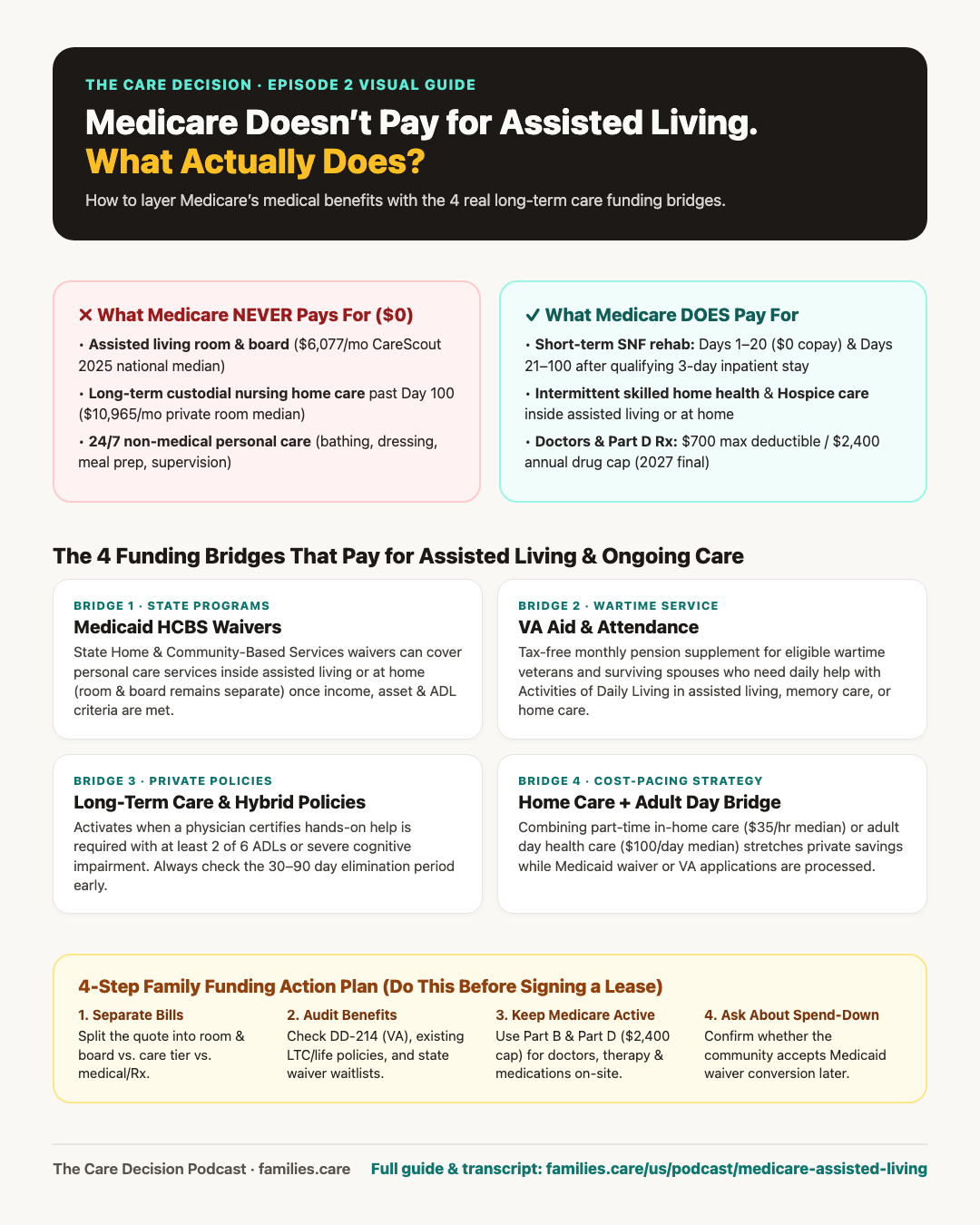
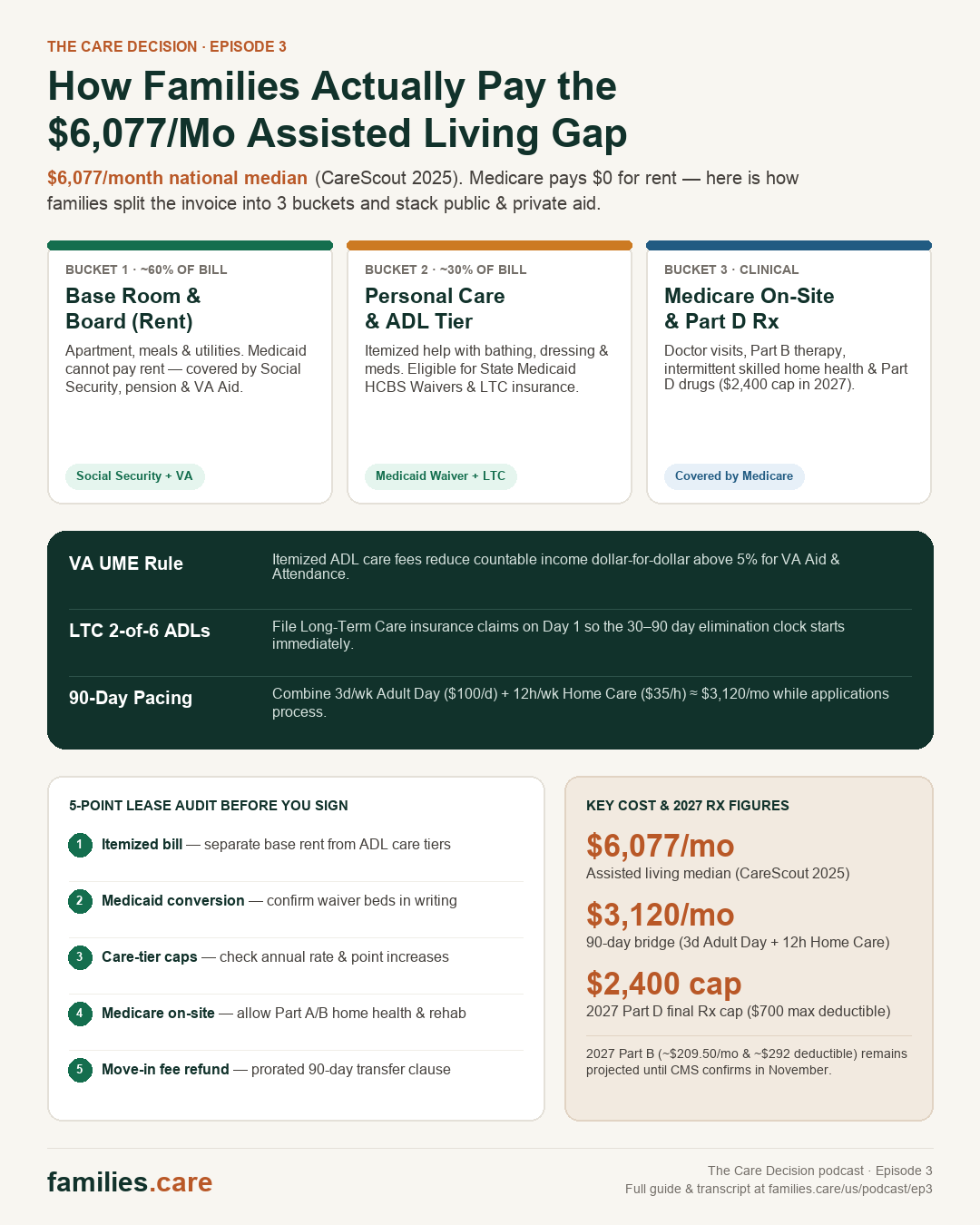
Base rent is rarely the final monthly invoice. Stream Episode 2 (19 min) or click either reference card below to zoom, save, or print our tour pricing checklist and 3-bucket invoice funding blueprint.

The Care Decision podcast cover art

Episode 02 · 19:21 · Hosted by Maya & Daniel

What Does Memory Care Actually Cost?

Assisted living base rent ($5,900–$6,250/mo) vs. memory care ($6,500–$8,500+/mo), level-of-care add-ons, and tour questions.

Tour Pricing Checklist · Ep 2 Assisted Living vs. Memory Care Cost Breakdown (Ep 2)
Save PNG
Funding Stack Blueprint · Ep 3 The 3-Bucket Invoice Split ($6,200/mo Gap · Ep 3)
Save PNG
📝 Open Interactive 5-Question Facility Tour Worksheet & 24-Month Calculator (Printable) Expand ↓
Interactive Facility Tour Scorecard

5-Question Tour Worksheet & 24-Month Survival Calculator

Fill in the numbers quoted during your tour to calculate the 2-year total at the next care tier up, then print a 1-page scorecard.

Day-1 Monthly (Base + Meds)

$7,140/mo

Year-2 Monthly (Next Tier Up)

$8,390/mo

24-Month Total at Next Tier Up

$199,774

🧮 Open Interactive 3-Bucket Monthly Gap & Six-Doors Benefit Calculator (Ep 3 · Printable) Expand ↓
Interactive 3-Bucket Funding Stack · Ep 3

3-Bucket Monthly Gap & Six-Doors Benefit Stacker

Split the community quote into Room & Board (Bucket 1) and Personal Care/ADLs (Bucket 2) to see how Social Security, VA Aid & Attendance, LTC insurance, and state Medicaid HCBS waivers reduce your net monthly gap.

Net Monthly Family Gap (After Benefits)

$4,129/mo

Total Invoice: $6,200/mo · Covered: $2,071/mo

90-Day Elimination / Approval Bridge

$12,387

Home Care + Adult Day pacing ($3,120/mo) saves $9,240 over 90d

24-Month Net Family Out-of-Pocket

$99,096

Bucket 3 Clinical & Part D ($2,400 Rx cap) stays on Medicare

Card 1 / 1

Printable Family Reference Card

⬇ Save PNG