




US · 51 · CareScout · Medicare.gov

Senior Care Insights & Guides

Expert advice to help you navigate senior care decisions.

How these guides fit your decision
3-step planning flow
01Care Setting

Match the care level

In-Home · Day Programs · Assisted · Memory Care

02Coverage Filter

Separate Medicare & Medicaid

Medicare (short-term rehab) vs. Medicaid (long-term)

03State Baseline

Estimate monthly budget

2025 CareScout state median vs. out-of-pocket gap

Key Takeaways

Read expert articles and in-depth guides about senior care, assisted living, and nursing homes on families.care.

The Care Decision podcast cover art
PodcastFree audio series · Hosted by Maya & Daniel

The Care Decision

One real decision families face with an aging parent, answered all the way through.

01 · Families Media

Good Years

Practical ideas for living well through every season of later life.

02 · Families Media

Provider Intelligence

Clear operating intelligence for care leaders.

Grounded visual guide · who pays for what

U.S. Senior Care Coverage & 2025 Cost Decision Map

See how Medicare, State Medicaid, VA Aid & Attendance, and private resources divide medical recovery versus ongoing monthly care.

CareScout 2025 national medians

Adult day health$95/day
In-home aide$35/hr
Assisted living$6,200/mo
Nursing home$9,581/mo–$10,798/mo
01 · Short-term clinical

Medicare Parts A, B & D

Days 1–20: $0 SNF copay

Pays for: Post-hospital SNF rehab (after 3 formal inpatient midnights), intermittent skilled home health, hospice, and Part D drugs ($2,400 cap in 2027).
Never pays: $0 toward assisted living rent & board or long-term custodial care past Day 100.
02 · Public safety net

State Medicaid & HCBS Waivers

#1 long-term payer

Pays for: Long-term nursing home stays and state HCBS assisted living / home care waivers (STAR+PLUS, Medi-Cal ALW, NY MLTC, PA CHC, IL SLP).
Gateways: Clinical level-of-care score + state income/asset thresholds (60-month look-back in most states).
03 · Wartime veterans

VA Aid & Attendance

Up to $2,424/mo–$2,874/mo

Pays for: Tax-free monthly pension supplement for wartime veterans and surviving spouses needing daily ADL help or cognitive supervision.
Gateways: Wartime service + countable net worth ≤ $163,699 (after deducting care UMEs).
04 · Bridge & residential

Private Pay & LTC Insurance

$6,200/mo AL median

Pays for: Base room & board, private-pay wait periods, flexible hourly home aides, and specialized memory care communities.
LTC trigger: Most private LTC policies pay daily benefits once a clinician certifies 2 of 6 ADLs or cognitive impairment.

Grounded in primary sources: CareScout 2025 Cost of Care Survey · CMS.gov (Part A SNF & 2027 Part D) · VA.gov Pension Rates (Dec 2025 – Nov 2026).

Sort:
Scope:
01

Funding

Medicare, VA benefits, insurance rules & covering the monthly gap

4
VA Aid and Attendance Benefit for Senior Living: Eligibility, Rates & Application Checklist — Editorial Dispatch Editorial Dispatch
5 min read 1 min listen
Rate

VA Aid and Attendance Benefit for Senior Living: Eligibility, Rates & Application Checklist

The VA Aid and Attendance benefit provides tax-free monthly pensions to help eligible wartime veterans and surviving spouses pay for assisted living, memory care, and in-home care.

US · Federal & 50 States

Reviewed by James Whitaker, Elder Law Attorney

Grounded in: CareScout · Medicare.gov

Published

At a glance 1:19
  • Verified VA Aid & Attendance MAPR (Dec 2025 – Nov 2026): up to $2,424/month for a single veteran, $2,874/month with a dependent, and $1,558/month for a surviving spouse.
  • Eligibility requires wartime active-duty service, clinical need for ADL help or cognitive supervision, and countable net worth at or below $163,699.
  • File an Intent to File (VA Form 21-0966) immediately to lock in retroactive monthly payments while gathering physician forms (VA Form 21-2680).

U.S. Department of Veterans Affairs Pension Rates (2025–2026)

1-minute grounded audio summary 1:19 · AI voice

Essential Legal Documents Needed for Family Care Planning — Editorial Dispatch Editorial Dispatch
2 min read 1 min listen
Rate

Essential Legal Documents Needed for Family Care Planning

Preparing essential legal documents before a health crisis ensures your aging loved one's medical and financial wishes are honored while protecting family members from costly court guardianship proceedings.

US · Federal & 50 States EN + ES Leer en Español →

Reviewed by James Whitaker, Elder Law Attorney

Grounded in: CareScout · Medicare.gov

Published

At a glance 1:15
  • Complete 4 core documents while your parent has full legal capacity: Durable Financial Power of Attorney, Healthcare Proxy/Medical POA, Living Will, and HIPAA Release.
  • Without signed Powers of Attorney before cognitive decline, families face slow, expensive probate court guardianship or conservatorship proceedings.
  • Verify whether banks and brokerages require their own proprietary POA forms in addition to your state statutory durable power of attorney.

American Bar Association Commission on Law and Aging & NIA Advance Care Planning

1-minute grounded audio summary 1:15 · AI voice
Medicare Supplement Insurance (Medigap): Plans, Costs & Senior Care Coverage — Editorial Dispatch Editorial Dispatch
5 min read 1 min listen
Rate

Medicare Supplement Insurance (Medigap): Plans, Costs & Senior Care Coverage

Medicare Supplement Insurance (Medigap) fills major out-of-pocket gaps in Original Medicare, but does not cover custodial senior care. Learn how plans work and when to enroll.

US · Federal & 50 States

Reviewed by James Whitaker, Elder Law Attorney

Grounded in: CareScout · Medicare.gov

Published

At a glance 1:02
  • Medigap policies (such as standardized Plan G and Plan N) cover Original Medicare Part A & B deductibles and 20% coinsurance nationwide.
  • Medigap NEVER pays for long-term custodial assisted living, memory care rent, or extended non-skilled nursing home stays.
  • Apply during your 6-month Medigap Open Enrollment Period at age 65+ (or a federal 63-day guaranteed-issue window) to avoid medical underwriting.

CMS Choosing a Medigap Policy Official Guide

1-minute grounded audio summary 1:02 · AI voice
How to Find a Good Elder Law Attorney Near You — Editorial Dispatch Editorial Dispatch

Elder law

5 min read 1 min listen
Rate

How to Find a Good Elder Law Attorney Near You

An elder law attorney can help with Medicaid planning, estate planning, guardianship, and protecting assets. Here is how to find a good one and what to expect.

US · Federal & 50 States

Reviewed by Luis Diaz Sendel, Founder, families.care

Grounded in: CareScout · Medicare.gov

Published · Updated

At a glance 0:56
  • Consult a dedicated elder law attorney (NAELA or CELA certified) before transferring assets, signing facility guarantees, or filing complex Medicaid claims.
  • State Medicaid programs enforce a 60-month look-back on uncompensated transfers in most states, with strict spousal impoverishment protections.
  • Bring 5 years of financial statements, existing powers of attorney, deeds, and monthly care cost estimates to your initial consultation.

NAELA, National Elder Law Foundation & Federal Medicaid Look-Back Rules

1-minute grounded audio summary 0:56 · AI voice
02

Care types

Assisted living, memory care, nursing homes & in-home pricing

32
Best in-home dementia care providers in 2026 — Editorial Dispatch Editorial Dispatch

In-home care

10 min read 1 min listen
Rate

Best in-home dementia care providers in 2026

Compare in home dementia caregivers by training, continuity, backup coverage, and medical needs. Choose the provider model that fits your family's routine.

US · Federal & 50 States

Grounded in: CareScout · Medicare.gov

Published

At a glance 1:18
  • Prioritize dementia-focused agencies for recurring care to ensure you have a documented process for staff supervision, training, and reliable backup coverage during caregiver absences.
  • Directly hiring a caregiver offers better personal continuity but requires your family to manage all employment, scheduling, and emergency backup responsibilities independently.
  • Clinician-directed home health is strictly for skilled medical needs and does not replace the requirement for ongoing daily supervision, companionship, or personal care assistance.

Families.care 2026 Guide, CareScout 2025 Cost of Care Survey & CMS.gov Medicare guidelines.

1-minute grounded audio summary 1:18 · AI voice
Best private home care services in 2026 — Editorial Dispatch Editorial Dispatch

In-home care

11 min read 1 min listen
Rate

Best private home care services in 2026

Compare private home care services by care needs, oversight, and backup coverage. Start with an employer-based agency for managed daily support.

US · Federal & 50 States

Grounded in: CareScout · Medicare.gov

Published

At a glance 1:11
  • Prioritize your specific care tasks—such as transfers, toileting, or skilled nursing—before selecting a hiring model, as service labels like 'companion' do not guarantee the ability to perform hands-on care.
  • Choose an employer-based agency if you want the provider to handle staffing, payroll, and supervision, or opt for direct hiring only if your household is prepared to manage employment and backup coverage.
  • Always obtain a written agreement that explicitly defines the missed-visit procedure, the escalation contact for concerns, and the specific scope of duties to ensure accountability for your loved one's care.

CMS.gov, CareScout 2025 Cost of Care Survey & State Medicaid Rules

1-minute grounded audio summary 1:11 · AI voice
Best live-in home care services in 2026 — Editorial Dispatch Editorial Dispatch

In-home care

10 min read 1 min listen
Rate

Best live-in home care services in 2026

Compare live-in home care services by oversight, overnight coverage, and caregiver fit. Choose agency-managed care or an alternative that fits your needs.

US · Federal & 50 States

Grounded in: CareScout · Medicare.gov

Published

At a glance 1:07
  • Choose agency-managed care if you want a provider to handle supervision and replacement staffing, but verify these responsibilities are explicitly written into your contract.
  • Directly hiring a caregiver offers more control but requires the family to manage all employment, payroll, and backup coverage duties when the primary caregiver is unavailable.
  • If your relative requires assistance throughout the night, prioritize awake shift-based care over a sleeping live-in arrangement to ensure continuous, responsive support.

Families.care 2026 Guide, CareScout 2025 Cost of Care Survey & State Medicaid Rules

1-minute grounded audio summary 1:07 · AI voice
Hospice Care vs. Palliative Care: Differences, Medicare Coverage & Transition Guide — Editorial Dispatch Editorial Dispatch

Hospice

5 min read 1 min listen
Rate

Hospice Care vs. Palliative Care: Differences, Medicare Coverage & Transition Guide

Palliative care offers symptom relief alongside curative treatments at any stage, while hospice provides comfort-focused end-of-life care. Learn how each works and when to transition.

US · Federal & 50 States

Reviewed by Aisha Patel, Registered Nurse

Grounded in: CareScout · Medicare.gov

Published

At a glance 0:56
  • Palliative care relieves symptoms at any stage alongside curative treatment; hospice serves patients with a 6-month terminal prognosis foregoing curative care.
  • The Medicare Part A Hospice Benefit covers nursing visits, comfort medications, durable medical equipment, and bereavement support with minimal copays.
  • Federal hospice rules mandate 4 care levels: Routine Home Care, Continuous Crisis Care, General Inpatient Care, and up to 5-day Inpatient Respite.

CMS Medicare Hospice Benefit (42 CFR Part 418)

1-minute grounded audio summary 0:56 · AI voice
How to Involve Children in Grandparent Care Decisions: A Family Guide — Editorial Dispatch Editorial Dispatch

Assisted living

2 min read 1 min listen
Rate

How to Involve Children in Grandparent Care Decisions: A Family Guide

When an aging grandparent faces health decline or transitions into senior living, involving grandchildren with age-appropriate roles builds empathy and maintains vital family bonds.

US · Federal & 50 States

Reviewed by Maria Gonzalez, Geriatric Care Manager

Grounded in: CareScout · Medicare.gov

Published

At a glance 1:12
  • Share honest, age-appropriate explanations of a grandparent’s health or memory changes so children do not blame themselves or fear visits.
  • Give grandchildren concrete, low-pressure connection roles — photo albums, favorite music playlists, short video calls, or decorating a new senior living room.
  • Prepare kids before visiting memory care or skilled nursing by explaining medical equipment and modeling calm, warm conversation.

National Institute on Aging & Family Caregiver Alliance Guidelines

1-minute grounded audio summary 1:12 · AI voice
How to Support a Family Member with Chronic Illness: Caregiving, Respite, and Living Options — Editorial Dispatch Editorial Dispatch

In-home care

2 min read 1 min listen
Rate

How to Support a Family Member with Chronic Illness: Caregiving, Respite, and Living Options

Caring for an aging family member with chronic disease requires a balanced caregiving strategy. Learn how to manage daily activities, access respite care, and navigate in-home care options.

US · Federal & 50 States

Reviewed by Dr. Sarah Jenkins, Geriatrician & Senior Care Advisor

Grounded in: CareScout · Medicare.gov

Published

At a glance 1:13
  • Build a sustainable care routine around medication reconciliation, symptom tracking, fall prevention, and scheduled primary/specialist follow-ups.
  • Prevent caregiver burnout early by layering Medicare home health episodes, adult day programs, and scheduled respite breaks.
  • Compare part-time in-home personal care ($35/hour national median) against residential support before daily caregiving becomes a medical crisis.

NIA Caregiver Guidance & CareScout 2025 Cost of Care Survey

1-minute grounded audio summary 1:13 · AI voice
Illinois Supportive Living Program: SLP Medicaid Assisted Living & DON Scores — Editorial Dispatch Editorial Dispatch

Assisted living

3 min read 1 min listen
Rate

Illinois Supportive Living Program: SLP Medicaid Assisted Living & DON Scores

Illinois operates one of the nation's premier Medicaid assisted living models through the Supportive Living Program (SLP). Learn how to achieve the 29-point DON clinical score and how room and board fees are capped at the SSI rate.

US · Federal & 50 States

Reviewed by Maria Gonzalez, Geriatric Care Manager

Grounded in: CareScout · Medicare.gov

Published · Updated

At a glance 1:04
  • Illinois Supportive Living Program (SLP) funds Medicaid-certified apartment assisted living for seniors age 65+ and adults with disabilities.
  • Applicants must score at least 29 points on the Illinois Determination of Need (DON) clinical assessment conducted by a local CCU.
  • Residents retain a protected monthly personal needs allowance while Medicaid covers personal care, medication oversight, and 24-hour staffing.

Illinois Dept. of Healthcare & Family Services (HFS) & IDoA DON Standards

1-minute grounded audio summary 1:04 · AI voice
Pennsylvania Community HealthChoices: CHC Waiver, PCH vs ALR & Spend-Down — Editorial Dispatch Editorial Dispatch

Nursing home

3 min read 1 min listen
Rate

Pennsylvania Community HealthChoices: CHC Waiver, PCH vs ALR & Spend-Down

Pennsylvania Community HealthChoices (CHC) coordinates long-term care for low-income seniors. Learn how the NFCE clinical standard, Form MA-51 medical evaluation, and Personal Care Homes differ from licensed Assisted Living Residences.

US · Federal & 50 States

Reviewed by James Whitaker, Elder Law Attorney

Grounded in: CareScout · Medicare.gov

Published · Updated

At a glance 1:08
  • Pennsylvania Community HealthChoices (CHC) delivers Medicaid home and community-based long-term services for adults who are Nursing Facility Clinically Eligible (NFCE).
  • Clinical eligibility requires physician certification on Form MA-51 paired with an Independent Enrollment Broker functional assessment.
  • Understand Pennsylvania’s licensing split between Personal Care Homes (PCH) and Assisted Living Residences (ALR) when matching waiver coverage.

Pennsylvania Dept. of Human Services (DHS) Community HealthChoices

1-minute grounded audio summary 1:08 · AI voice
New York Medicaid Long-Term Care: MLTC, Pooled Income Trusts & Home Care — Editorial Dispatch Editorial Dispatch

In-home care

3 min read 1 min listen
Rate

New York Medicaid Long-Term Care: MLTC, Pooled Income Trusts & Home Care

New York offers some of the nation's most comprehensive home care under Community Medicaid. Learn how Pooled Income Trusts protect excess pensions and how CDPAP pays family members to provide in-home care.

US · Federal & 50 States

Reviewed by James Whitaker, Elder Law Attorney

Grounded in: CareScout · Medicare.gov

Published · Updated

At a glance 1:11
  • New York Managed Long-Term Care (MLTC) coordinates community Medicaid home care, adult day health, and personal care aides after NYIAP nursing assessment.
  • Seniors with monthly income above the Medicaid threshold can shelter surplus income inside a nonprofit Supplemental Needs Pooled Income Trust to pay household bills.
  • Consumer Directed Personal Assistance (CDPAP) permits eligible Medicaid enrollees to recruit and direct eligible family caregivers (excluding spouses).

New York State Dept. of Health (NYSDOH) Community Medicaid & NYIAP

1-minute grounded audio summary 1:11 · AI voice
Texas Medicaid Assisted Living: STAR+PLUS Waiver, Income Caps & Miller Trusts — Editorial Dispatch Editorial Dispatch

Assisted living

3 min read 1 min listen
Rate

Texas Medicaid Assisted Living: STAR+PLUS Waiver, Income Caps & Miller Trusts

Texas Medicaid does not pay room and board, but the STAR+PLUS HCBS waiver covers personal care and nursing in contracted assisted living facilities. Learn how the $2,901 income cap and Miller Trusts work.

US · Federal & 50 States

Reviewed by James Whitaker, Elder Law Attorney

Grounded in: CareScout · Medicare.gov

Published · Updated

At a glance 1:13
  • Texas STAR+PLUS HCBS waivers fund assisted living services in contracted facilities for seniors meeting Medical Necessity (MN) nursing-facility criteria.
  • Applicants exceeding the monthly Medicaid income cap can establish a Qualified Income Trust (Miller Trust) to regain financial eligibility.
  • Verify Type B assisted living licensing when a resident needs nighttime evacuation help or progressive dementia supervision.

Texas Health and Human Services (HHSC) STAR+PLUS Handbook

1-minute grounded audio summary 1:13 · AI voice
State Medicaid Waivers for Senior Living: California (Medi-Cal ALW) vs. Florida (SMMC LTC) — Editorial Dispatch Editorial Dispatch

Assisted living

2 min read 1 min listen
Rate

State Medicaid Waivers for Senior Living: California (Medi-Cal ALW) vs. Florida (SMMC LTC)

A deep legal and operational comparison of two major retirement states: California's zero-asset Medi-Cal rules versus Florida's strict algorithmic waitlist scoring and Miller Trusts.

US · Federal & 50 States

Reviewed by James Whitaker, Elder Law Attorney

Grounded in: CareScout · Medicare.gov

Published · Updated

At a glance 1:14
  • California eliminated the Medi-Cal asset test, broadening financial access, though Assisted Living Waiver (ALW) slots remain county-capacity constrained.
  • Florida Statewide Medicaid Managed Care Long-Term Care (SMMC LTC) uses DOEA 701B frailty scoring to prioritize waitlist placement alongside strict income/asset caps.
  • In both states, Medicaid waivers subsidize personal care services while residents cover capped room-and-board portions from monthly income.

California DHCS Medi-Cal ALW & Florida AHCA / DOEA SMMC LTC Rules

1-minute grounded audio summary 1:14 · AI voice
Navigating a 48-Hour Hospital Discharge: The Skilled Nursing Playbook for Families — Editorial Dispatch Editorial Dispatch

Nursing home

3 min read 1 min listen
Rate

Navigating a 48-Hour Hospital Discharge: The Skilled Nursing Playbook for Families

A clinical nurse's step-by-step guide to surviving an abrupt hospital discharge: avoiding the Medicare observation trap, evaluating SNF staffing, and exercising your legal right to an expedited QIO appeal.

US · Federal & 50 States

Reviewed by Aisha Patel, Registered Nurse

Grounded in: CareScout · Medicare.gov

Published · Updated

At a glance 1:12
  • Confirm formal inpatient admission (3 consecutive midnights) rather than outpatient observation status (MOON form) so Medicare Part A covers SNF rehab.
  • Exercise your statutory BFCC-QIO expedited appeal before midnight if the patient is medically unstable or no safe rehab bed is ready.
  • Screen facilities on CMS Care Compare for 4–5 Health Inspection stars, weekend RN presence, and verified Payroll-Based Journal staffing.

CMS NOTICE Act (MOON), BFCC-QIO Rights & Care Compare

1-minute grounded audio summary 1:12 · AI voice
How to Pay for Memory Care: Costs, Facility Safety, and Medicaid Spend-Down — Editorial Dispatch Editorial Dispatch

Memory care

2 min read 1 min listen
Rate

How to Pay for Memory Care: Costs, Facility Safety, and Medicaid Spend-Down

A comprehensive, medically grounded guide to navigating memory care costs, assessing facility safety features, and understanding Medicaid spend-down rules without impoverishing a spouse.

US · Federal & 50 States

Reviewed by Dr. Sarah Jenkins, Geriatrician & Senior Care Advisor

Grounded in: CareScout · Medicare.gov

Published · Updated

At a glance 1:07
  • Memory care generally adds a $1,200–$2,500/month specialized dementia care tier above the $6,200/month CareScout 2025 assisted living base median ($7,400–$8,700/month total).
  • Evaluate secured courtyards, delayed-egress doors, dementia-specific staff training, and night-shift awake ratios before aesthetics.
  • Federal Medicaid spousal impoverishment rules (CSRA & MMMNA) let the healthy spouse keep a home and protected assets during spend-down.

CareScout 2025 Benchmarks & CMS Spousal Impoverishment Standards

1-minute grounded audio summary 1:07 · AI voice
The 2026 Senior Care Quality Gap: Where Government-Rated Care Is Best and Worst — Editorial Dispatch Editorial Dispatch

Nursing home

6 min read 1 min listen
Rate

The 2026 Senior Care Quality Gap: Where Government-Rated Care Is Best and Worst

We analyzed 22,937 government-rated senior care facilities nationwide. Below-average facilities outnumber top-rated ones, and a senior in Utah is more than twice as likely to find a top-rated facility as one in New Mexico.

US · Federal & 50 States

Reviewed by Luis Diaz Sendel, Founder, families.care

Grounded in: CareScout · Medicare.gov

Published · Updated

At a glance 1:16
  • Quality of care varies significantly by state, with 35.5% of facilities nationwide rated as below average and only 34.5% achieving a top 4-5 star rating.
  • Geography is a major factor in care quality; for example, Utah has 54.2% of facilities rated as top-tier, while New Mexico has only 21.8% in that same category.
  • Families should always verify the official CMS star rating before choosing a facility, as regional quality gaps mean that local options may not meet high standards.

CMS.gov, CareScout 2025 Cost of Care Survey & families.care 2026 Senior Care Quality Gap Analysis

1-minute grounded audio summary 1:16 · AI voice
Adult Day Care: The Affordable Alternative Most Families Overlook — Editorial Dispatch Editorial Dispatch

Adult day care

6 min read 1 min listen
Rate

Adult Day Care: The Affordable Alternative Most Families Overlook

Adult day care programs cost a fraction of in-home care or assisted living while providing socialization, meals, and supervision. Here is how they work and who benefits most.

US · Federal & 50 States

Reviewed by Luis Diaz Sendel, Founder, families.care

Grounded in: CareScout · Medicare.gov

Published · Updated

At a glance 1:05
  • Adult day care carries a $95/day CareScout 2025 national median — providing daytime supervision, meals, and social engagement at a fraction of residential care.
  • Medical-model adult day health centers add nursing oversight, medication administration, and physical or occupational therapy.
  • Medicaid HCBS waivers, VA health benefits, and local Area Agencies on Aging frequently subsidize weekday enrollment for working caregivers.

CareScout 2025 Cost of Care Survey & ACL Area Agencies on Aging

1-minute grounded audio summary 1:05 · AI voice
VA Benefits for Senior Care: A Complete Guide for Veterans and Families — Editorial Dispatch Editorial Dispatch

In-home care

8 min read 1 min listen
Rate

VA Benefits for Senior Care: A Complete Guide for Veterans and Families

Veterans and their spouses may qualify for significant care benefits most families do not know about. Here is everything the VA offers for senior care and how to apply.

US · Federal & 50 States EN + ES Leer en Español →

Reviewed by Luis Diaz Sendel, Founder, families.care

Grounded in: CareScout · Medicare.gov

Published · Updated

At a glance 0:57
  • VA senior care spans four distinct tracks: tax-free Aid & Attendance pension supplements, VA Community Living Centers, VA Home Health/Respite, and State Veterans Homes.
  • Physician-ordered assisted living and memory care fees often deduct from gross income as Unreimbursed Medical Expenses (UMEs) to qualify middle-income veterans.
  • Work with an accredited Veterans Service Officer (VSO) for free claim preparation — never pay unaccredited fee-charging application mills.

VA.gov Geriatrics and Extended Care & Pension Guidelines

1-minute grounded audio summary 0:57 · AI voice
What to Expect the First Week of Assisted Living: A Family Guide — Editorial Dispatch Editorial Dispatch

Assisted living

6 min read 1 min listen
Rate

What to Expect the First Week of Assisted Living: A Family Guide

The first week after moving a parent to assisted living is emotional for everyone. Here is what actually happens and how to make the transition smoother.

US · Federal & 50 States

Reviewed by Luis Diaz Sendel, Founder, families.care

Grounded in: CareScout · Medicare.gov

Published · Updated

At a glance 1:04
  • The first week of assisted living is a major emotional transition, so keep move-in day brief and avoid extended goodbyes to help your parent focus on their new environment.
  • Expect frequent calls or expressions of regret during the first few days, as this is a normal part of the adjustment process that staff are trained to manage effectively.
  • Plan for 2-3 visits during the first week to provide support without hindering your parent's ability to build new routines and relationships with staff and other residents.

CareScout 2025 Cost of Care Survey & Assisted Living Transition Best Practices

1-minute grounded audio summary 1:04 · AI voice
Long-Distance Caregiving: How to Manage a Parent's Care From Far Away — Editorial Dispatch Editorial Dispatch

In-home care

8 min read 1 min listen
Rate

Long-Distance Caregiving: How to Manage a Parent's Care From Far Away

More than 11 million Americans provide care for an aging parent from a distance. Here is how to coordinate care, stay informed, and handle emergencies when you cannot be there every day.

US · Federal & 50 States

Reviewed by Luis Diaz Sendel, Founder, families.care

Grounded in: CareScout · Medicare.gov

Published · Updated

At a glance 1:14
  • Assemble a local support network including a geriatric care manager, trusted neighbors, and professional home care aides, which currently cost a national median of $35 per hour.
  • Utilize technology like medical alert systems and smart home sensors to monitor your parent's safety, while scheduling regular video calls to observe their physical condition and mood.
  • Use in-person visits to conduct safety checks, review financial documents for potential scams, and attend medical appointments to ensure you are fully informed about your parent's health.

CareScout 2025 Cost of Care Survey & Long-Distance Caregiving Guide

1-minute grounded audio summary 1:14 · AI voice
How to Pay for Nursing Home Care: Every Option Explained — Editorial Dispatch Editorial Dispatch

Nursing home

10 min read 1 min listen
Rate

How to Pay for Nursing Home Care: Every Option Explained

Nursing home care averages $10,798 per month for a private room. Here is every way families pay for it — from Medicare and Medicaid to VA benefits and Medicaid planning.

US · Federal & 50 States

Reviewed by Luis Diaz Sendel, Founder, families.care

Grounded in: CareScout · Medicare.gov

Published · Updated

At a glance 1:14
  • Long-term nursing home care carries a $10,798/month private-room ($9,581/month semi-private) CareScout 2025 national median.
  • Medicare Part A covers short-term post-hospital skilled rehab only (Days 1–20 at $0 copay; Days 21–100 daily coinsurance; $0 after Day 100).
  • Medicaid Long-Term Care, VA Community Living Centers / Aid & Attendance, and private LTC insurance fund extended custodial stays.

CareScout 2025 Cost of Care Survey, CMS Part A SNF Rules & VA.gov

1-minute grounded audio summary 1:14 · AI voice
When Is It Time for Memory Care? 8 Signs Families Should Watch For — Editorial Dispatch Editorial Dispatch

Memory care

7 min read 1 min listen
Rate

When Is It Time for Memory Care? 8 Signs Families Should Watch For

Knowing when a loved one with dementia needs more care than family can provide is one of the hardest calls. Here are the signs that memory care may be the right next step.

US · Federal & 50 States EN + ES Leer en Español →

Reviewed by Luis Diaz Sendel, Founder, families.care

Grounded in: CareScout · Medicare.gov

Published · Updated

At a glance 1:03
  • Recognize that memory care is necessary when safety incidents like wandering or stove accidents become frequent, as home environments often cannot provide the specialized security features required.
  • Prioritize caregiver health, as burnout and physical decline are clear indicators that the current arrangement is unsustainable and that professional support is needed for your loved one.
  • Consider that memory care provides essential structure, medication management, and social engagement that are difficult to maintain at home, especially when daily care needs exceed one person's capacity.

CareScout 2025 Cost of Care Survey & Families.care clinical guidelines

1-minute grounded audio summary 1:03 · AI voice
How Much Does Assisted Living Cost in 2026? State-by-State Breakdown — Editorial Dispatch Editorial Dispatch

Assisted living

9 min read 1 min listen
Rate

How Much Does Assisted Living Cost in 2026? State-by-State Breakdown

The national median cost of assisted living is $6,200 per month. But prices vary dramatically by state and city. Here is what families actually pay and how to afford it.

US · Federal & 50 States EN + ES Leer en Español →

Reviewed by Luis Diaz Sendel, Founder, families.care

Grounded in: CareScout · Medicare.gov

Published · Updated

At a glance 1:15
  • The CareScout 2025 national median for assisted living is $6,200/month ($74,400/year), though state medians and local markets vary substantially.
  • Monthly bills combine base apartment rent and meals with tiered ADL care points, medication administration fees, and one-time move-in fees.
  • Ask for an itemized 3-bucket invoice so personal care charges qualify for LTC insurance triggers, VA medical deductions, or state Medicaid HCBS waivers.

CareScout 2025 Cost of Care Survey & State Medicaid HCBS Guidelines

1-minute grounded audio summary 1:15 · AI voice
Caregiver Burnout Is Real: How to Recognize It and What to Do — Editorial Dispatch Editorial Dispatch

In-home care

5 min read 1 min listen
Rate

Caregiver Burnout Is Real: How to Recognize It and What to Do

More than 50 million Americans provide unpaid care to a family member. Many are burning out without realizing it. Here is how to spot the signs and what actually helps.

US · Federal & 50 States

Reviewed by Luis Diaz Sendel, Founder, families.care

Grounded in: CareScout · Medicare.gov

Published · Updated

At a glance 1:13
  • More than 53 million Americans provide unpaid care, and caregivers experiencing chronic stress face a 63% higher mortality rate than their peers, making self-care a critical health necessity.
  • Recognizing burnout early is vital; if you identify with three or more physical or emotional signs, such as exhaustion or resentment, it is time to seek professional support or respite care.
  • When home care becomes unsustainable, transitioning to professional settings like assisted living or nursing facilities is a valid, healthy choice that preserves your own well-being and relationship.

Caregiver Action Network, ARCH National Respite Network & CareScout 2025 Cost of Care Survey

1-minute grounded audio summary 1:13 · AI voice
Essential Home Safety Modifications for Aging in Place — Editorial Dispatch Editorial Dispatch

Home safety

6 min read 1 min listen
Rate

Essential Home Safety Modifications for Aging in Place

Most seniors want to stay in their own home as they age. These room-by-room modifications can make that safer and more realistic — and some of them cost less than you think.

US · Federal & 50 States

Reviewed by Luis Diaz Sendel, Founder, families.care

Grounded in: CareScout · Medicare.gov

Published · Updated

At a glance 0:40
  • Bathrooms and stairs account for the highest home fall injury rates: prioritize stud-mounted grab bars, walk-in shower seating, and dual stair handrails.
  • Upgrade hallway and night-path lighting, remove throw rugs, and place frequently used kitchen items at waist-to-shoulder height.
  • Occupational therapists can perform an in-home fall-risk audit — often covered under Medicare Part B when ordered by a physician.

CDC STEADI Older Adult Fall Prevention & Medicare Part B Therapy Rules

1-minute grounded audio summary 0:40 · AI voice
What Is a Geriatric Care Manager and When Do You Need One? — Editorial Dispatch Editorial Dispatch

Care management

5 min read 1 min listen
Rate

What Is a Geriatric Care Manager and When Do You Need One?

A geriatric care manager can coordinate your parent's care, navigate the healthcare system, and reduce family conflict. Here is what they do, what they cost, and when it makes sense to hire one.

US · Federal & 50 States

Reviewed by Luis Diaz Sendel, Founder, families.care

Grounded in: CareScout · Medicare.gov

Published · Updated

At a glance 0:52
  • Aging Life Care Professionals (geriatric care managers) are typically licensed nurses or social workers who assess needs, vet facilities, and coordinate medical care.
  • Private consultations commonly run $150–$250/hour and are especially valuable for long-distance children, complex dementia transitions, or sibling disagreements.
  • Look for ALCA membership or CMC/SW credentials and confirm the advisor receives zero hidden placement kickbacks from senior living communities.

Aging Life Care Association (ALCA) Standards of Practice

1-minute grounded audio summary 0:52 · AI voice
Non-Emergency Medical Transport for Seniors: What Families Need to Know — Editorial Dispatch Editorial Dispatch

Medical transport

5 min read 1 min listen
Rate

Non-Emergency Medical Transport for Seniors: What Families Need to Know

Getting to medical appointments is a real barrier for millions of seniors. Here is how non-emergency medical transport works, what it costs, and who pays for it.

US · Federal & 50 States

Reviewed by Luis Diaz Sendel, Founder, families.care

Grounded in: CareScout · Medicare.gov

Published · Updated

At a glance 0:52
  • Non-Emergency Medical Transportation (NEMT) bridges standard rideshares and ambulances with wheelchair lifts, stretcher vans, and door-through-door escort.
  • Original Medicare Parts A & B generally exclude routine clinic rides, whereas Medicaid mandates NEMT coverage for eligible medical appointments.
  • Many Medicare Advantage plans, VA Veterans Transportation Service hubs, and local Area Agencies on Aging offer scheduled ride benefits.

CMS Medicaid NEMT Mandate & Medicare.gov Coverage Guidelines

1-minute grounded audio summary 0:52 · AI voice
7 Signs Your Aging Parent Needs More Help Than They're Admitting — Editorial Dispatch Editorial Dispatch

In-home care

6 min read 1 min listen
Rate

7 Signs Your Aging Parent Needs More Help Than They're Admitting

Most aging parents will not ask for help until things get serious. Here are seven warning signs that your parent needs more support — and what to do about each one.

US · Federal & 50 States EN + ES Leer en Español →

Reviewed by Luis Diaz Sendel, Founder, families.care

Grounded in: CareScout · Medicare.gov

Published · Updated

At a glance 1:13
  • Recognize early warning signs like unpaid bills, poor nutrition, or home disrepair, as these often indicate a need for support before a crisis occurs.
  • Address safety concerns proactively by scheduling medical evaluations to rule out treatable conditions and considering home modifications to prevent dangerous falls.
  • Start with small, manageable assistance like meal delivery or a home health aide, which costs $35/hour, to help your parent maintain independence while ensuring their safety.

CareScout 2025 Cost of Care Survey & CMS.gov Medicare/Medicaid Statutory Guidelines

1-minute grounded audio summary 1:13 · AI voice
Dementia Care Options: A Family Guide to Every Stage — Editorial Dispatch Editorial Dispatch

Dementia care

8 min read 1 min listen
Rate

Dementia Care Options: A Family Guide to Every Stage

Dementia care needs change as the disease progresses. This guide breaks down what type of care is appropriate at each stage — from early diagnosis through late-stage care.

US · Federal & 50 States

Reviewed by Luis Diaz Sendel, Founder, families.care

Grounded in: CareScout · Medicare.gov

Published · Updated

At a glance 0:52
  • Early-stage dementia allows structured aging in place with legal POA execution, home safety upgrades, and adult day programs.
  • Middle-stage dementia introduces wandering and sundowning risks where dedicated memory care wings or daily in-home aides become essential.
  • Late-stage dementia centers on full ADL assistance, swallowing and skin protection, and Medicare Part A hospice comfort support when clinically eligible.

National Institute on Aging (NIA) & CMS Hospice Benefit Guidelines

1-minute grounded audio summary 0:52 · AI voice
10 Questions to Ask When Visiting an Assisted Living Facility — Editorial Dispatch Editorial Dispatch

Assisted living

6 min read 1 min listen
Rate

10 Questions to Ask When Visiting an Assisted Living Facility

Touring an assisted living facility can be overwhelming. These 10 questions will help you cut through the marketing and find out what daily life is really like for residents.

US · Federal & 50 States

Reviewed by Luis Diaz Sendel, Founder, families.care

Grounded in: CareScout · Medicare.gov

Published · Updated

At a glance 0:48
  • Ask for shift-by-shift caregiver-to-resident ratios (especially overnight) and whether a licensed nurse is on site 24/7 or on call.
  • Request the complete fee schedule in writing: base rent, ADL care tiers, medication management surcharges, and historical annual rate increases.
  • Clarify clinical discharge triggers ("aging in place" limits) and written Medicaid waiver conversion policies before signing a lease.

National Center for Assisted Living & State Licensing Standards

1-minute grounded audio summary 0:48 · AI voice
Understanding Hospice Care: When Is It Time and What to Expect — Editorial Dispatch Editorial Dispatch

Hospice

6 min read 1 min listen
Rate

Understanding Hospice Care: When Is It Time and What to Expect

Deciding when hospice care is right for a loved one is one of the hardest calls a family faces. Here is what hospice actually provides, when to consider it, and how to get started.

US · Federal & 50 States

Reviewed by Luis Diaz Sendel, Founder, families.care

Grounded in: CareScout · Medicare.gov

Published · Updated

At a glance 0:52
  • Hospice focuses on pain relief, dignity, and family support when two physicians certify a terminal prognosis of 6 months or less if the illness runs its normal course.
  • Medicare Part A covers virtually 100% of hospice nursing, comfort drugs, hospital beds, oxygen, and aide visits wherever the patient lives.
  • Families can elect hospice at home, in assisted living, or in a nursing home — and may revoke hospice at any time to resume curative care.

CMS Medicare Hospice Benefits Official Publication

1-minute grounded audio summary 0:52 · AI voice
What Does In-Home Care Cost? 2026 Price Guide by State — Editorial Dispatch Editorial Dispatch

In-home care

5 min read 1 min listen
Rate

What Does In-Home Care Cost? 2026 Price Guide by State

In-home care costs range from $24 to $42+ per hour (with a $35/hour CareScout 2025 national median) depending on where you live and the type of care needed. Here is what to expect and how to budget for it.

US · Federal & 50 States

Reviewed by Luis Diaz Sendel, Founder, families.care

Grounded in: CareScout · Medicare.gov

Published · Updated

At a glance 1:17
  • Non-medical in-home personal care averages a $35/hour CareScout 2025 national median (~$5,600/month at 40 hours/week); skilled home health nursing averages $90/hour.
  • Licensed home care agencies handle payroll taxes, background checks, liability insurance, and backup coverage when an aide is sick.
  • Pacing weekday adult day programs alongside targeted morning/evening aide shifts can cut monthly out-of-pocket costs nearly in half.

CareScout 2025 Cost of Care Survey

1-minute grounded audio summary 1:17 · AI voice
Medicare vs Medicaid: What Senior Care Does Each Cover? — Editorial Dispatch Editorial Dispatch

Nursing home

7 min read 1 min listen
Rate

Medicare vs Medicaid: What Senior Care Does Each Cover?

Medicare and Medicaid both help pay for senior care, but they cover very different things. Here is a plain-language breakdown of what each program pays for and how to check if a provider accepts them.

US · Federal & 50 States

Reviewed by Luis Diaz Sendel, Founder, families.care

Grounded in: CareScout · Medicare.gov

Published · Updated

At a glance 0:53
  • Medicare is federal age/disability health insurance covering hospital stays, doctors, hospice, and short-term skilled rehab — never long-term custodial rent.
  • Medicaid is the primary public payer for long-term nursing homes and state HCBS assisted living / home care waivers for financially and clinically eligible seniors.
  • Verify whether a community accepts Medicare rehab, long-term Medicaid, or requires a 12-to-24-month private-pay period before waiver conversion.

CMS Medicare.gov & Medicaid.gov Long-Term Services and Supports

1-minute grounded audio summary 0:53 · AI voice
How to Choose a Nursing Home: A Complete Guide for Families — Editorial Dispatch Editorial Dispatch

Nursing home

8 min read 1 min listen
Rate

How to Choose a Nursing Home: A Complete Guide for Families

Choosing a nursing home is one of the hardest decisions a family can make. This guide walks through what to look for, questions to ask on tours, and red flags to watch for.

US · Federal & 50 States

Reviewed by Luis Diaz Sendel, Founder, families.care

Grounded in: CareScout · Medicare.gov

Published · Updated

At a glance 0:54
  • Filter facilities using CMS Care Compare unannounced Health Inspection stars and Payroll-Based Journal (PBJ) nurse staffing hours rather than brochure ratings.
  • Verify Medicare and Medicaid bed certification upfront — long-term nursing home medians reach $9,581/month (semi-private) and $10,798/month (private room).
  • Visit unannounced between 4:30 PM and 6:00 PM to observe dinner assistance, weekend RN coverage, and hallway call-light response times.

CMS Care Compare, PBJ Staffing Data & CareScout 2025 Cost of Care Survey

1-minute grounded audio summary 0:54 · AI voice
03

Caregiving

Tour checklists, home safety & kitchen-table family planning

15
November Is National Family Caregivers Month: 13 Million Dementia Caregivers, 19 Billion Hours — and the Free Help Most Families Never Claim — Editorial Dispatch Editorial Dispatch
2 min read 1 min listen
Rate

November Is National Family Caregivers Month: 13 Million Dementia Caregivers, 19 Billion Hours — and the Free Help Most Families Never Claim

National Family Caregivers Month 2026: the Alzheimer's Association counts nearly 13 million unpaid dementia caregivers and 19+ billion hours in 2025; CAN's theme is 'Care Connects Us.' The free helplines, webinars, and support programs families can claim now — and which November events end on the 30th.

US · Federal & 50 States

2 verified sources · Research method

Grounded in: CareScout · Medicare.gov

Published

At a glance 1:12
  • Nearly 13 million Americans provide unpaid dementia care, contributing over 19 billion hours of support in 2025 according to the Alzheimer's Association.
  • Families can access free, year-round resources including the Alzheimer's Association 24/7 Helpline at 800.272.3900, on-demand ALZ Talks, and the Caregiver Action Network Help Desk.
  • While November-specific events like the Care in Context series and the November 9 Hill Briefing conclude on November 30, core support programs remain available to families all year.

Alzheimer's Association, Caregiver Action Network, and CareScout 2025 Cost of Care Survey

1-minute grounded audio summary 1:12 · AI voice
An Alzheimer's Blood Test Is Now Being Used on Real Patients — What Each Result Actually Means — Editorial Dispatch Editorial Dispatch
3 min read 1 min listen
Rate

An Alzheimer's Blood Test Is Now Being Used on Real Patients — What Each Result Actually Means

Roche's FDA-cleared Elecsys pTau217 blood test entered reported clinical use in October 2026. Who it's for (55+ with cognitive symptoms), who it's not for, and what a positive, intermediate, or negative result does and does not mean.

US · Federal & 50 States

3 verified sources · Research method

Grounded in: CareScout · Medicare.gov

Published

At a glance 1:02
  • The FDA-cleared Roche Elecsys pTau217 blood test is intended for adults 55 and older experiencing cognitive symptoms, but it does not provide a definitive Alzheimer's diagnosis on its own.
  • Test results are categorized as positive, negative, or intermediate, with intermediate results requiring further confirmatory testing to determine the next steps in your diagnostic workup.
  • While Labcorp and Quest plan to offer this test nationally, pricing and insurance coverage remain unconfirmed, so you must verify costs with your provider and insurer before proceeding.

FDA.gov, Roche Diagnostics, Memorial Health System & CareScout 2025 Cost of Care Survey

1-minute grounded audio summary 1:02 · AI voice
86% of Caregivers Would Make the Same Choices Again — but Only 20% Felt Prepared — Editorial Dispatch Editorial Dispatch
3 min read 1 min listen
Rate

86% of Caregivers Would Make the Same Choices Again — but Only 20% Felt Prepared

A Place for Mom's 2026 State of Caregiving report finds caregivers stand by their decisions while naming exactly what they lacked: what to expect as needs change (33%) and what insurance covers (32%). Only 20% felt completely prepared, down from 26% in 2025.

US · Federal & 50 States

1 verified source · Research method

Grounded in: CareScout · Medicare.gov

Published

At a glance 1:05
  • While 86% of caregivers would repeat their caregiving choices, only 20% felt prepared at the start, highlighting a critical need for proactive planning before a crisis occurs.
  • The most difficult decisions involve balancing a loved one's safety against their personal wishes, identifying when additional help is required, and asking family members for support.
  • Families should prioritize understanding insurance coverage and care expectations early, as 32% of caregivers regret not knowing what benefits were available before their journey began.

A Place for Mom 2026 State of Caregiving Report, CareScout 2025 Cost of Care Survey & CMS.gov

1-minute grounded audio summary 1:05 · AI voice
Connecticut proposes a new assisted-living Level 5 for elders with higher care needs — Editorial Dispatch Editorial Dispatch
3 min read 1 min listen
Rate

Connecticut proposes a new assisted-living Level 5 for elders with higher care needs

Connecticut's Department of Social Services wants to add a fifth, higher-acuity level of assisted living under the state's elder waiver, so members whose needs grow can stay in assisted living and age in place. Public comments are open until December 3, 2026.

US · Federal & 50 States

1 verified source · Research method

Grounded in: CareScout · Medicare.gov

Published

At a glance 1:04
  • Connecticut is proposing a new Level 5 assisted living tier under the CHCPE waiver to help residents with higher care needs age in place instead of moving to a nursing facility.
  • The state is also updating standards for Adult Family Living and expanding the COPE caregiver training program to allow independent occupational therapists to work without a registered nurse.
  • These changes are currently in the proposal phase, and the Connecticut Department of Social Services is accepting public comments on the waiver amendments until December 3, 2026.

Connecticut Department of Social Services, CMS.gov & CareScout 2025 Cost of Care Survey

1-minute grounded audio summary 1:04 · AI voice
Medicare Open Enrollment 2026: Key Dates — Editorial Dispatch Editorial Dispatch
4 min read 1 min listen
Rate

Medicare Open Enrollment 2026: Key Dates

Medicare Open Enrollment runs October 15 to December 7, 2026. Here is what can change, when changes take effect, and what documents to review first.

US · Federal & 50 States EN + ES Leer en Español →

Reviewed by Luis Diaz Sendel, Founder, families.care

Grounded in: CareScout · Medicare.gov

Published

At a glance 0:39
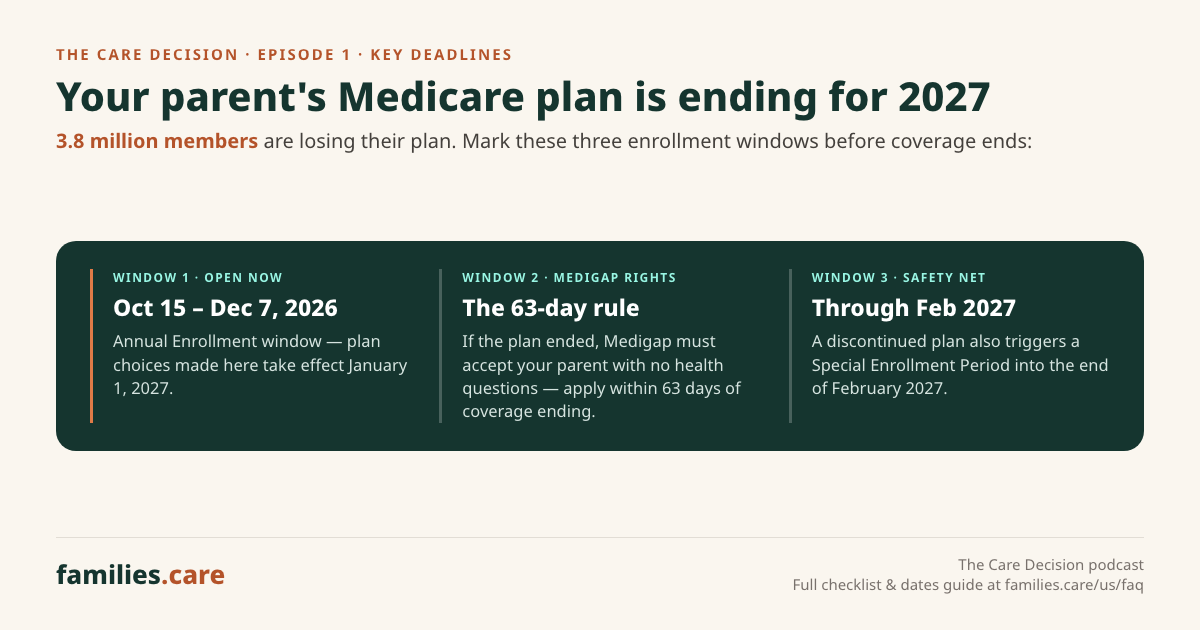
  • Medicare Open Enrollment runs October 15 – December 7, 2026 for coverage effective January 1, 2027.
  • Roughly 3.8M Medicare Advantage enrollees in discontinued plans get a Special Enrollment Period through Feb 28, 2027 plus a 63-day Medigap guaranteed-issue window.
  • 2027 Part D prescription parameters are final: $700 max standard deductible and $2,400 annual out-of-pocket cap.

CMS Medicare Open Enrollment & 2027 Part D Rate Announcement

1-minute grounded audio summary 0:39 · AI voice
2027 Medicare Costs: Final and Pending — Editorial Dispatch Editorial Dispatch
4 min read 1 min listen
Rate

2027 Medicare Costs: Final and Pending

Part D standard deductible ($700) and out-of-pocket cap ($2,400) are official for 2027, while Part B figures remain pending from CMS.

US · Federal & 50 States

Reviewed by Luis Diaz Sendel, Founder, families.care

Grounded in: CareScout · Medicare.gov

Published

At a glance 0:42
  • CMS finalized 2027 Medicare Part D parameters: a $700 maximum standard deductible and a $2,400 annual out-of-pocket cap on covered drugs.
  • Part B 2027 standard premium (~$209.50/month) and deductible (~$292) remain Medicare Trustees projections until CMS issues official figures.
  • Compare plans in 5-step order: in-network doctors, 2027 drug formulary, maximum out-of-pocket ceiling, extra benefits, and monthly premium last.

CMS 2027 Part D Rate Announcement & 2026 Medicare Trustees Report

1-minute grounded audio summary 0:42 · AI voice
What Medicare Covers in Senior Care Planning — Editorial Dispatch Editorial Dispatch
4 min read 1 min listen
Rate

What Medicare Covers in Senior Care Planning

Medicare covers short-term skilled nursing and limited home health, not long-term custodial care. Here is how skilled medical care differs from custodial living.

US · Federal & 50 States

Reviewed by Luis Diaz Sendel, Founder, families.care

Grounded in: CareScout · Medicare.gov

Published

At a glance 1:13
  • Medicare covers acute hospital care, short-term skilled nursing rehab after a qualifying inpatient stay, intermittent home health, and hospice — not long-term custodial care.
  • Custodial help with bathing, dressing, and assisted living rent requires private resources, LTC insurance, VA benefits, or state Medicaid waivers.
  • Review Annual Notice of Change (ANOC) letters during Open Enrollment (Oct 15 – Dec 7) to protect hospital, rehab, and Part D prescription coverage.

CMS Medicare & You Official Handbook

1-minute grounded audio summary 1:13 · AI voice
Medicare Plan Ending for 2027? Now What? — Editorial Dispatch Editorial Dispatch
7 min read 1 min listen
Rate

Medicare Plan Ending for 2027? Now What?

Roughly 3.8 million Medicare Advantage enrollees face discontinued 2027 plans. Compare the Three Doors, the 63-day Medigap rule, and the 5-step checklist.

US · Federal & 50 States EN + ES Leer en Español →

Reviewed by Luis Diaz Sendel, Founder, families.care

Grounded in: CareScout · Medicare.gov

Published

At a glance 1:17
  • Roughly 3.8M Medicare Advantage members in non-renewing 2027 plans must choose among 3 doors: a new MA plan, Original Medicare + Part D, or Original Medicare + Medigap.
  • Plan termination triggers a federal 63-day Medigap guaranteed-issue right (no health underwriting) and a Special Enrollment Period through Feb 28, 2027.
  • Check plans in strict 5-step order: doctors in network, 2027 formulary ($700 max deductible, $2,400 OOP cap), MOOP ceiling, extras, and monthly premium last.

CMS Medicare Advantage Non-Renewal Rules & 2027 Part D Rate Announcement

1-minute grounded audio summary 1:17 · AI voice
Medicare & Assisted Living: 4 Funding Bridges — Editorial Dispatch Editorial Dispatch
8 min read 1 min listen
Rate

Medicare & Assisted Living: 4 Funding Bridges

Medicare pays $0 for assisted living room and board ($6,200/mo median). Learn how to layer Medicare clinical coverage with the 4 real senior care funding bridges.

US · Federal & 50 States EN + ES Leer en Español →

Reviewed by Luis Diaz Sendel, Founder, families.care

Grounded in: CareScout · Medicare.gov

Published

At a glance 1:11
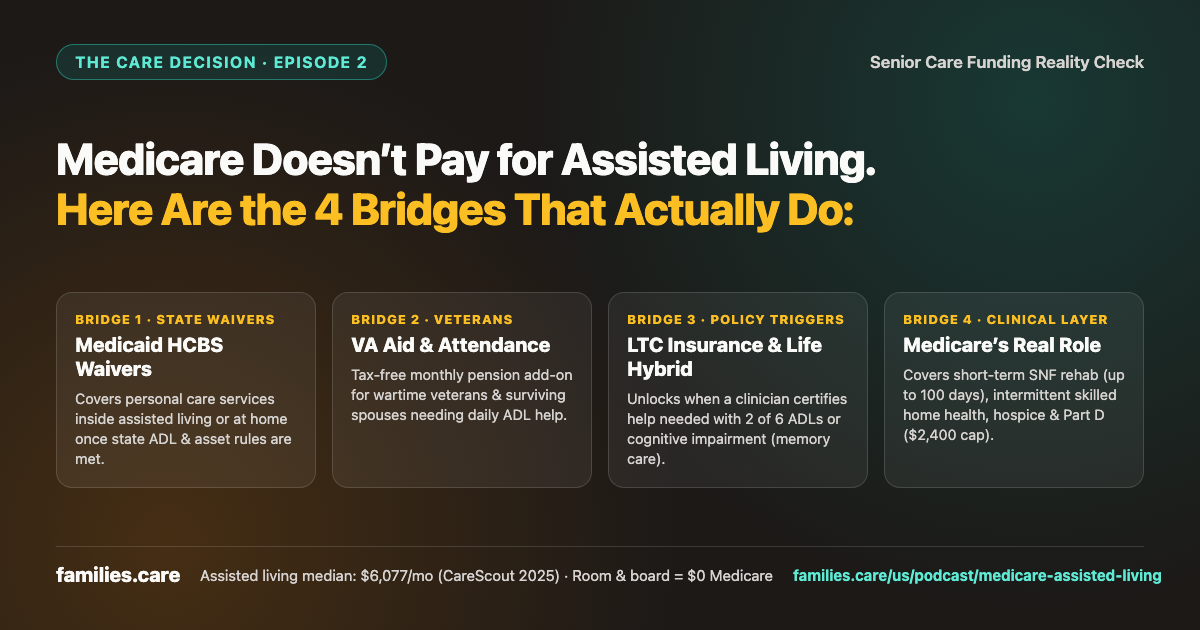
  • Original Medicare pays $0 toward ongoing assisted living room and board ($6,200/month CareScout 2025 national median) or long-term custodial care.
  • Medicare still covers clinical care inside assisted living: physician visits, Part B therapy, intermittent skilled home health, hospice, and Part D drugs.
  • Families bridge custodial housing and ADL tiers using state Medicaid HCBS waivers, VA Aid & Attendance, private LTC policies, and home-equity / income layering.

CareScout 2025 Cost of Care Survey & CMS Medicare Coverage Boundaries

1-minute grounded audio summary 1:11 · AI voice

Paying the $6,200/Mo Assisted Living Gap — Editorial Dispatch Editorial Dispatch
8 min read 1 min listen
Rate

Paying the $6,200/Mo Assisted Living Gap

How to split the $6,200/month assisted living bill into 3 funding buckets and stack Medicaid HCBS waivers, VA Aid & Attendance, LTC policies, and bridge pacing.

US · Federal & 50 States EN + ES Leer en Español →

Reviewed by Luis Diaz Sendel, Founder, families.care

Grounded in: CareScout · Medicare.gov

Published

At a glance 1:27
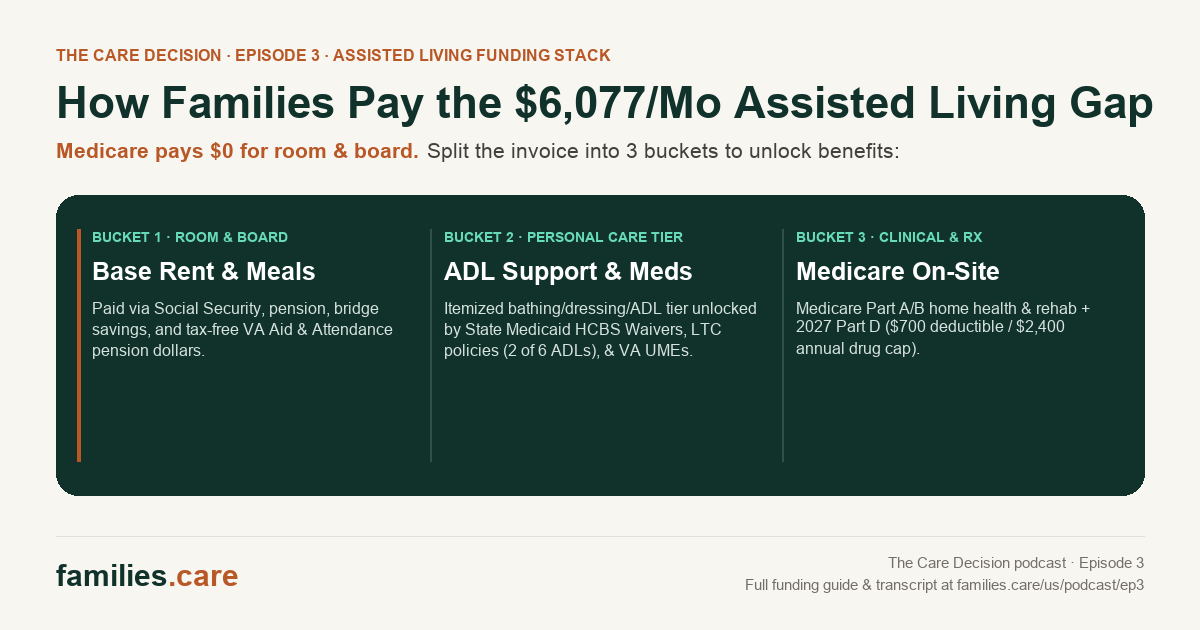
  • Request an itemized 3-bucket invoice separating (1) Base Room & Board, (2) Personal Care / ADL Tiers, and (3) Medicare-billed Clinical & Part D services.
  • Itemized ADL care charges unlock Long-Term Care insurance (2-of-6 ADL trigger), VA Unreimbursed Medical Expense deductions, and state Medicaid HCBS waivers.
  • During 60-to-120-day benefit approval waits, combining weekday adult day care ($95/day) with targeted in-home aides ($35/hour) cuts monthly cash burn roughly in half.

CareScout 2025 Cost of Care Survey, VA UME Rules & Medicaid 1915(c) Waivers

1-minute grounded audio summary 1:27 · AI voice
48-Hour Hospital Discharge & Rehab Guide — Editorial Dispatch Editorial Dispatch
9 min read 1 min listen
Rate

48-Hour Hospital Discharge & Rehab Guide

The 48-hour hospital discharge playbook: how to avoid the 3-midnight observation status trap, trigger a BFCC-QIO appeal, and vet CMS 5-Star nursing homes in 20 minutes.

US · Federal & 50 States EN + ES Leer en Español →

Reviewed by Luis Diaz Sendel, Founder, families.care

Grounded in: CareScout · Medicare.gov

Published

At a glance 1:14
  • Original Medicare Part A covers SNF rehab (Days 1–20 at $0 copay) ONLY after 3 consecutive formal inpatient midnights — outpatient observation nights do not count.
  • Calling your state BFCC-QIO before midnight on the planned discharge date legally freezes an unsafe hospital discharge with $0 hospital billing during review.
  • Vet SNF shortlists in 20 minutes using CMS Health Inspection stars (avoid G–L harm codes), PBJ nursing hours (3.5–4.0+ hrs/resident/day), and <60% staff turnover.

Social Security Act §1861, CMS BFCC-QIO Appeals & CMS Five-Star PBJ Data

1-minute grounded audio summary 1:14 · AI voice
Benchmark ACA premiums rise 13% for 2027 — Editorial Dispatch Editorial Dispatch
2 min read 1 min listen
Rate

Benchmark ACA premiums rise 13% for 2027

Open enrollment for 2027 Marketplace coverage opened November 1 in most states, with finalized benchmark silver premiums up 13% on average — a second straight year of double-digit increases, per KFF.

US · Federal & 50 States

1 verified source · Research method

Grounded in: CareScout · Medicare.gov

Published

At a glance 0:20
  • ACA benchmark silver premiums rise 13% on average for 2027 across federal and state marketplaces (KFF analysis).
  • Rate increases average 11% in HealthCare.gov states and 16% across state-operated marketplaces ahead of November 1 open enrollment.
  • Adults ages 55–64 bridging to Medicare at 65 should review household income subsidies and silver cost-sharing reductions before auto-renewing.

KFF Marketplace Rate Filing Analysis & HealthCare.gov

1-minute grounded audio summary 0:20 · AI voice
Complete Guide to Assisted Living — Editorial Dispatch Editorial Dispatch
5 min read 1 min listen
Rate

Complete Guide to Assisted Living

Everything you need to know about assisted living: from understanding what it covers, to evaluating costs, to choosing the right facility for your loved one.

US · Federal & 50 States

Reviewed by Luis Diaz Sendel, Founder, families.care

Grounded in: CareScout · Medicare.gov

Published · Updated

At a glance 0:50
  • Assisted living supports daily activities (bathing, dressing, medication management) with a $6,200/month CareScout 2025 national median.
  • Original Medicare pays $0 toward assisted living room and board; families combine private funds, LTC insurance, VA Aid & Attendance, and state Medicaid waivers.
  • Tour communities unannounced during mealtime or shift change and request an itemized fee sheet separating base rent from care-tier surcharges.

CareScout 2025 Cost of Care Survey & CMS Medicare Coverage Rules

1-minute grounded audio summary 0:50 · AI voice
How to Choose a Nursing Home: A Comprehensive Checklist — Editorial Dispatch Editorial Dispatch
5 min read 1 min listen
Rate

How to Choose a Nursing Home: A Comprehensive Checklist

Choosing a nursing home is one of the most critical decisions a family can make. Use our comprehensive checklist to evaluate facilities and ensure your loved one receives the highest standard of care.

US · Federal & 50 States

Reviewed by Luis Diaz Sendel, Founder, families.care

Grounded in: CareScout · Medicare.gov

Published · Updated

At a glance 0:54
  • Confirm active Medicare and Medicaid certification plus zero federal abuse icons or G–L high-severity harm citations on CMS Care Compare.
  • Ask for exact daytime, overnight, and weekend RN and CNA resident ratios alongside annual nursing staff turnover.
  • Drop by unannounced on an evening or weekend to check cleanliness, dining support, odor control, and call-light response.

CMS Nursing Home Five-Star Quality Rating System

1-minute grounded audio summary 0:54 · AI voice
In-Home Care vs Assisted Living: Complete Comparison — Editorial Dispatch Editorial Dispatch
5 min read 1 min listen
Rate

In-Home Care vs Assisted Living: Complete Comparison

Should your loved one age in place with in-home care or move to an assisted living community? We compare the costs, benefits, and drawbacks of both options.

US · Federal & 50 States

Reviewed by Luis Diaz Sendel, Founder, families.care

Grounded in: CareScout · Medicare.gov

Published · Updated

At a glance 0:53
  • Part-time in-home care ($35/hour median) is typically more economical under 25–30 hours/week; around-the-clock home care quickly exceeds assisted living ($6,200/month median).
  • In-home care preserves familiar surroundings and one-on-one routines, whereas assisted living bundles 24/7 awake staff, meals, and peer socialization.
  • Factor hidden home ownership expenses (property taxes, utilities, maintenance, modifications) when comparing monthly budgets side by side.

CareScout 2025 Cost of Care Survey & NIA Aging-in-Place Guidance

1-minute grounded audio summary 0:53 · AI voice

How we research and verify this information

Our team compiles this listing from public records and provider data, and reviews it against authoritative sources. Read our editorial standards and research methodology.

Editorial review by John Richie, Senior Care Research Editor.